www.it-connect.fr


World Cup 2026 Theme-Based Passwords: Are Your Users Playing at a Disadvantage?
With just hours to go before the kickoff of the 2026 World Cup, one thing is certain: it will be the last appearance for Messi and Cristiano Ronaldo. This rivalry goes beyond football, because it also shows up in the passwords users choose: many people reference their favorite player or club when creating a password. When those passwords are used in the workplace, in Active Directory, they are likely to make attackers very happy.
Major sporting events do more than spark conversations around the coffee machine. They also make their way, in a very concrete way, into the passwords chosen by employees. Ahead of the North American tournament, Specops Software published an analysis of more than 6.4 billion compromised passwords to measure football's influence on user habits.
The result: player and club names feature prominently, along with easy-to-guess variations that still appear to follow security best practices. That is hardly surprising, since people often draw inspiration from what they like or own when imagining a password.
In this article, I will break down this phenomenon, especially to understand why these "theme-based" passwords are such a recurring weak point for businesses. It is also an opportunity to see how to protect yourself with Specops Password Policy, especially with its Breached Password Protection feature, which helps address the issue in Active Directory.
This article includes promotional content for Specops Software.
Why users choose passwords tied to current events
The starting point is simple: today, users have to manage a number of passwords that no one would have imagined fifteen years ago.
Work accounts, SaaS applications, VPN access, email, internal tools... Users have to manage multiple passwords. Even with SSO and authentication mechanisms that let a single account access several services, there will always be exceptions and a growing number of passwords to keep track of.
To reduce the mental burden of managing these passwords, users have two options: use a password generator (recommended) or rely on personal references (easier to remember).
In the second scenario, football checks every box: a player you admire, a club you have supported since childhood, a final that remains etched in memory (prefer 2018 over 2022). These elements are memorable because they carry emotional weight. When a password policy forces you to change your precious credential, the brain naturally turns to whatever is dominating the news or personal interests at that moment. The major event right now is the 2026 FIFA World Cup, hosted by the United States, Mexico, and Canada.
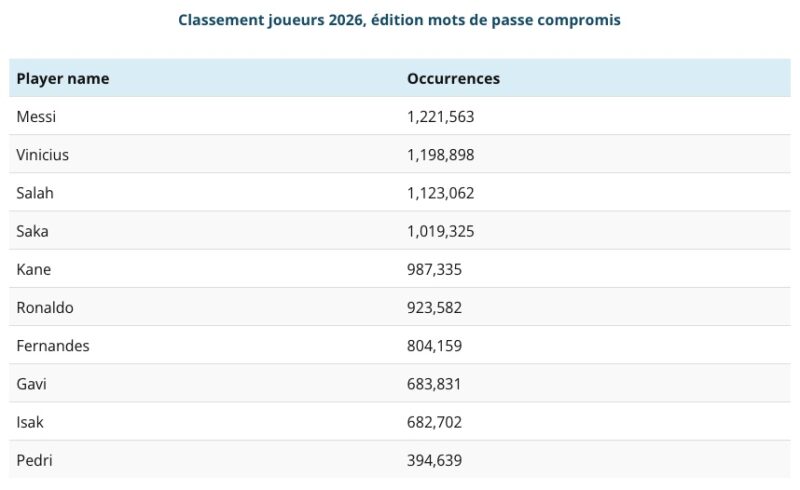
This is exactly what the Specops study highlights. By analyzing data from recent leaks, including the infostealer dump known as Alien Txtbase, the researchers compiled a ranking of the player names most frequently found in compromised passwords.
If you were looking for the greatest player of all time, here is a clue based on password analysis.
Lionel Messi's name ranks far ahead of the rest, with more than 1.2 million occurrences, ahead of Cristiano Ronaldo and his 923,000 appearances, a gap of roughly 26%. Behind them are no French players, but players from several generations, such as Vinicius, Salah, Saka, Kane, and Pedri. One thing is certain: a player's performance influences their popularity, and therefore the likelihood that their name will be used to build a password.
The club ranking shared by Specops Software really surprised me. AS Roma leads with more than 5.3 million occurrences, far ahead of Porto, Barcelona, or Lyon, with 10 times more occurrences. Surprising. "This gap is probably explained more by references to the city of Rome than by the club's supporters themselves," the report states.
This mechanism is obviously not limited to football. Pop culture, hit series, movie releases, or artist names produce the same effect. The World Cup is just a visible indicator of a deeper trend: many users build passwords from what surrounds them, and part of that surrounding context is known to everyone.
How attackers exploit these trends
The problem is that a password that is easy for a human to remember is also, most of the time, easy for a machine to guess. And contrary to popular belief, attackers do not test passwords one by one by hand.
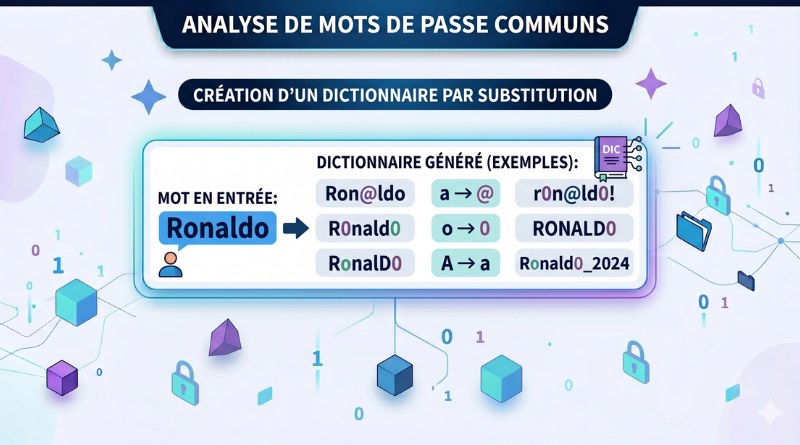
They rely on proven tools to generate password lists, especially relevant and contextualized ones (we mentioned CeWL in a previous article). These lists include correctly spelled words, but also variants that can become a strong password after transformation. The idea is to mimic user habits: adding a year at the end, substituting letters with numbers ("o" replaced by "0", "a" by "@"), capitalizing the first letter, adding an exclamation point at the end.
Take an example from the Specops Software study. A Cristiano Ronaldo fan who chooses "Cr7ronaldo@?" as a password may feel they have made a good choice: the password contains uppercase letters, lowercase letters, numbers, and special characters. It therefore satisfies all the complexity requirements of a classic policy. Yet if an attacker knows or suspects that this user is a football fan, the password becomes highly predictable, even if it has never leaked before. Apparent complexity protects against nothing when the underlying pattern can be guessed.
Another password such as "Messi2022!" found in this study perfectly illustrates the [word][year][symbol] pattern, one of the most common in leaks.
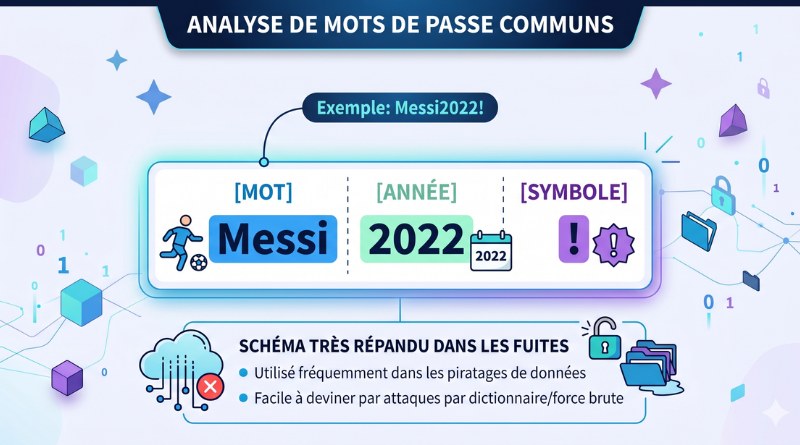
Two attack families directly take advantage of this predictability:
- Password spraying: rather than testing many passwords against a single account, which would trigger a lockout, the attacker tests a few very likely passwords across a large number of accounts.
- Credential stuffing : because users frequently reuse their credentials, a password compromised on a public-facing service can open the door to a professional account hosted in Active Directory. An identifier exposed in a seemingly harmless context then becomes an entry point into the company's information system.
The more contextual information an attacker has about their target, industry, current events, presumed interests, the more targeted and effective these attacks become. The 2026 World Cup provides exactly that context on a silver platter, on a global scale and over several weeks.
The limitations of native password policies in Windows
Given this, one might think that the password policies built into Active Directory are enough. They do form the foundation of credential security in most Windows environments, but they quickly show their limits when it comes to countering theme-based passwords such as football-related ones.
Group Policy lets you define the classic settings: minimum length, password history, maximum lifetime, and complexity requirements that enforce several character categories. These settings are useful, but they only reason in terms of structure, not meaning. The native complexity mechanism simply checks for uppercase letters, lowercase letters, numbers, and symbols. Under this kind of policy, "Messi2026!" appears valid, since it does contain the four expected categories. The native engine has no concept of the fact that "Messi" is a term massively present in leaks.
Fine-grained password policies, introduced by Microsoft to apply differentiated policies based on user groups, add flexibility but do not change the underlying issue. The same rules still apply: no dictionary of forbidden terms, and no check against databases of compromised passwords.
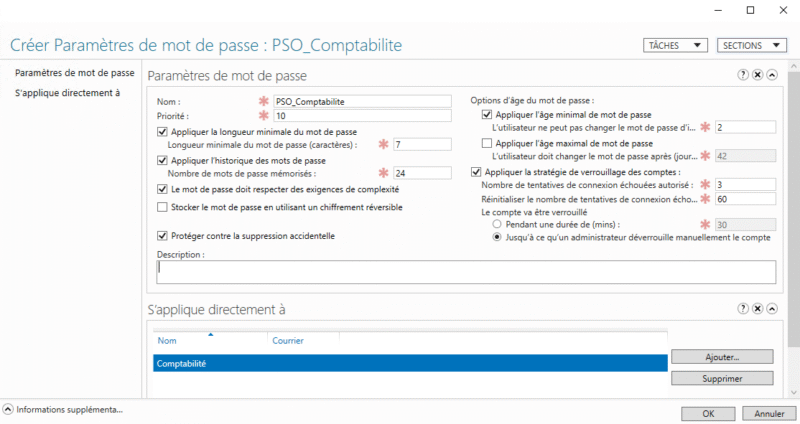
This lack of a customizable dictionary is one of the gaps. With native tools, you cannot easily block a list of sensitive words, whether it is your company name, your products, industry-specific terms, or the current sports news of the moment. You also cannot compare the chosen password against a database of billions of already exposed credentials. Yet that is exactly what is needed to neutralize predictable passwords.
Why blocking weak and compromised passwords in Active Directory matters
The logic to adopt is therefore to move the check to the right place: the exact moment when the user sets or changes their password, directly in Active Directory. That is when you need to be able to reject a weak, predictable, or already exposed password before it is used for months.
Blocking a password after the fact, once the leak has been detected, is always possible but less satisfying: between the moment the credential is created and the moment the risk is identified, there is an exposure window. The preventive approach, which prevents the user from choosing a bad password in the first place, reduces this window and avoids emergency resets.
To be effective, this check must rely on two pillars:
- A custom dictionary : it makes it possible to ban terms related to the organization and trendy words, such as player or team names during a major tournament. It is a preventive measure
- A continuously updated database of compromised passwords : it makes it possible to reject any password that has already leaked in a real attack.
Specops Password Policy and Breached Password Protection: the solution
Specops Password Policy is a solution that integrates with Active Directory to extend the capabilities of native Group Policy password controls. It installs on AD domain controllers and relies on GPOs to enforce rules, allowing policies to be targeted by organizational unit or group without disrupting the existing architecture. On the admin side, you keep your bearings while gaining far more granular settings.
It includes native features to block password lists (dictionaries) and compromised passwords. In practice, you can forbid a list of terms of your choosing, and the tool automatically applies rules to detect variants: character substitution and the addition of numbers or symbols are no longer enough to bypass the restriction. In other words, it simulates user behavior by anticipating the variants they might come up with.
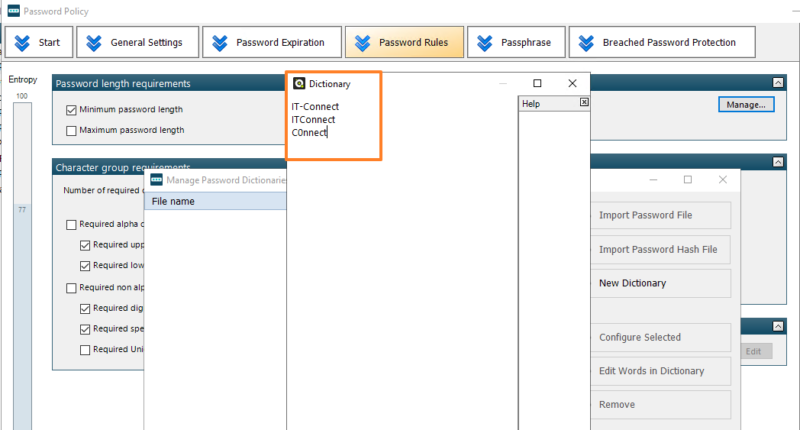
During the World Cup, adding a list of player names, club names, and competition-related terms to the dictionary takes just a few minutes. That closes the door on an entire family of predictable passwords.
To go even further, you should look to the Breached Password Protection feature in Specops Password Policy. It compares user passwords against a database of compromised credentials that now exceeds 6.1 billion entries.
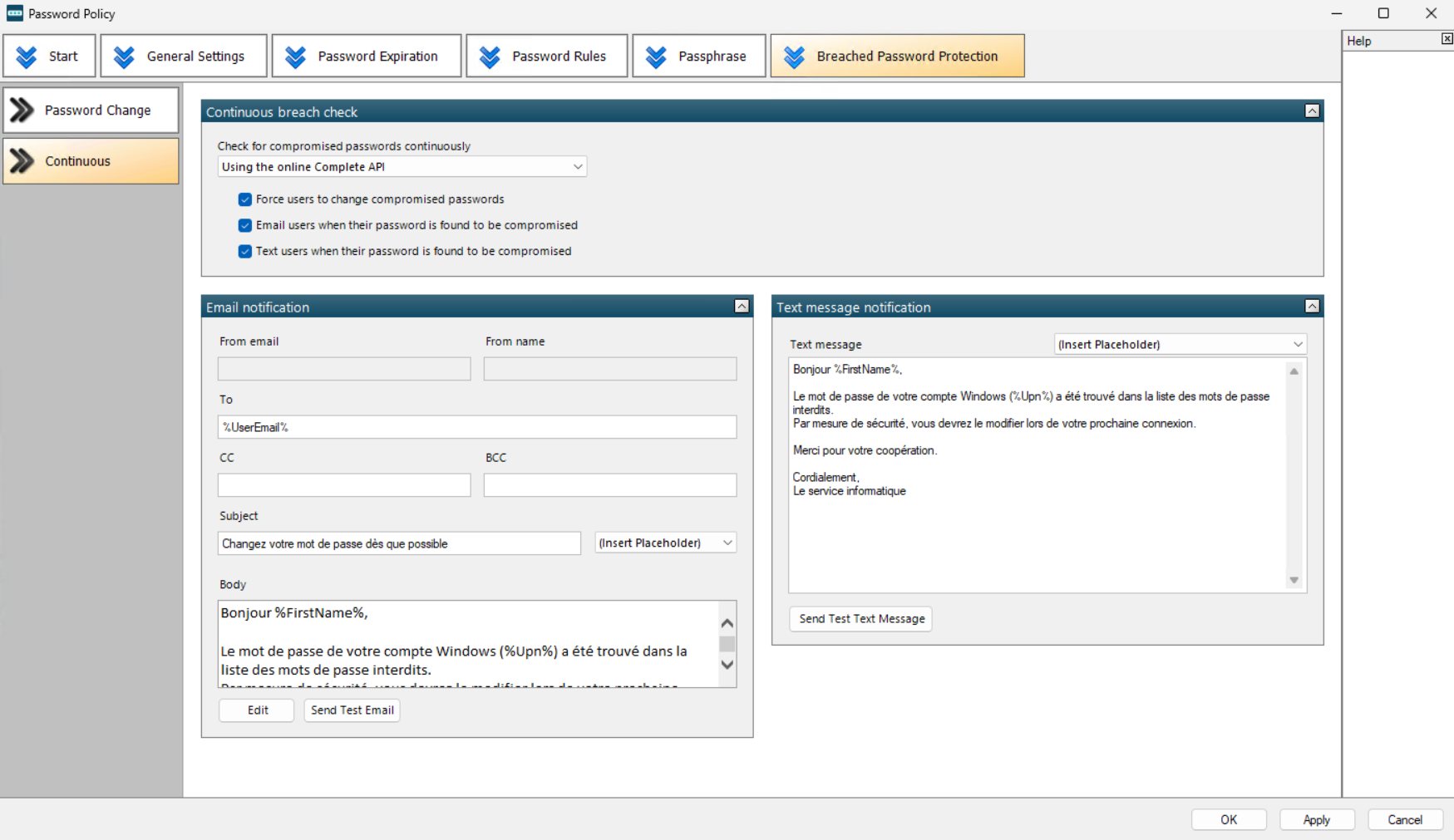
For several years, this database has been continuously enriched by Specops' research team from a variety of sources. They use, in particular, a network of honeypots, threat intelligence data, and leaks from infostealer activity. Incidentally, the recently published World Cup study mentions that 300 million new compromised passwords were recently added to the service.
The forbidden-word dictionary and compromised-password detection are two complementary and proven protective measures. Specops Software's solution also supports passphrases, which I recommend. They are naturally longer than passwords, and therefore have greater entropy.
Current guidance, whether from NIST publications or ANSSI guidelines, now emphasizes length and the banning of compromised passwords, rather than rigid complexity rules that push users toward predictable patterns. In other words, prefer passphrases.
Conclusion
The 2026 World Cup will capture the attention of hundreds of millions of people, and some of them will consciously or unconsciously bring their football passion into their work passwords. Keep that in mind when you or your users have to change passwords in the coming weeks.
What you should remember: do not trust appearances. The apparent complexity of a password says nothing about its real resistance. At present, the situation is much more complex because of the intense activity of cybercriminals over the past several years.
Now is the time to improve the security of your Active Directory and watch the matches of Les Bleus a little more calmly. Needless to say.