www.it-connect.fr

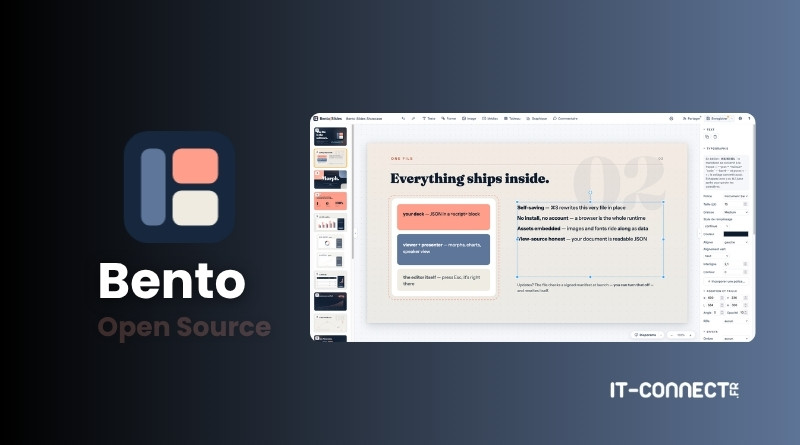
Bento: the Open Source PowerPoint Alternative Packed Into a Single HTML File
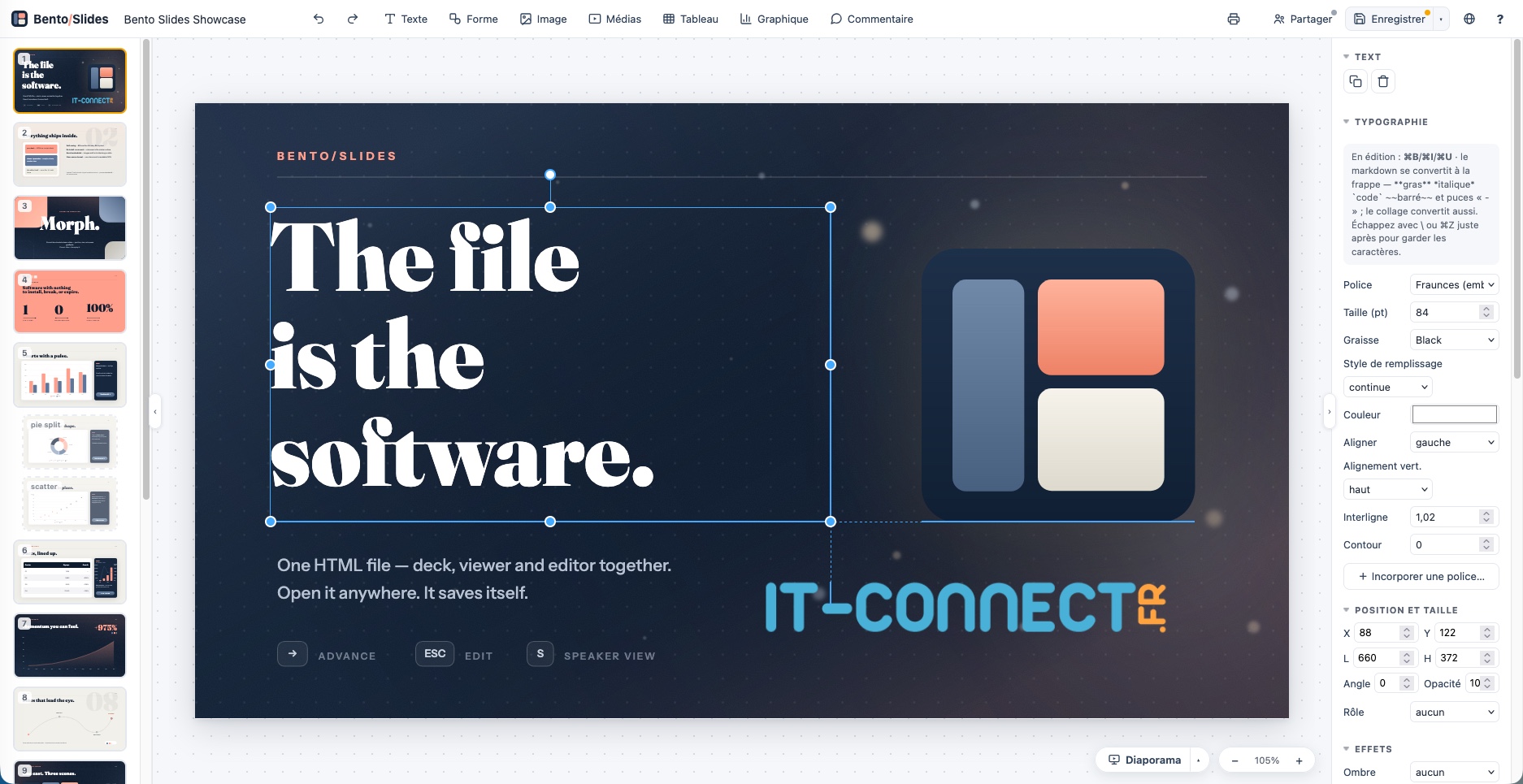
A slide deck, its editor, presenter mode, fonts, images, and data—all in a single HTML file of about 570 KB. That’s the promise of Bento, a very recent open source project. No installation, no account, no cloud, and above all, just one file.
The nyblnet/bento repository was created on July 17, 2026 on GitHub and already has more than 1,200 stars. The idea is simple: an office suite that fits in a single file. Well, that is a bit exaggerated in its current state, since Bento is only used to create presentations, but it is a solid start. The idea is good, and this project was built in one week with the help of Claude Code (the author makes no secret of it).
In practice, you only need to download Bento’s HTML file and open it in a browser. That file itself is the application. You edit your slides, present them, save, and the file rewrites itself by embedding your document. You then send it by email, and your recipient only needs a browser to read or edit it.
Not to be confused with: Bento has no connection to BentoPDF, the client-side PDF toolkit (merge, split, OCR, encryption) that I already covered in another article. Different authors, different repositories, different licenses, and no shared dependency. The two projects only share a philosophy: fully local processing.
A HTML File That Rewrites Itself
The architecture described by the project is based on two separate blocks inside the same file. The first is a JSON block placed at the top of the document, which contains the presentation data. The second is the application itself, embedded as a base64-encoded blob and decompressed on the fly in the browser via the DecompressionStream API. This compression explains the compact size of the deliverable, according to the explanations given by the author on Hacker News. For saving, Bento relies on an API to rewrite the open file, with a fallback to a simple download when the browser does not support it.
In terms of features, here is everything you get inside a single file:
- A custom animation engine, with slide transitions (elements sharing the same identifier animate from one slide to the next).
- A custom chart engine (bar, line, pie, scatter), interactive during the presentation.
- Presenter mode, comments, templates, curve and connector drawing, PDF export, and 8 interface languages.
- End-to-end encrypted live collaboration, with an in-house CRDT.
Encrypted Collaboration: The Server Sees Nothing
Real-time collaboration does not rely on a service that hosts your documents. The keys are generated client-side when the document is created and live inside the file itself. In other words: owning the file means joining the group, and key rotation acts as revocation.
The optional synchronization relay is described as "blind" by the project. According to the author, it is a small service running on Cloudflare Durable Objects, with each slide deck getting its own object. According to the repository documentation, this relay only sees three things: encrypted data (AES-GCM), connection timestamps, and a session key fingerprint. Neither the content, nor the names, nor the document structure.
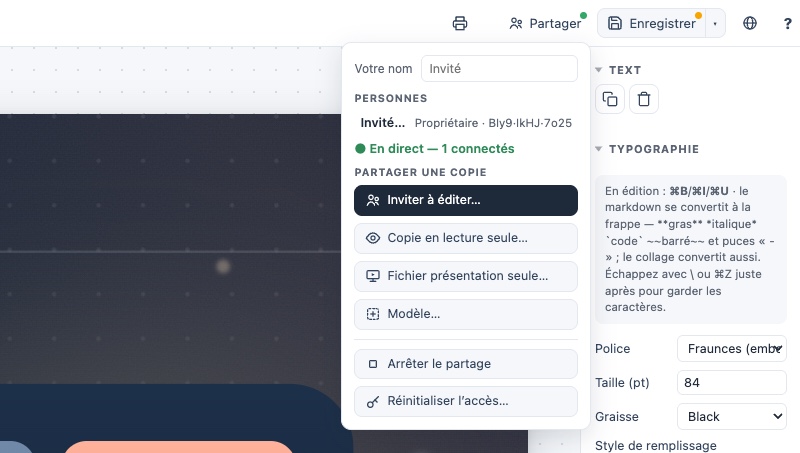
The collaborative mode is optional, which is why there is an offline mode. It lets you block all network connections, which in turn blocks update checks and collaboration.
Beyond being usable interactively on a computer or a smartphone, Bento was designed for AI agents. Since the document is plain JSON inside a text block, any assistant capable of reading and writing a file can modify a .bento.html file in place, without a plugin or API. In that spirit, the GitHub repository also offers an agents.md file and a plugin for Claude Code (installable via /plugin marketplace add nyblnet/bento), which can download the latest signed version of the application on its own.
Bento/Slides is presented as the first application in a broader suite: Bento/Suite. The planned additions already include a word processor (bento/docs) and a spreadsheet app (bento/sheets). As for the business model, there isn’t one. The project is entirely licensed under MIT.
What do you think?