www.it-connect.fr

GitHub Backlash Erupts Over Rsync and Claude AI Use
Rsync is currently going through a rough patch! A recent update had a negative impact on the proper functioning of some incremental backups. Users then inspected the project's source code, and what they discovered set things off immediately: they found numerous commits co-written with Anthropic's Claude AI. But what is the reality behind it?
On May 20, 2026, a new version of Rsync was released: v3.4.3. This update was intended to improve the security of this open source tool (6 vulnerabilities fixed) and patch a few bugs. Rsync receives few updates, but that does not matter: it is a stable, high-performance tool with plenty of options. That is exactly why it is appreciated.
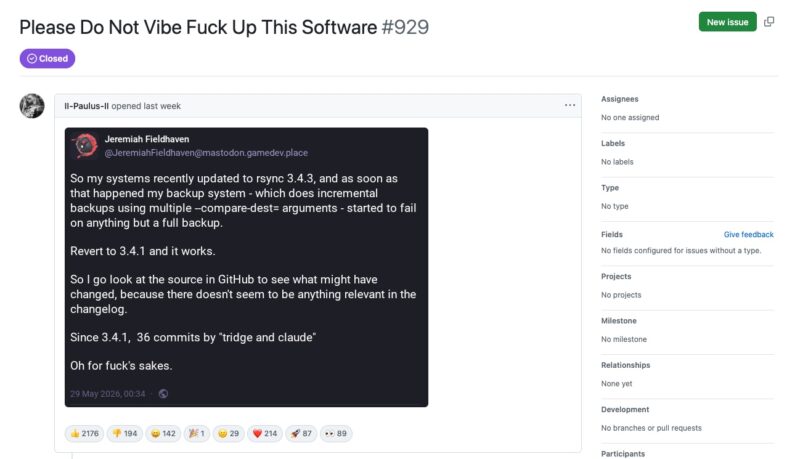
However, things did not go as planned with version 3.4.3. Indeed, several users noticed new bugs with backups after installing this version. By tracing the change history on GitHub, several developers noticed the presence of many references associating the project's long-time maintainer with Claude AI.
As a result, one of them went on a rant on GitHub with a post titled: "Please Do Not Vibe F*** Up This Software". Enough to throw fuel on the fire and reignite the debate over the use of AI-generated code within software source code. What some would call AI slop.
Andrew Tridgell's response: AI as a simple executor
In response to these criticisms, rsync creator Andrew Tridgell sought to clarify the situation in an article published on Medium. With 40 years of experience behind him, he explained that this was by no means blind or uncontrolled development.
Overwhelmed by a wave of security reports themselves submitted with the help of AI (a common phenomenon throughout the open source world), the maintainer decided to modernize rsync. This involved, among other things, rewriting the old test suite (in Shell scripts) in the Python language.
It was precisely for this task that he used AI, and not just Claude: "I rewrote the rsync test suite in Python from the old shell script. I designed the architecture myself (and I am really pleased with it), but I used Claude, cross-checking the results with Codex and Gemini, to do the bulk of the work. I did not simply vibe-code to 'convert the test suite to Python'.", we can read.
This was therefore a sensible use of AI, where the code blocks generated were reviewed by a human. Above all, he wanted to be transparent with the community by saying that he had used Claude, and that decision backfired on him.
Most importantly, the regressions observed in rsync version 3.4.3 have nothing to do with AI: it was used to rewrite the test suite.
A new version is available: rsync v3.4.4
The version 3.4.4 of Rsync was released on Monday, June 8, 2026, so it is brand new! Released directly by the Rsync maintainer, it fixes the bugs introduced by the previous version. If you use Rsync, it is therefore best to update.
In the end, after what just happened, we can infer that using AI to uncover vulnerabilities and bugs is allowed, but not to help produce code. Paradoxical.