www.it-connect.fr

Debian Officially Allows Generative AI, But Contributors Remain Fully Responsible
Should Debian allow the use of generative AI? After two weeks of voting, the developer community has decided and adopted the following position: generative AI is neither forbidden nor recommended, and it is the human who signs the contribution who bears full responsibility.
Debian tackled a topic that is both hot and unavoidable: should code, documentation, or translations produced with the help of a LLM be accepted in a distribution as important as Debian? The issue was addressed through what is known as a General Resolution titled "The use of LLMs in Debian".
As a reminder, a General Resolution is the highest decision-making instrument in the Debian project, as defined in Article 4 of the Debian Constitution. It allows all developers to decide collectively on an issue. The tally relies on the Condorcet method, with a quorum to reach and a majority threshold that varies depending on the scope of the text: a simple majority for a statement, a 3-to-1 majority to amend the Social Contract.
Eight proposals, one survivor
In this case, the General Resolution ran from August 15 to 28, 2026. Developers had to rank eight proposals, plus the default option "none of the above." Each proposal was more or less favorable to AI use, ranging from a strict ban written into the Social Contract to a controlled acceptance.
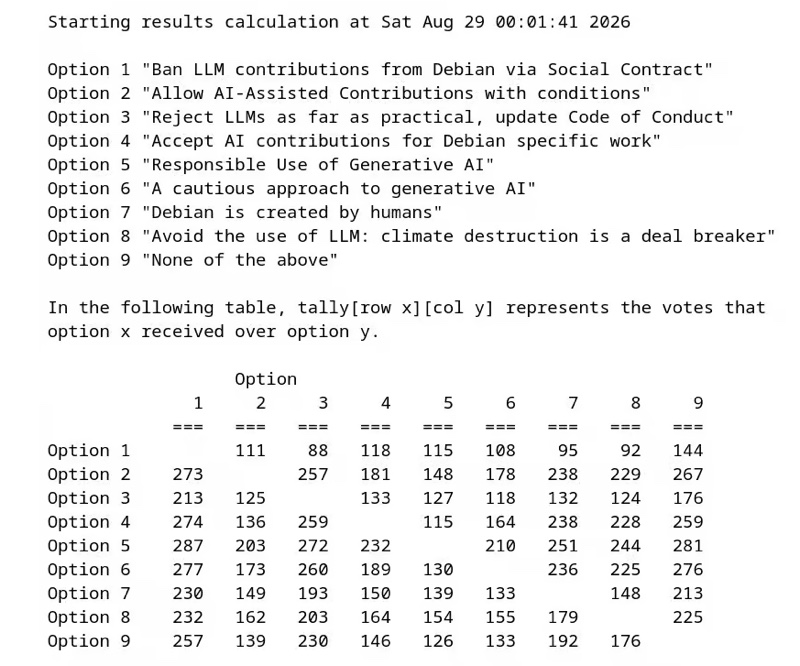
A balanced option won the vote: "Responsible Use of Generative AI", backed by developer Marc Haber. It is the only one to beat all the others in head-to-head matchups. Here are the results compared with the other proposals:
- 203 votes to 148 against "Allow AI-assisted contributions under conditions"
- 232 to 115 against "Accept AI contributions for Debian-specific work"
- 210 to 130 against "A cautious approach to generative AI"
- 251 to 139 against "Debian is built by humans"
- 281 to 126 against the default option
What the adopted text actually says
In substance, Debian neither approves nor bans the use of generative AI tools, according to the text that received the most votes. What is interesting is to look at the rules that must be followed:
- Every contribution must meet the same standards of quality, accuracy, maintainability, and compliance, regardless of the tool used
- The contributor must understand, review, test, and, if necessary, correct the AI output before integrating it
- Accepting or submitting generated content without human review is considered contrary to the project's established practices
- Disclosure of AI use is encouraged, but not mandatory
- Non-public information (embargoed security reports, cryptographic keys, identifiers, private exchanges) must not be sent to third-party AI services without explicit authorization
- Mass changes and automated processes must be discussed in advance and remain supervised by a responsible human
A model in which the human remains in the loop and, above all, remains responsible for their actions, whether they use AI or not. That said, the text defines no enforcement mechanism. So let’s say that all of this relies on the discipline of the contributing developers. Debian also does not take a position on the open legal questions surrounding AI-generated output, whether that concerns copyright, ownership, or licensing.
This decision made by Debian is truly important, and it goes beyond Debian itself. After all, this distribution powers thousands of packages and sits at the heart of a whole ecosystem. It also serves as the foundation for other distributions such as Ubuntu.
What do you think?