www.it-connect.fr

Synology Unveils the neo+ Range: Four Cheaper NAS Models, but No ECC Memory
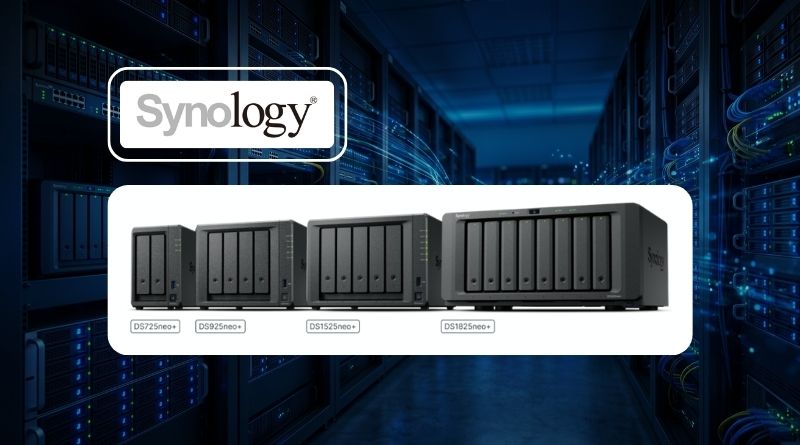
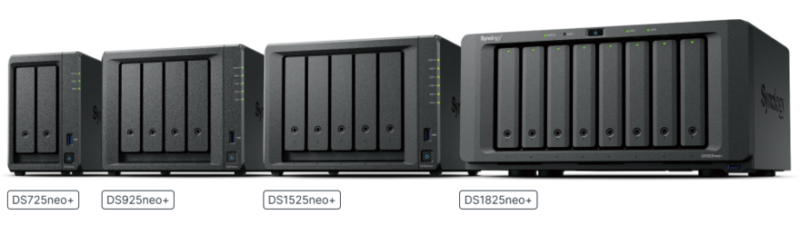
Synology is launching a new family of desktop NAS devices: the DiskStation neo+ range, made up of the DS1825neo+, DS1525neo+, DS925neo+ and DS725neo+. But what exactly is behind these new model names? How can Synology lower the entry price of its NAS devices? By changing the RAM, that’s probably what comes to mind. Here’s what is really going on.
Four models, the DS Plus platform, and one major change
Synology’s press release, dated August 14, 2026, states that the neo+ range is based on the same platform as the DS Plus series. In other words, this is not really a new NAS generation, but rather a lower-priced version of models already available on the market.
Here is the hardware configuration common to all four models:
- 4 GB of non-ECC DDR4 SODIMM memory by default, expandable up to 32 GB
- Built-in M.2 slots for SSD cache
- 2.5 GbE network interfaces
- Capacity expansion possible via the DX525 unit
- PCIe 3.0 slots on the DS1825neo+ and DS1525neo+, for an optional 10 GbE or 25 GbE network card
As for the processor, there does not appear to be any change between the models we already know and this new range. Indeed, the DS1825neo+, DS1525neo+ and DS925neo+ would rely on the AMD Ryzen V1500B (4 cores), while the DS725neo+ would feature an AMD Ryzen R1600 (2 cores). These are the same chips used by the corresponding DS Plus models, including the DS925+ we tested last year.
Synology emphasizes one point: upgrades are still possible, since these NAS devices accept existing ECC memory modules up to 32 GB, which is the maximum capacity for these NAS models. But the difference between the usual Plus range and the neo+ range is the move away from ECC RAM in favor of non-ECC modules. The goal: to lower the purchase price, because as you know, the RAM market is tight.
What you really lose compared with DS Plus models
Synology’s press release refers to a "more affordable memory configuration", without detailing the difference versus the standard DS Plus models. I took the time to compare the technical specifications published by Synology, and the gap is not the same depending on the model:
- DS725+ : 4 GB DDR4 ECC, the same amount as the DS725neo+, but with error correction (ECC)
- DS925+ : 4 GB DDR4 ECC, again the same amount
- DS1525+ : 8 GB DDR4 ECC, double that of the DS1525neo+
- DS1825+ : 8 GB DDR4 ECC, also double that of the DS1825neo+
On the 2-bay and 4-bay models, the neo+ range therefore does not reduce memory capacity; it only drops ECC. On the 5-bay and 8-bay models, however, there is half as much memory, and no error correction. It all depends on your needs: not everyone needs ECC RAM... For example, if it is for backup or file storage, it is not essential. But for heavy business use, with many containers or virtualization, ECC RAM is preferable.
A range born out of the memory crisis
Synology is not hiding the context. "In response to the evolving memory market, the neo+ range reinforces our commitment to accessibility by giving customers the freedom to upgrade their hardware according to their immediate budget and future growth," said Bie-I Chu, executive vice president of Synology’s NAS group. This new range should be more affordable, although pricing is still unknown. In any case, Synology has to respond, as the NAS market is becoming increasingly competitive, especially with brands such as UGREEN and Minisforum attracting more and more users.
On the software side, nothing changes. The neo+ models run DSM and provide access to the same applications as the Plus series: Synology Drive for private cloud, the Active Backup suite for backups (including workstations), and Surveillance Station for camera management.
Two questions remain: availability and price. On the first point, Synology mentions availability in Europe starting in early Q4 2026. On the second, Synology says pricing information will be announced at launch. Without a concrete price gap compared with the DS Plus models, it is impossible to know whether dropping ECC will result in significant savings or just a few dozen euros.
And you — would you be willing to give up ECC memory to pay less for your next NAS?