www.it-connect.fr


Cyber News Recap: What You Missed Between August 1 and 16, 2026
What happened in the cyber world from August 1 to 16, 2026? Since I was on vacation and away from my PC during that period, I decided to put together a recap so you could do your own monitoring with the “key takeaways only” approach. I probably wasn’t the only one spending time away from screens, right? All right, back to work—here are the main events.
I’m not going to cover the news in chronological order, but rather by importance. I have to start with an event that dates back to August 12, 2026, with yet another data leak in France, and this time it concerns the DGFiP (the tax authority). A hacker known as ZeroBytes claimed to have exfiltrated 678,438 lines of data from systems associated with impots.gouv.fr.
This malicious actor’s intrusion into the DGFiP information system reportedly dates back to June 26, 2026, although the disclosure is recent. The data leak is confirmed and appears to involve both individuals and companies. According to the DGFiP statement, the attacker was able to view and extract data including:
- For individuals, tax data such as the reference tax income, family quotient, or withholding tax rate.
- For companies, data such as the company name or SIREN.
- Cadastral data related to property addresses and surface areas.
Bercy specifies: "The personal and professional public finance spaces of users have not been compromised. The usernames and passwords of individuals and professionals have not been compromised." - Which does not stop you from changing your passwords as a precaution.
In this latest intrusion, the hacker allegedly used a legitimate account. In other words, no vulnerability was exploited; this is more likely an authentication issue (was MFA enabled?) and a segmentation problem regarding access to business databases. This same pattern was already used during the FICOBA data leak earlier in the year, with the use of an employee’s login credentials.
References
- Press release from August 14, 2026, from the DGFiP (Ministry of Economy and Finance)
- Unauthorized access to the DGFiP information system
WordPress: more major security flaws
At the end of July, WordPress was affected by the WP2Shell security flaw. And, to be honest, August is still busy for WordPress site administrators. Indeed, as early as August 6, WordPress version 7.0.3 was released to fix around ten security flaws. The most worrying one was the security issue associated with CVE-2026-64638 and nicknamed XSS2Shell.
The starting point is a pre-authentication XSS flaw, located in the way WordPress handles the username after a failed login. Researchers say they have several paths to move from this XSS to PHP code execution, including via plugin installation or uploading an arbitrary ZIP archive. According to the researchers, the exploitation chain was discovered and reproduced by a system based on multiple AI agents in just under four days, based on work published in 2022 on SAME (Same Origin Method Execution) attacks by Paulos Yibelo.
"The vulnerability can be exploited via a specially crafted malicious third-party site and requires a social engineering operation as well as explicit victim interaction. Under certain conditions, it can be escalated to remote code execution.", explains the CERT Santé. Patches are available for many WordPress versions, from branch 7.0.X all the way down to branch 4.7.X.
👉 A second WordPress Core update a few days later.
On August 12, 2026, WordPress released version 7.0.4 to fix CVE-2026-65640, a remote code execution vulnerability exploitable via the upload of a malicious file. Here again, the fix was backported all the way to the WordPress 4.7 branch. To exploit this vulnerability, two prerequisites must be met: Imagick (very common) and Ghostscript must be used on the server, and the attacker must have the upload_files capability, meaning an Author-level account or higher on the WordPress site. Many sites do not grant the Author role to users beyond a few people (this role allows creating drafts in WordPress). It should also be noted that this weakness is not in WordPress code itself, but in the way Ghostscript processes certain files. WordPress is therefore fixing an exploitation path that goes through its file upload function, even though the original flaw is not its own.
👉 The plugins, next.
Seven plugins from publisher BdThemes were disabled on the official WordPress repositories on August 7 and 8 following a compromise of the publisher’s infrastructure: Element Pack, Prime Slider, Pixel Gallery, Ultimate Post Kit, Ultimate Store Kit, Live Copy Paste and Smart Admin Assistant. The Advanced Responsive Video Embedder plugin was also temporarily removed, as version 10.8.7 had been published with a backdoor (CVE-2026-18072). It should be noted that this plugin is used by more than 20,000 sites, which is still concerning. Finally, the Ajax Search Lite plugin is affected by CVE-2026-28139 up to version 4.14.4.
If you use these plugins, I strongly recommend auditing the administrator accounts present on your WordPress site, just in case.
References
- WordPress - CVE-2026-64638
- WordPress - CVE-2026-65640
- WordPress - Advanced Responsive Video Embedder
- Ajax Search Lite - CVE-2026-28139
- Wordfence - Latest security advisories for vulnerabilities
VMware vCenter: more than 360 servers compromised
On July 29, 2026, Broadcom patched several security flaws, including CVE-2026-59310, a directory traversal in the Syslog service of vCenter Server, associated with a CVSS score of 9.8 out of 10. In practice, an unauthenticated attacker with network access and the ability to communicate with the vulnerable instance could potentially execute arbitrary code.
A few days later, starting on August 3, 2026, the security flaw began to be exploited. At least that is what the German company Quirso claims in a report published on August 10. According to their observations, a group of hackers was scanning the web for vCenter instances exposed on the Internet (people really do that?!) in order to exploit this security flaw.
Once the attack succeeded, the hackers reportedly performed reverse SSH with an open source tool written in Go. The goal: establish an outbound SSH tunnel from the compromised vCenter server to the attacker’s infrastructure (which makes filtering easier to bypass).
Here are some figures shared by Quirso about this campaign:
- 361 confirmed victim IP addresses spread across 47 countries.
- More than half of the compromised systems concentrated in five countries: Germany, the United States, Turkey, Iran and France.
- 151 new victims identified in a single day, on August 7.
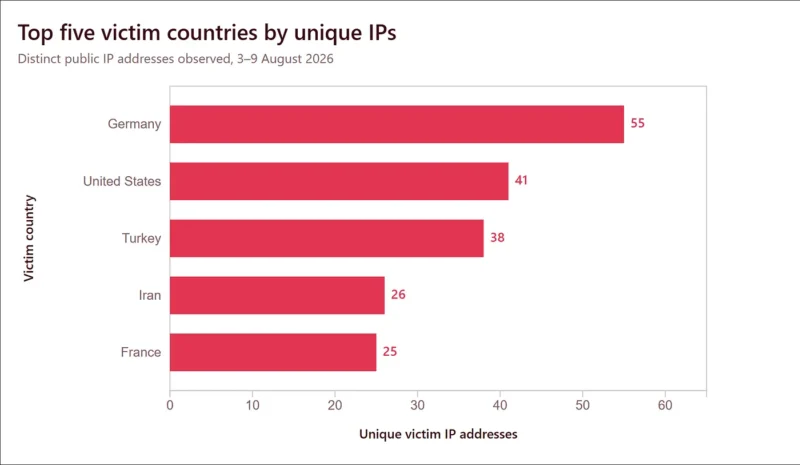
What you need to understand is that the security patch is not enough: if the host is already compromised, the SSH tunnel will remain active even if you install the patch. You therefore need to monitor connections.
References
Apple: an update for an actively exploited flaw
Two hot Apple topics during the first half of August 2026.
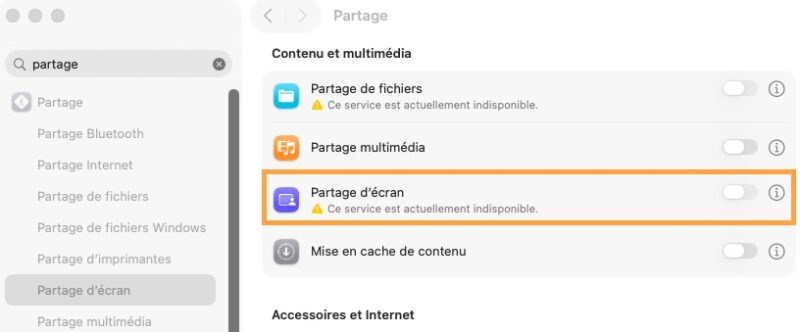
On August 6, 2026, Apple released an out-of-band update for macOS Tahoe 26.6.1, macOS Sequoia 15.7.9 and macOS Sonoma 14.8.9. It fixes a single vulnerability, CVE-2026-65400, in the Screen Sharing service. Apple describes it as "an authentication issue resolved through improved state management", which is rather vague. However, it is specified that an attacker on the network could authenticate to Screen Sharing without valid credentials.
As a reminder, this is the built-in screen sharing feature in macOS, which allows remote control of a Mac from another machine on the network, much like a VNC server.
The analysis published by Calif provides additional details about this vulnerability, which sits in the SRP (Secure Remote Password) implementation of the Screen Sharing service. It appears to involve a length check failure that returns a value corresponding to the success code from the previous read, which the caller interprets as a successful authentication step. Researchers say they produced a working exploit about four hours after starting reverse engineering of the security patch pushed by Apple.
For its part, the Dutch NCSC says it observed active exploitation of this vulnerability on Apple machines exposing port 5900 on the Internet, with the installation of malware that is a Monero miner. It is recommended to install the macOS patch or disable screen sharing (which is the default).
👉 Beyond this security flaw, there was another important Apple-related event.
On August 4, 2026, researchers Tommy Mysk and Talal Haj Bakry published an analysis showing a weakness in iCloud Private Relay, the iCloud+ feature designed to hide the user’s IP address and encrypt Safari traffic. Its limitation is that it operates at the browser level rather than the system level, unlike a VPN that could protect all traffic.
With this analysis, they identified three WebKit features that bypass iCloud Private Relay: DNS preloading (also known as DNS prefetch), WebAuthn requests called Related Origin Requests, and WebTransport. In all three cases, the network request leaves the page-loading path managed by WebKit, and the remote server therefore sees the device’s real IP address as well as its DNS resolvers. As you can imagine, this is a privacy issue!
This security issue goes beyond iCloud Private Relay, since all iOS browsers based on WebKit are affected, including when using Tor. The simplest attack scenario for a malicious site uses a fake passkey invitation. In that case, the WebAuthn request goes out at the system level, outside Safari, and Private Relay never sees it. As a result, the user’s real IP address is revealed.
For now, Apple has not released a fix for this security issue (it is expected in fall 2026). Psylo, for its part, has fixed this security issue in the latest version of its browser: Psylo 1.3.1.
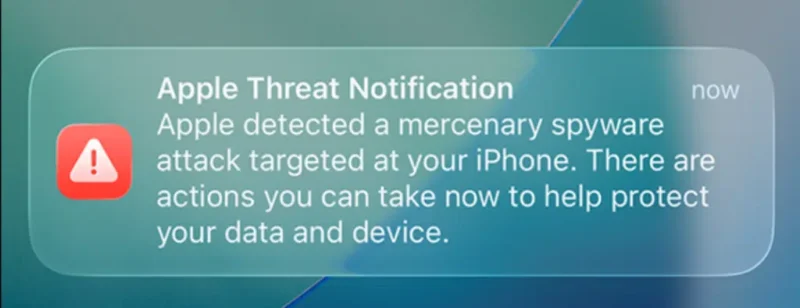
Finally, on a different note, Apple sent a wave of notifications to some users. As a reminder, Apple has an alert mechanism intended for people it believes are targeted by commercial spyware, in the style of Pegasus. It turns out that in early August, Apple sent notifications to users in more than 110 countries, and these notifications now appear directly on the iPhone lock screen (making it easier to be notified immediately).
References
- macOS Tahoe 26.6.1 (Apple)
- No Country for Old Passwords (Calif)
- Security report on IP disclosure (Mysk)
- iPhone notifications about spyware (Malwarebytes)
Bloctel data leak: three million numbers exposed
On August 12, the DGCCRF published a statement about a data breach. A cybercriminal gained fraudulent access to a professional Bloctel account, the do-not-call list for telemarketing, and retrieved files containing around three million phone numbers, including 600,000 registered on the service.
According to the DGCCRF, only phone numbers were exposed in this security incident. No names, no email addresses, and not even postal addresses. The Bloctel database itself was not compromised, but the attacker was able to access the data available to the compromised account.
"The investigations carried out confirmed that only phone numbers were exposed, with no other personal data (name, address, etc.). Consumers registered on Bloctel affected by this incident were informed by Bloctel via email.", the statement reads.
This is a good moment to recall that Bloctel stopped operating on August 11, 2026, under the law of June 30, 2025, which moves France to a prior-consent regime for telemarketing. Three million numbers are therefore circulating at the exact time the opt-out mechanism disappears. Be wary of suspicious calls... If you want to get rid of telemarketing calls, I recommend installing WinCalls or Saracroche, two very effective apps.
Reference
AI: fake CVEs, a Claude Code agent that deletes everything...
If we mix Cyber and AI, there are some real gems to dig into. Grab the popcorn.
👉 Six critical SQLite flaws that do not exist.
At the beginning of August, a GitHub repository published a series of security advisories for vulnerabilities. Six of them concerned SQLite, with CVSS scores ranging from 7.5 to 9.8 out of 10. Following this disclosure, these security flaws were added to the NVD database, which is truly the reference database for vulnerability tracking. As a result, any vulnerability scanner on the market treats them as real vulnerabilities.
Except there is a problem with these flaws. The researchers at JFrog reviewed the bulletins one by one. None of them describes a reproducible vulnerability. For example, one of the flaws mentioned relies on a function that does not even exist in the target version, since SQLite only added it in 2025, a full year after the supposedly affected version! These appear to be AI-generated security advisories, complete nonsense. In addition, none of these CVE identifiers appears on SQLite’s official page, which is also true for most of the other flaws disclosed in that repository (except one).
For teams managing vulnerability remediation through CVE feeds, this is alarming. A critical score in the NVD is no longer, by itself, a sufficient signal to trigger emergency remediation. Looking ahead, one can imagine an awkward scenario: a triage agent tries to locate the vulnerable function, generates a patch, and proposes code changes for code that does not exist.
👉 An agent that deletes a developer’s files.
A developer reported on Reddit that he lost all of his user files during a Claude Code session. According to his post, he asked for a backup, the agent wrote it to the wrong path, then executed a forced deletion of all files and folders to clean up its own mistake, before continuing the session as if nothing had happened. It’s just one example among many showing that with AI, things can quickly get out of hand.
👉 A Zoom exploitation chain built in under 24 hours.
On August 11, 2026, Zoom patched four vulnerabilities, including three in the annotation engine used during screen sharing (CVE-2026-53413, CVE-2026-53414 and CVE-2026-53415), with Workplace versions 7.1.5 and 7.0.6. Researchers from A Security, who named the set of flaws ZOOMSDAY, say they produced a working exploit in less than 24 hours and with fewer than 20 requests sent to public AI models.
👉 OpenAI Astra
In a statement published on August 7, 2026, OpenAI says it is slowing down the development of Astra, an AI model in testing and not publicly available. Indeed, according to internal evaluations, it could reach capabilities considered critical from a cybersecurity perspective. In other words, it could design and carry out complex cyberattacks almost autonomously.
References
- SQLite Critical CVEs or LLM Slop? (JFrog Security Research)
- File deletion by Claude Code (Reddit)
- Zoom Zero-Click RCE: AI Helped Build an Exploit in Under 24 Hours (TechRepublic)
- Press release about Astra (OpenAI)
LiteLLM: 153 GB of secrets stolen, and credentials still valid five months later
The incident dates back to March, and yet it is still making headlines. We are talking about LiteLLM, an open source AI gateway. Remember when the TeamPCP group compromised the release process for Trivy, a vulnerability scanner used by LiteLLM and installed automatically. From there, the attackers recovered the project’s PyPI publishing credentials and released malicious versions: 1.82.7 and 1.82.8. They stayed online for about forty minutes on March 24. Enough to harvest a lot of data.
Indeed, a report published by Hudson Rock on August 13, 2026 provides some figures after analyzing a 153 GB RAR archive assembled by the attackers. In total, this archive contains 433,909 files associated with 2,488 enterprise domains. It reportedly includes AWS secret access keys, Salesforce client secrets, Slack signing secrets, Azure environment variables, and API keys for accessing AI systems.
"Each time a development machine, production server, or CI/CD pipeline ran the compromised LiteLLM package, the hackers were able to extract memory and production environment configurations during execution.", the Hudson Rock report says. Among the victim companies are Amazon, Samsung, ServiceNow, John Deere, Deloitte, Orange and TomTom.
For his part, researcher Kevin Beaumont confirmed the authenticity of the data with several victim organizations. "By the way, I checked that the data was authentic: it comes from multiple victim organizations. It contains a significant amount of sensitive information from those organizations — for once, Hudson Rock understated the scale of the content.", he wrote on Mastodon.
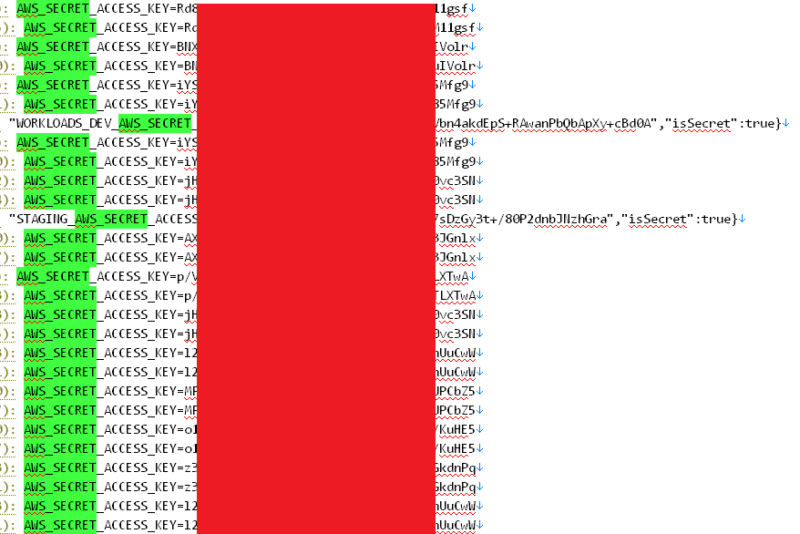
What you need to understand is that a forty-minute exposure window in March still makes valid access possible today. Any organization that installed LiteLLM 1.82.7 or 1.82.8, including as a dependency, should consider all secrets accessible from the affected environment to be exposed.
References
- Largest AI Supply Chain Breach of 2026: LiteLLM Hack Impacts Thousands of Global Enterprises (Hudson Rock)
- Security Update: Suspected Supply Chain Incident, March 24, 2026 (LiteLLM)
- Kevin Beaumont’s message about credential testing, August 13, 2026 (Mastodon)
- LiteLLM exposure verification portal (Hudson Rock)
Mozilla revokes its GPG signing key after exposure on GitHub
On August 10, 2026, Mozilla announced the replacement of the GPG subkey used to sign certain Firefox and Thunderbird release artifacts. The reason: an unencrypted copy of this private subkey was accidentally uploaded to a private GitHub repository belonging to the organization.
In practice, this key was used to sign Linux archives, Firefox RPM packages and checksum files. Mozilla says that a review of the available audit logs showed no sign of access by any unauthorized third party, and that access to the repository was limited to a small internal group whose members already had legitimate access to the key by other means. Still, as a precaution, Mozilla preferred to revoke the old GPG subkey.
The key changes to remember:
- The primary key remains the same, with the fingerprint
14F2 6682 D091 6CDD 81E3 7B6D 61B7 B526 D98F 0353. - The new signing subkey has the fingerprint
827E 6586 0867 9618 CD34 9F93 678E 455D 7676 7AA3and expires on August 5, 2028. - The new public key and the revocation of the previous one are available via the Firefox Nightly
KEYfiles and thekeys.openpgp.orgserver.
The OpenPGP standard defines machine-readable revocation reason codes. Code 1 means that a key has been replaced and leaves all prior signatures valid. Code 2 means the cryptographic material has been compromised, and makes every signature ever produced by that key suspect. Mozilla chose code 2. Anyone who imported the revocation certificate will therefore find that older versions of Firefox and Thunderbird now fail GPG verification. This is the normal consequence of the code chosen by Mozilla’s teams (and it best protects users).
Reference
Supply chain: npm, Arch Linux AUR
👉 The Shai-Hulud worm is back on npm.
On August 4, 2026, the GitHub account of the maintainer of keyv, a key-value storage library with around 127 million weekly downloads, was compromised. The attackers were able to push malicious commits to the main branch and publish new versions through the project’s GitHub Actions pipeline. The author of this library also maintains other projects such as cacheable, flat-cache, file-entry-cache, cacheable-request and cache-manager, which are dependencies for many tools.
Each time, every package receives a preinstall hook which, during npm install, collects npm, GitHub, AWS and Vault credentials, then exfiltrates them to public GitHub repositories created with the stolen token. Aikido Security counted at least 868 compromised packages across 1,381 versions, or more than two billion monthly installs. Yet another fine example of a supply chain attack...
👉 Arch Linux AUR changes strategy.
Recently, there was a major malicious campaign on the AUR, the community package repository used by Arch Linux (a community platform hosting PKGBUILD files submitted by users). Hackers managed to adopt orphaned packages in order to distribute malicious versions. That required days of cleanup... Well, know that it is happening again (or continuing, whichever you prefer).
This is the third wave of the same campaign, called Atomic Arch, which has been running since the end of May. The first two involved installing malicious npm packages from PKGBUILD files, and Arch had purged more than 1,900 packages before declaring the repository cleaned up in mid-June. This time, the attacker is directly bundling compiled ELF binaries disguised as tools named linter, hasher or minifier, which specifically bypasses the detections that stopped the previous waves.
In response to these multiple waves, orphan package adoption was first suspended on July 30, 2026, then all push operations were suspended on August 1, effectively freezing all writes to the repository. The freeze was lifted on August 11 with the deployment of aurweb 6.5.0, announced by Leonidas Spyropoulos on the aur-general mailing list, and there are important changes. Understandably, this is essential to stop the bleeding. Orphaned package adoption is no longer automatic: the user must now submit a request that a Package Maintainer must approve, with only one pending request per package and automatic rejection after fourteen days. Unverified accounts are warned after seven days and deleted after fourteen, and new account creation remains closed.
This is a structural change that should allow the AUR to regain some stability… That said, the incident is not over, because there is still cleanup to do, but things are moving in the right direction!
References
- Keyv and friends compromised in npm supply chain attack (Aikido Security)
- AUR packages adoption disabled, announcement from the DevOps team on the aur-general list (Arch Linux)
- AUR registration disabled then reopened, aur-general list (Arch Linux)
Browsers and messaging: Edge buries Manifest V2, Signal prepares phone-numberless accounts
👉 Microsoft Edge is preparing to abandon Manifest V2.
On August 7, 2026, Microsoft published the schedule for the transition to Manifest V3, starting in August 2026 on Canary, Dev and Beta channels before reaching the stable channel in the following months. This means Manifest V2 extensions will gradually be disabled by default, and Microsoft says 95% of the most widely used v2 extensions have already moved to V3.
I’m mentioning this because the uBlock Origin ad-blocking extension relies on the webRequest API, which is absent from Manifest V3. After Google Chrome, Edge will therefore stop supporting it, forcing you to use the uBlock Origin Lite version instead (subject to a filtering-rule limit). You can also go another route with a network-level filtering solution, such as AdGuard Home or Technitium DNS, for example.
👉 Signal is reportedly working on accounts without a phone number.
Elements found in the app’s Android source code refer to a feature called Signal Login, which would allow users to create an account without providing a phone number. But be careful, it would come at a cost: reportedly a one-time payment, the amount of which is not known. This would not be the first paid feature offered by Signal; secure backups, available since September 2025, already work this way. For now, this information has not been officially confirmed.
References
- Microsoft Edge follows Google Chrome as it begins killing uBlock Origin and all such add-ons (Neowin)
- Signal Login: optional registration without a phone number will require a one-time payment (About Signal)
- References to SignalLoginPaymentState in the Signal-Android source code (GitHub)
I hope you enjoyed this recap! I’m preparing other articles on current topics that I want to cover separately. If you spotted other important information, feel free to drop the links in the comments. 🙂