www.it-connect.fr

Privacy Alert: Open-Source Loupe Exposes iPhone Fingerprinting
Loupe is the name of a new free, open-source app for iOS and iPadOS. Its goal: show users what information third-party apps can collect from their devices to build a unique digital fingerprint using the system’s public APIs.
Understanding fingerprinting with the Loupe app
Developed by Mysk with the help of AI, the Loupe app highlights the fingerprinting surface of Apple devices, especially the iPhone and iPad. To do this, Loupe positions itself like other apps installed on the device so it can read the values exposed through iOS public APIs. This shows what apps can see on your device, and that applies to any app installed from the App Store.
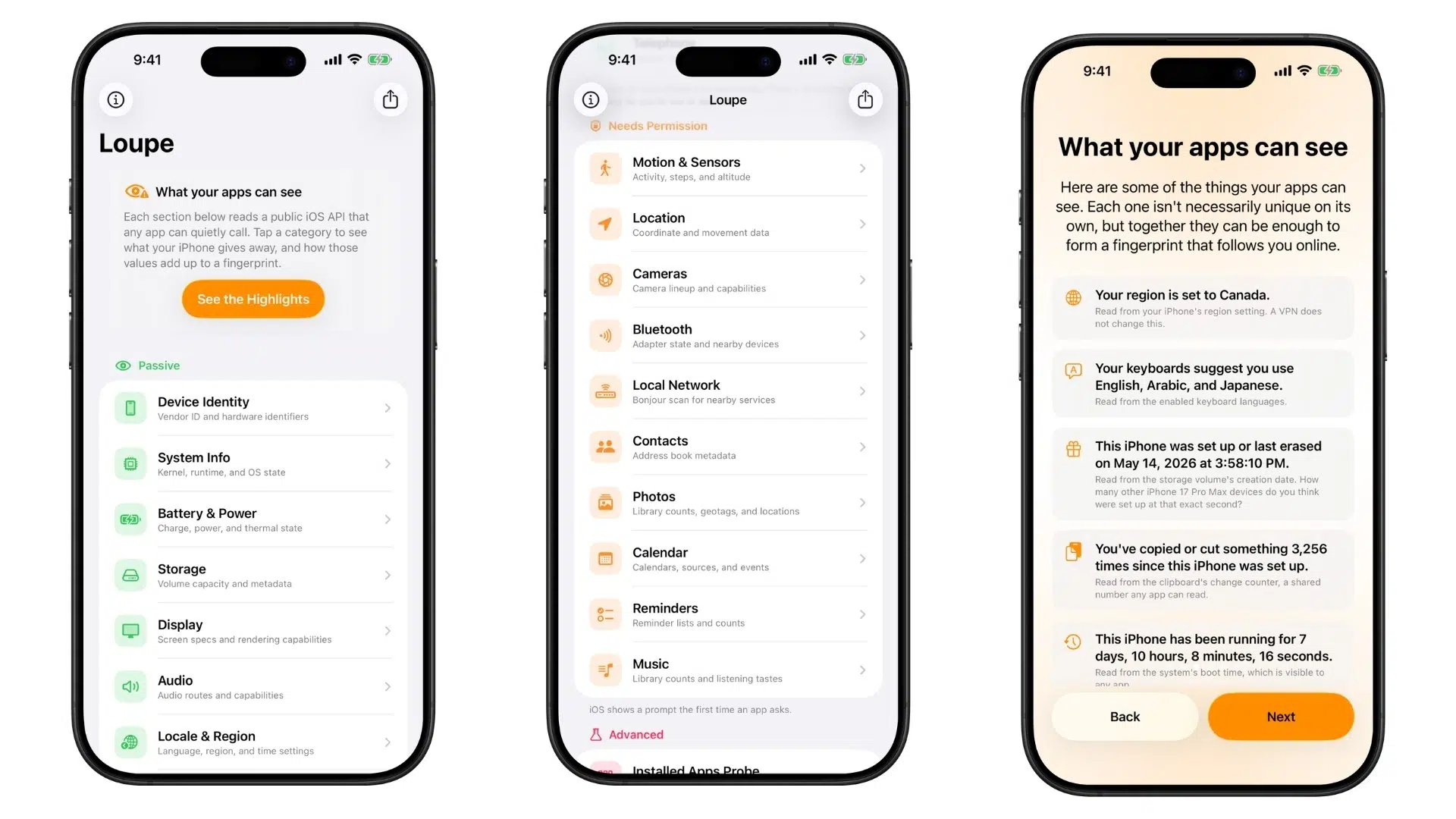
To help users understand how their information is exposed, Loupe organizes the collected data into three distinct categories:
- Passive: information available to any app without any permission being requested. This includes general device information such as battery data, language, time zone, and display settings.
- Requires permission: data that requires explicit user approval through iOS permission prompts. This covers more sensitive permissions, such as access to your contacts, photos, or location.
- Advanced: more sophisticated fingerprinting techniques that attempt to abuse public APIs. One example is probing URL schemes through Apple’s
canOpenURLAPI.
This is not about your first name, last name, or email address. That is no surprise, because today’s tracking tools do not need that information to recognize you. A combination of signals is enough to create a digital fingerprint and identify you across multiple apps and websites. Taken individually, these pieces of information are not very useful, but it is really the combination that changes everything.
A look at the Loupe app
Since I do not have an iPhone, I cannot test it directly, but the screenshots shared on Loupe’s GitHub clearly show what the app’s interface looks like. Loupe displays collected data in its raw form, without trying to anonymize it. That is ideal, because it lets you see exactly what apps can access. However, keep in mind that Loupe is a visualization tool, not a blocking tool.
As for privacy, Mysk says that all data stays locally on the device: there is no synchronization with Mysk’s servers, or with any third party. As a user, you can still export the data if you want.
For now, Loupe is aimed at iOS and iPadOS users. However, Mysk has a macOS version in the works, but it is not ready yet. If you are interested, find Loupe on the Apple App Store.