www.it-connect.fr

Orange Mobile Outage Lasts Nearly 10 Hours: Was a 5G SA Migration to Blame?
Wednesday, October 21, 2026 was a rough day for millions of Orange and Sosh subscribers, due to an outage that lasted nearly ten hours. The operator points to a faulty piece of equipment, while signs increasingly suggest a failed migration to its new 5G core network. Here is what we know.
The outage began around 11:20 a.m. across the entire country: calls, SMS, and mobile Internet, for both consumers and businesses. Everything was disrupted. Orange 5G boxes, which rely on the mobile network for connectivity, were also affected. And when it comes to Orange, that hurts: the operator claimed 21.6 million mobile customers in France at the end of June.
A quick look at DownDetector is enough to show that the outage was both long and significant. By late morning, reports had peaked at more than 12,000!
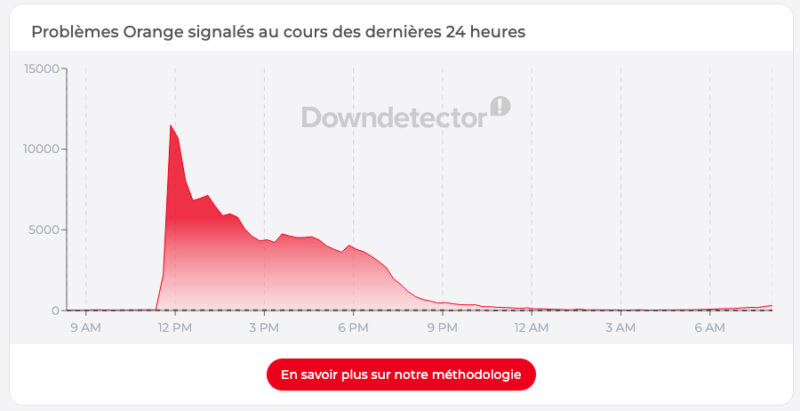
Early in the afternoon, the operator confirmed to AFP that a nationwide incident was affecting its mobile network, without specifying the cause. It was not until shortly after 9 p.m. that Orange's official statement announced that services had been restored. "This incident is linked to a failure of equipment in our mobile core network," the operator said. Which equipment, and why did it take ten hours? The statement does not say.
This is the third nationwide Orange mobile network outage this year, after those on January 30 (around seven and a half hours) and June 29. It is also the longest.
A move to the 5G SA core network may have gone wrong
The antennas relay the phone signal. The core network, meanwhile, authenticates the SIM card, locates the device, and routes calls, SMS, and data. Orange's standard 5G (known as NSA) still relies on the 4G core network. Standalone 5G (known as SA), marketed as 5G+, requires a dedicated core, to which lines are gradually being migrated.
It is precisely this migration that may be behind the outage (information that was passed on to me). Indeed, Orange reportedly tried on Wednesday morning to move part of its subscribers to this new 5G core. The affected lines would then no longer have been able to connect, neither to the old system nor to the new one. For Orange's teams, the challenge was therefore to resynchronize subscriber profiles (identity, entitlements, and services linked to the plan), all in a gradual manner.
However, that does not explain why the outage also affected 4G plans, standard 5G lines, and even roaming. The impact therefore appears to have been broader. I saw some people mention on social media that forcing a switch to 3G made it possible to regain a working connection, so the incident still seemed targeted. In any case, Orange does not mention either migration or 5G in its statement, while not denying it either.
This outage has a major impact on several levels, because beyond calls and mobile connectivity, there is something else to consider: SMS. More specifically, those who receive a one-time code by SMS to authenticate to certain services in order to satisfy MFA. When you cannot receive that code for 10 hours, it can become truly blocking if there is no fallback solution.
One question remains unanswered: was Orange able to complete its migration the hard way, or was a rollback performed?