www.it-connect.fr

LG TVs Allegedly Scan Your Local Network and Listen in Standby
An OLED television that scans and inventories connected devices on the local network is the behavior observed by Gamers Nexus on LG TVs. For its part, the manufacturer says the allegations are false. Here’s what we know.
A new video published on September 6, 2026 on the Gamers Nexus YouTube channel has once again rattled LG. The title of the video: "216,000,000 Spy TVs", or in French "216 millions de téléviseurs espions". Behind that title are the results of an analysis carried out using LG OLED TVs bought at retail, including the high-end G5 model. The analysis is based on network traffic captures with Wireshark and on the webOS firmware.
As a reminder, Gamers Nexus had already gone after LG in July. At the time, I explained how a simple LG display connected to a Windows PC triggered the installation of an app that displayed McAfee ads. This time, the issue is different: it involves the microphone and the local network.
What an LG TV would be doing behind your back
Following this analysis of network traffic and firmware, here are the conclusions presented in the Gamers Nexus video:
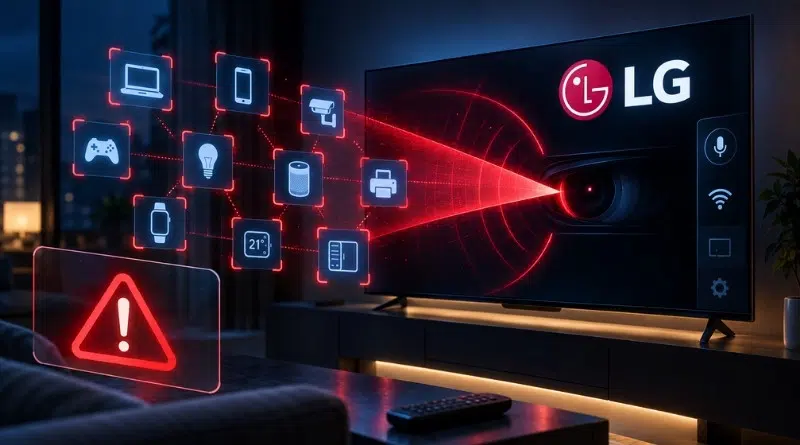
- Local network scanning. The TV allegedly identified up to 38 devices during a test: smartphones, smartwatches, a 3D printer, thermostats, an air purifier, development boards. Steve Burke, the founder of Gamers Nexus, also told The Register that BMC controllers from servers were also listed. He calls it an "egregious invasion of privacy".
- Wi-Fi mapping. The TV would reportedly record the names, signal strength, and channels of nearby Wi-Fi networks, enough to improve geolocation.
- Plain-text transcriptions. After rooting a TV to access its logs, the team says it found text files generated by voice recognition. Some transcriptions would cover 10 to 15 seconds of conversation after the voice command.
- Offline storage. With the Ethernet cable unplugged, the TV would continue capturing audio, store it locally, and send the data once the connection is restored.
- Vulnerabilities under disclosure. A remote code execution issue in webOS was reportedly detected and reported to LG (no technical details were provided).
The data would feed LG Ad Solutions, the group’s ad business, which can reach several hundred million LG TVs worldwide.
LG's response, and what it doesn't say
LG first stayed silent, then sent a statement to several media outlets, including The Register on September 9. The TV manufacturer says: "The claims in the recently published video are not true." LG says its TVs only process voice in two cases: when the microphone button on the remote is held down, or when the wake word "Hi LG" is recognized, provided the user has enabled remote voice recognition. In standby, the TV would only listen for that keyword, with local processing and immediate deletion of unrecognized audio. A sort of Alexa-style bug, but built directly into your TV.
On the network side, LG does not contradict Gamers Nexus. Scanning nearby devices is presented as "a standard feature" of Smart TVs and connected devices. As for ACR, the automatic recognition of content displayed on screen, LG says it relies on explicit consent and that the data is not used for advertising without permission. By the way, back in April, I explained how to disable ACR on your Smart TV.
One question still remains unanswered by LG: what happens to the plain-text transcriptions, and what are they used for? Another important point is that Gamers Nexus only tested models sold in the United States: what about Europe, with TVs on a market subject to the GDPR? Do they behave the same way? I don’t know, but it is easy to imagine they do, at least in some respects.
A problem that goes beyond LG
The ACR feature exists on other brands; it is not specific to LG. That said, I believe that discovering the local network and detecting Wi-Fi networks should not necessarily be seen as suspicious behavior. LG describes it as a standard feature, and I want to believe that. It is probably behavior you could observe with other brands as well.
In reality, a Smart TV has legitimate reasons to look for devices on the network, and I am thinking in particular of two uses:
- Finding a DLNA server on a NAS,
- Being discoverable by AirPlay or Google Cast
However, the TV has no legitimate reason to make a complete inventory of devices and record it. Discovering a media player is a necessary function, but cataloging every device regardless of type is not normal.
What do you think?