www.it-connect.fr

Kimi K3: The Largest Open AI Model Is Now Free to Download
Moonshot AI has released Kimi K3, a 2.8 trillion-parameter model. It is the largest open-weight model ever offered as a free download, with an archive weighing in at roughly 1.5 TB. But can it really run? Let’s take a closer look.
2.8 Trillion Parameters: Things Are Getting Hot
The Beijing-based lab Moonshot AI launched Kimi K3 on July 16, 2026, initially only as a hosted service. Eleven days later, it published the model directly on Hugging Face, along with a technical report posted on GitHub. Anyone can download and use it for free. The model has generated a lot of buzz since its unveiling, to the point of affecting the stock market (-1.5% on the Nasdaq at the time of the announcement).
Let’s start by reviewing Kimi K3, an LLM built on a Mixture-of-Experts (MoE) architecture with the following characteristics:
- 2.8 trillion total parameters, with 104 billion activated per token
- 896 experts, 16 selected at each token, plus 2 shared experts
- 93 layers, split between 69 Kimi Delta Attention layers and 24 Gated MLA layers
- An approximately one-million-token context window (like the latest Anthropic and OpenAI models)
- Native understanding of text and images, via a visual encoder called MoonViT-V2
In the benchmarks published by the vendor, Kimi K3 scores 93.5 on GPQA Diamond and 91.2 on BrowseComp. However, Moonshot AI itself acknowledges in its technical blog that "its overall performance still trails the strongest proprietary models, Claude Fable 5 and GPT 5.6 Sol". Even so, it still delivers strong results, especially for a model that anyone can obtain.
In any case, with benchmarks like these, caution is warranted. And if you read the fine print at the bottom of the page, it is clearly stated that the compared models were not all evaluated with the same agent harness.
An Open Weight License, Not Open Source
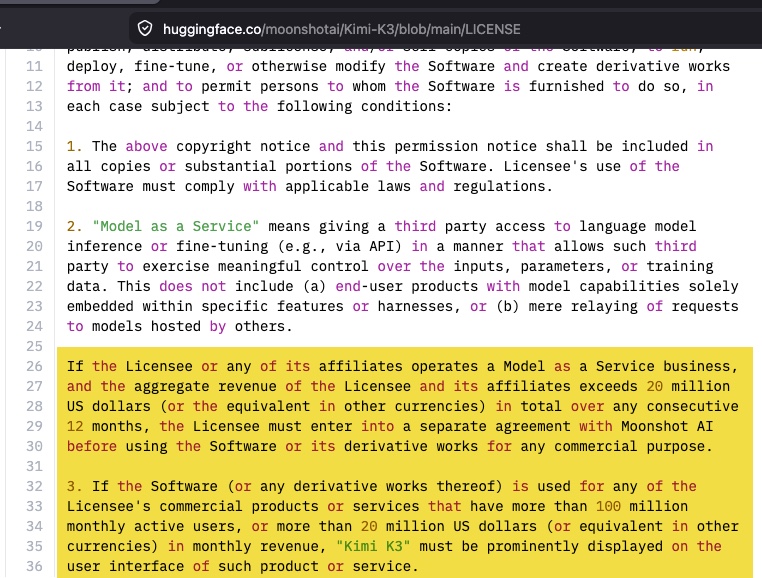
Kimi K3 is distributed neither under MIT nor Apache 2.0, but under a custom license, the Kimi K3 License. On the AI model page, Moonshot AI uses the term open weight and never refers to open source.
What you need to understand is that commercial usage is regulated (Moonshot AI is not naive).
- Any entity operating a "Model as a Service" business, meaning providing third parties with access to inference or fine-tuning, must sign a separate agreement with Moonshot AI once its cumulative revenue, including subsidiaries, exceeds 20 million dollars over twelve consecutive months.
- Any commercial product or service exceeding 100 million monthly active users, or 20 million dollars in monthly revenue, must display Kimi K3 prominently in its interface.
This would therefore not apply to internal deployments, but directly to commercial products and services. In other words, a hosting provider reselling inference has to take this into account.
Downloading Does Not Mean Running
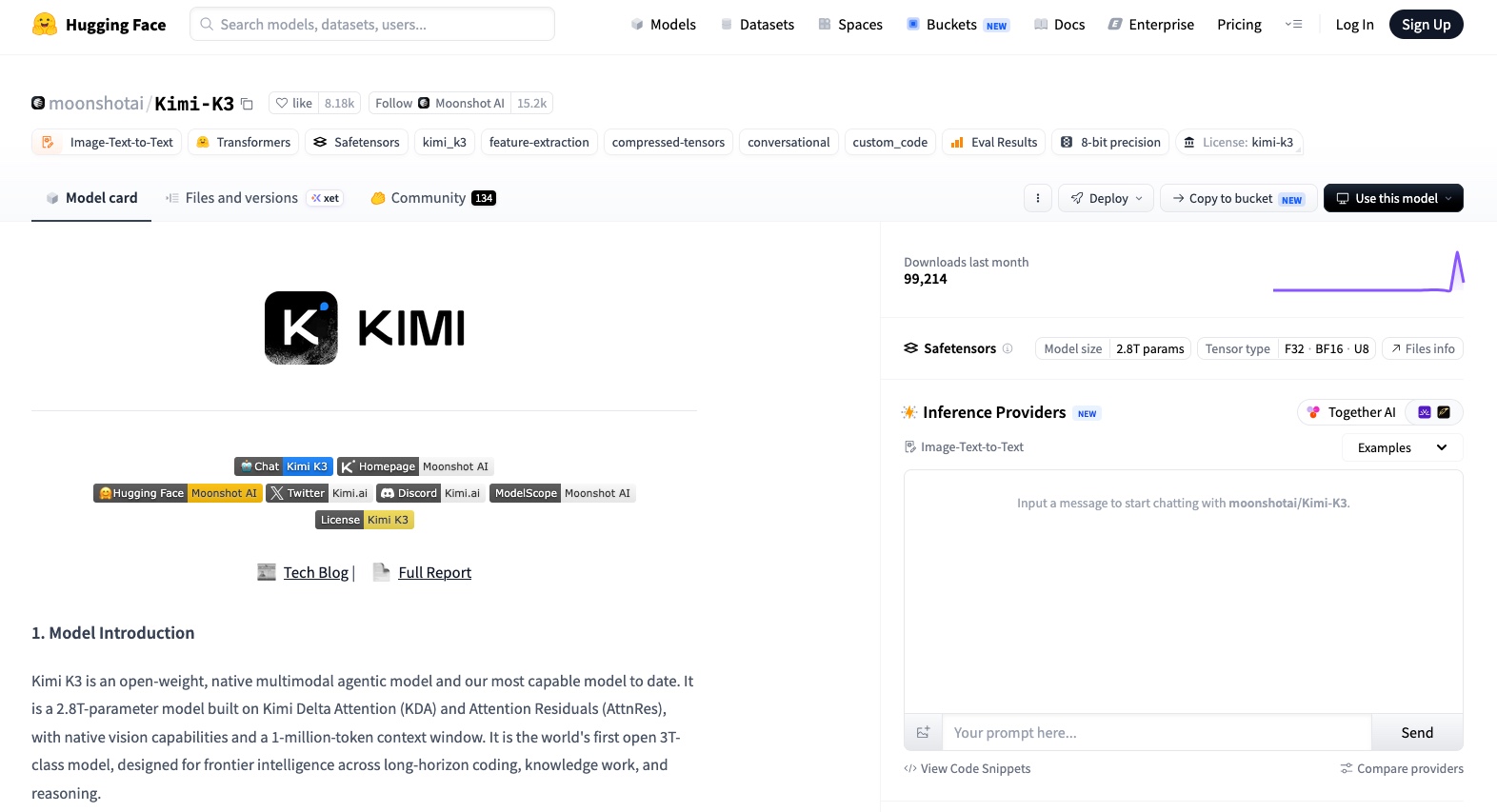
That brings us to the hardware question. Kimi K3 is available for download. It is free. You go to Hugging Face and you can retrieve all the data needed to have your own copy of Kimi K3, a package weighing 1.56 TB.
Downloading it is one thing; running it is another. As you can probably guess, that second point is the real challenge. Let me be clear right away: if you were hoping to run Kimi K3 on your PC, forget it. It is a monster and requires serious resources.
The vLLM project, which has supported Kimi K3 since launch day, says the model "barely fits on a single NVIDIA DGX B300 and requires a minimum of 16 NVIDIA B200/GB200 GPUs" to be served on this generation of hardware. The entry point is therefore an 8-GPU B300 node, or 16 B200s. Moonshot AI goes further and recommends, in its technical blog, supernodes with at least 64 accelerators, not to fit the model in memory, but to provide a high-bandwidth communication domain.
If we start from a minimal configuration, namely 8 B300 GPUs at 12 dollars per hour at Fireworks AI, that comes to about 70,000 dollars per month to run it non-stop. This is just an estimate to show that using Kimi K3 for local AI is not within everyone’s reach.
If you want to use Kimi K3, you can always call its official API. It is billed at 3 dollars per million input tokens, 0.30 dollar for a cache hit, and 15 dollars for output, under the identifier kimi-k3.
To go further, here are some useful links:
- Moonshot AI official announcement, Kimi K3
- Moonshot AI, Kimi K3 License
- Kimi K3 model page on Hugging Face (Moonshot AI)
- vLLM, Kimi K3 Is Here: Efficient Day-0 Support on vLLM