www.it-connect.fr

Google Says Gmail and Google Photos Can Now Influence Ads — If You Connect Them to Search
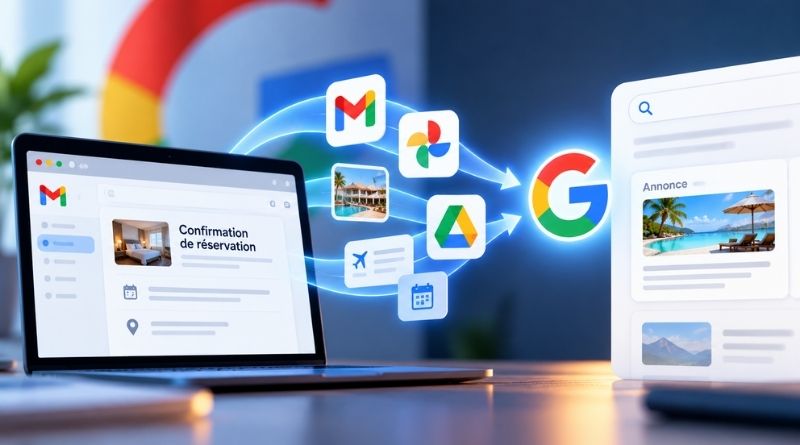
An hotel booking confirmation email that helps suggest things to do on site, and then helps determine which ads you see. At Google, that is now spelled out in black and white — provided you have connected Gmail or Google Photos to Search. Here is what is changing.
On October 16, 2026, Google published a new version of its privacy policy. And as often happens, it is worth taking a closer look at what the American giant has changed.
Until now, Google said it did not show personalized ads based on the contents of users' Drive, Gmail, or Photos. That sentence is still present in the new version of the privacy policy. But it is now a little longer to include an exception: "unless you choose to make data from those services available to other Google services that support personalized ads.", we can read.
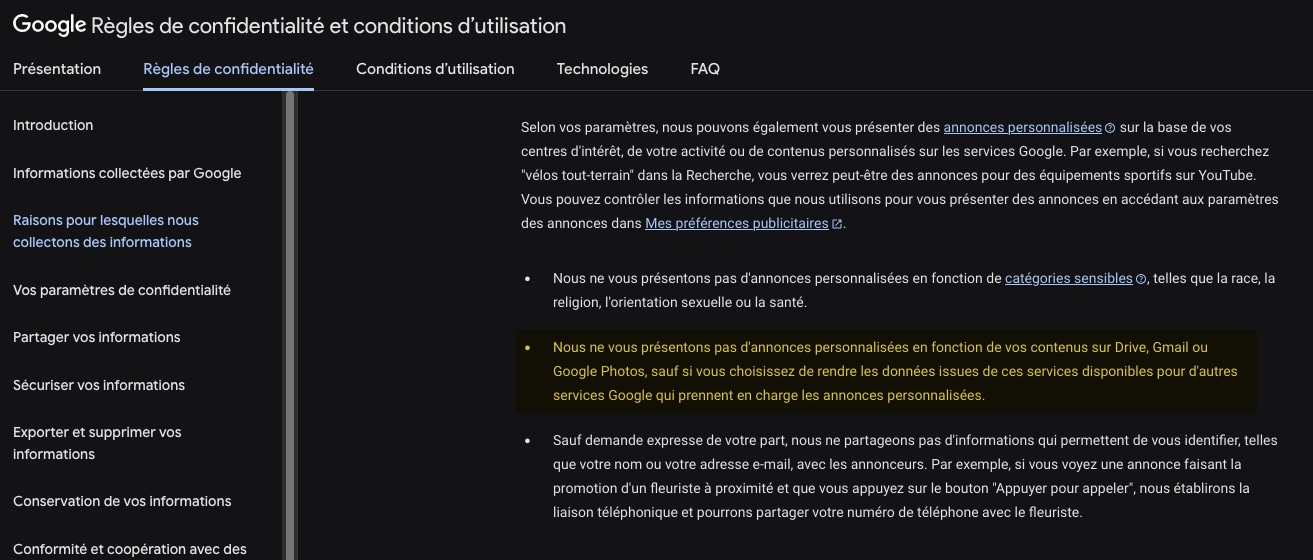
OK, what does that mean? Another paragraph, also added, explains the mechanism: if you allow it, Google Search or Gemini apps can access data from Google Photos, Gmail, and Drive. And Google Search can process some of it to personalize content, including ads, based on the content of your Google account.
Google is tackling a sensitive topic here. And this is not the first time. In June 2017, Diane Greene, then head of Google Cloud, announced the end of analyzing the content of emails in the free version of Gmail for advertising purposes, as had already been the case for G Suite. Nearly ten years later, Google is trying to reopen that door through a different path.
Personal Intelligence, the entry point
This exception is tied to Personal Intelligence, the feature that lets Google Search AI Mode, Maps, and other search services draw on your emails and photos to personalize their responses. According to Google’s help page dedicated to connected content apps, you can connect Workspace (for now Gmail and Google Calendar) as well as Google Photos.
On advertising, Google is trying to reassure users. "Ads will not be based directly on your Gmail inbox or your Google Photos library.", the American company says. But the rest of the response states that summaries, excerpts, and inferences drawn from these sources to personalize your experience can also be used to show you ads. Think of it this way: information extracted from an email to answer your question can therefore become an advertising signal.
However, Google says there will be no personalized ads based on sensitive categories (ethnic origin, religion, sexual orientation, health), and advertisers will never have access to your emails or photos.
And be careful: Google also recommends against connecting Gmail, Google Calendar, or Google Photos if they contain personal or confidential information. That says it all.
Who is affected, and how do you turn it off?
If you are in France, you are not affected for now. At the time of writing, France is not on the list of countries where the feature is available, nor are any other EU member states, the United Kingdom, or Switzerland. On the other hand, Canada, Morocco, Algeria, Tunisia, and Senegal are included. The feature is also limited to personal Google accounts and users aged 18 and over.
If you are affected, here are the settings to check:
- Connected apps: from your Google account, open the Search services personalization page, then Additional Personal Intelligence and Connected apps, to disconnect Google Workspace or Google Photos. I checked on my own Google account: from France, the Additional Personal Intelligence section simply does not appear on my side.
- Personalized recommendations: without them, it is impossible to connect content apps. In your Google account, open Data & privacy, then Personalization settings. Depending on the interface version, the option is called Personalized recommendations in search services or, as on my account, Personalize Search.
- My Ad Center: personalized ads are managed separately in My Ad Center (you will see which ads Google loves to show you).
- History: disconnecting an app does not delete the data already saved in the Search services history. You must delete it separately from Google's My Activity tool.
The key takeaway: your Gmail emails and photos can now influence ads if you connect them to Google Search. If you have never set up that bridge between the two, that will not be the case, but it is worth checking.
There you go — now it is up to you!