www.it-connect.fr


Januscape: A 16-Year-Old KVM Flaw Threatening the Cloud
Januscape (CVE-2026-53359) is the name of a new security flaw shaking the Linux virtualization world. This vulnerability allows a virtual machine to corrupt the host kernel memory and break out of its sandbox. It affects servers powered by Intel processors as well as those based on AMD chips. Here's what we know.
A KVM flaw tied to the Linux kernel
To run a virtual machine, KVM keeps its own page tables up to date to mirror guest memory. That is the role of the shadow MMU. The flaw is here: to reuse one of these pages, KVM relied only on the memory address, without checking the page type. The problem is that two different pages can share the same address. KVM would therefore sometimes reuse the wrong one, leading to this use-after-free vulnerability.
In most cases, the kernel detects the inconsistency and stops immediately. That is what the proof-of-concept code published by the researcher does: from a simple VM, it crashes the host and, with it, all the other virtual machines running on it. A neat kernel panic that effectively becomes a denial of service.
What is more worrying is the second exploitation scenario: a precise chain of events makes it possible to write outside the authorized memory areas. The attacker cannot choose the value being written, only its location, but according to the researcher, that is enough to execute code on the host. The good news is that the researcher kept that exploit to himself. We will not complain about that.
By the way, the discovery of the Januscape flaw goes to Hyunwoo Kim. To his knowledge, this would be the first exploit allowing a guest-to-host escape that can be triggered on both Intel and AMD (arm64 is not affected). It may earn him an excellent reward: Kim says he submitted this exploit as a zero-day in Google’s kvmCTF program. This is the bug bounty dedicated to KVM, which pays up to $250,000 for a full VM-to-host escape. Jackpot.
The cloud on the front line
To be exploited, the Januscape flaw requires two conditions to be met on the guest side:
- The attacker must have root privileges inside the VM.
- The host must expose nested virtualization within the VM.
This security flaw is especially dangerous in cloud environments. Indeed, if you rent a VPS server (which is therefore a virtual machine), you have root access on that machine. In addition, even on hosts that rely by default on EPT (Intel) or NPT (AMD) hardware acceleration, enabling nested virtualization sends KVM back to the old shadow MMU, where the bug is precisely located.
There is therefore a high risk on any environment hosting uncontrolled guests (a rented instance, for example) with nested virtualization enabled. An attacker who rents a single instance can bring down the host and, with it, all the other tenants’ VMs on the same physical server. Hosting providers should therefore be cautious and patch their platforms quickly.
How do you protect yourself from the Januscape flaw?
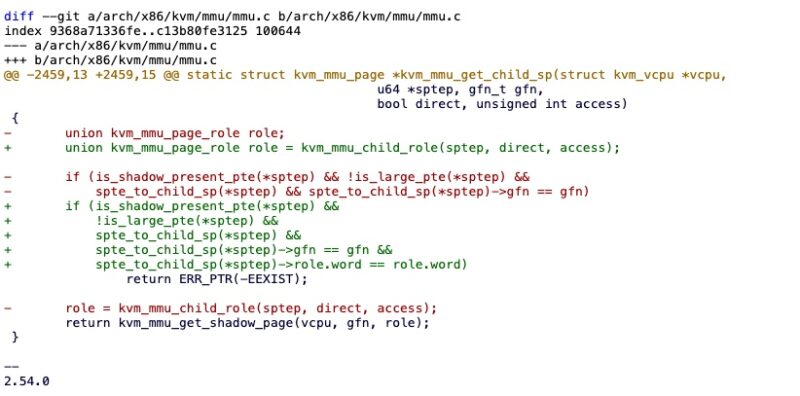
The vulnerable code has been present since commit 2032a93d66fa, integrated in August 2010, back in kernel 2.6.36. That means nearly 16 years of existence for this vulnerability. The patch, meanwhile, is just a few lines long. It completes the reuse condition in kvm_mmu_get_child_sp() so that it now checks the page role (role.word) in addition to gfn. A page is therefore reused only if its frame number and role match.
The patch was written by KVM maintainer Paolo Bonzini and merged into the mainline kernel on June 19, 2026, via commit 81ccda30b4e8. On the Linux kernel side, the fixed stable releases were published on July 4, 2026: 7.1.3, 6.18.38, 6.12.95, 6.6.144, 6.1.177, 5.15.211 and 5.10.260.
On the Linux distribution maintainer side, fixes are already starting to roll out, as is the case with Debian. For Red Hat, see this page : patches are pending on vulnerable versions.
What about KVM-based platforms? Proxmox VE and oVirt are affected, but at the host kernel level, not as products. Fixing the issue therefore means updating the kernel: the pve-kernel package for Proxmox VE, and the underlying distribution kernel for oVirt.
If you cannot apply the patch, disabling nested virtualization (kvm_intel.nested=0 or kvm_amd.nested=0) removes the attack vector. Even if this may have consequences depending on what is running inside the virtual machines, at least you prevent escape to the host.
For several months now, critical flaws in the Linux kernel have been piling up. Several vulnerabilities allow root access on Linux, from Fragnesia to the very recent DirtyClone flaw, not to mention Dirty Pipe.
To go further: