www.it-connect.fr

Dawarich: The Best Open-Source, Self-Hosted Alternative to Google Timeline
Google Timeline is no longer available on the web, and location history is now locked to the smartphone and deleted after three months. To keep control of their travel history, some users are turning to self-hosted solutions. The most complete one, Dawarich, is open source and has surpassed 9,000 stars on GitHub, while GeoPulse is the underdog. Here’s why these solutions may be worth your attention.
Google Maps Timeline Has Changed: What Disappeared
First, a quick reminder to provide context and better explain the rise of solutions like Dawarich. Google has completely redesigned its Timeline (formerly Location History). This change has had a very concrete impact:
- No more web access: Timeline is no longer viewable from a browser, only from the mobile app (the web now redirects to mobile).
- Data on the device: history is now stored on each connected smartphone. Only an optional encrypted backup on Google’s servers remains possible.
- Automatic deletion: by default, visits and trips older than three months are deleted unless you take action.
For anyone who likes having a complete history that can be viewed from a computer and stored on their own infrastructure, the answer is to self-host everything. Before going that far, it is still worth checking your privacy settings: see our article to learn how to manage your Web and location history with Google.
Dawarich: The Most Polished Self-Hosted Alternative
Dawarich is a web application you install on your own server to replace Google Timeline. Using your GPS data, Dawarich builds a mapped history of all your movements. The project has a strong community base: more than 9,000 stars and around 300 forks on GitHub at the time of writing. It also has more than 3,400 commits and has been under active development since 2024, with version 1.0 arriving in January 2025.
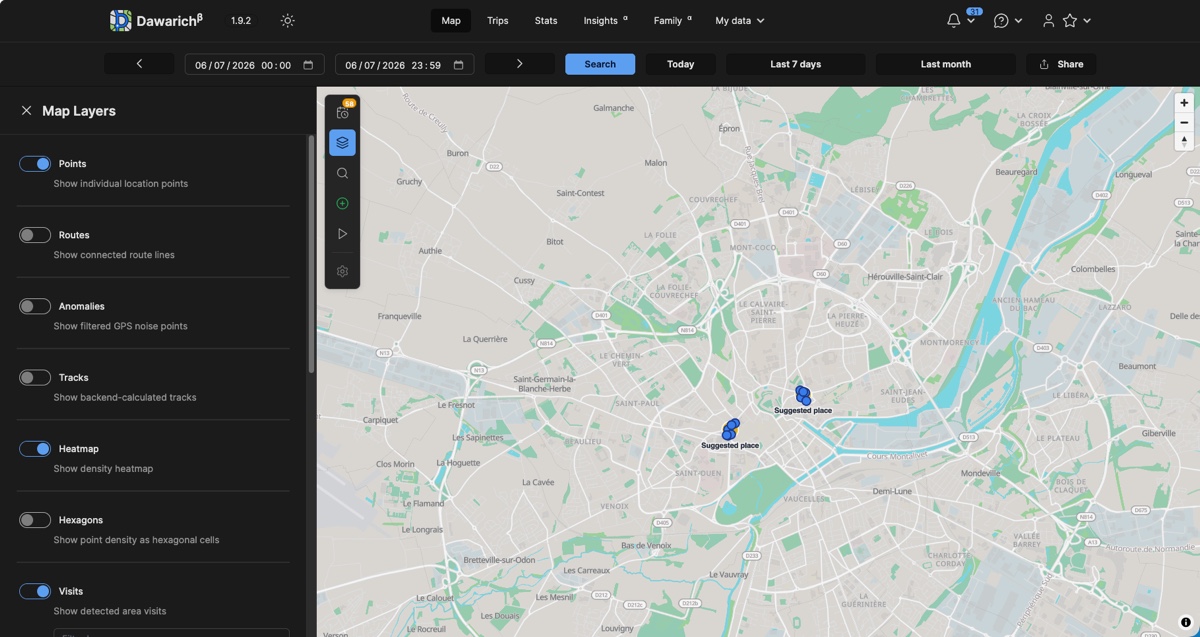
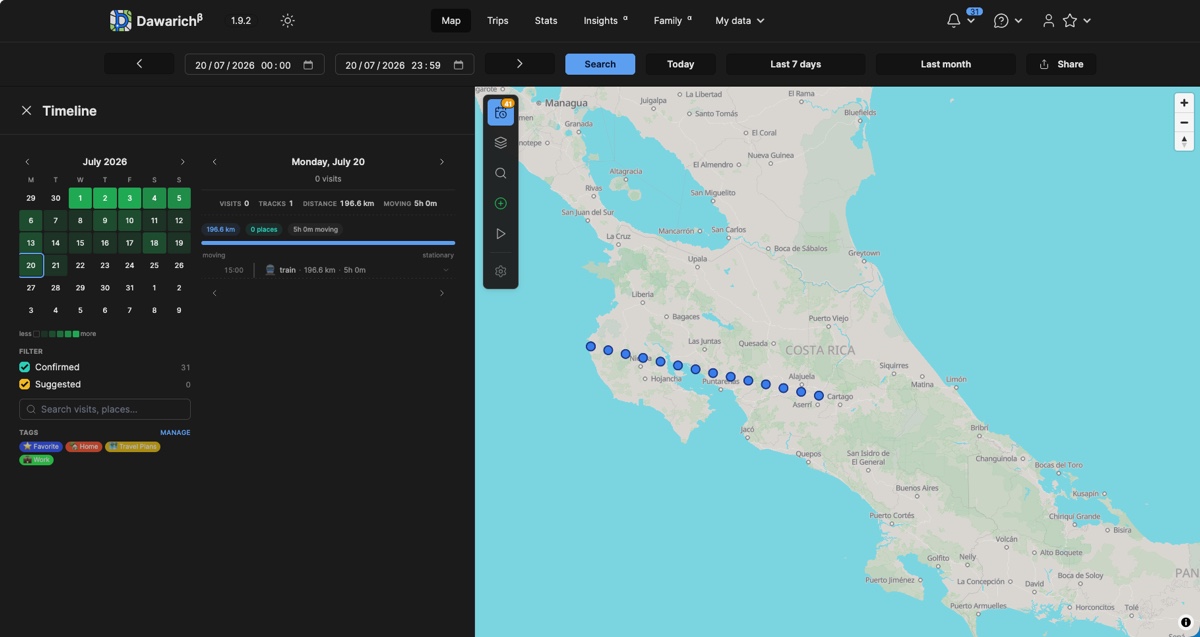
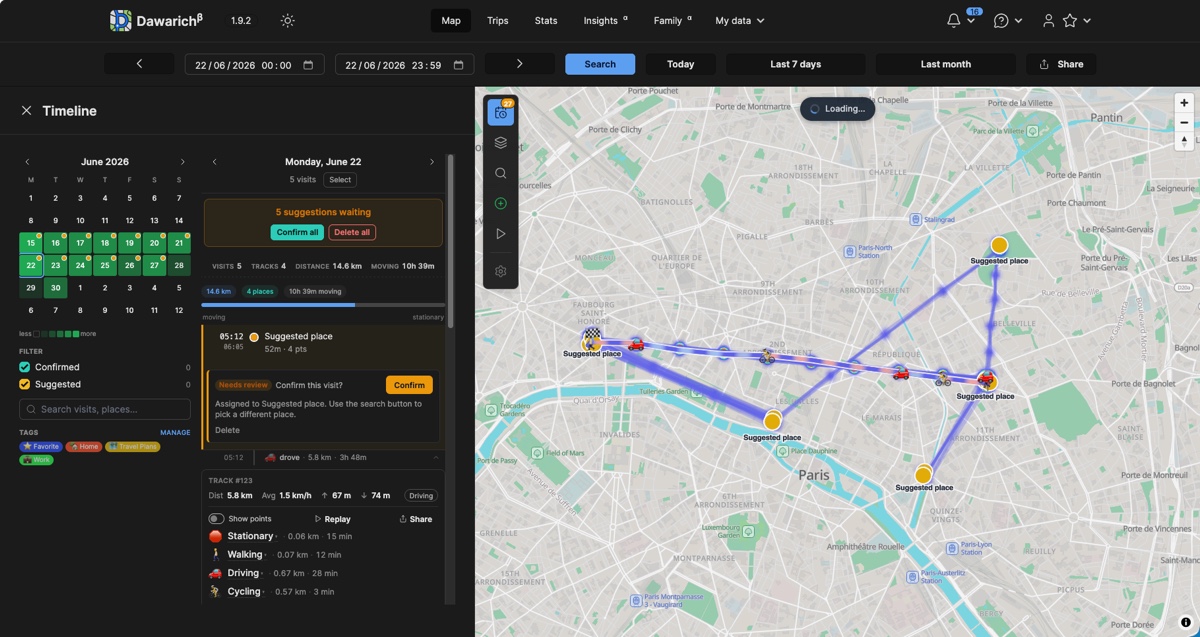
As shown in the images below, Dawarich brings together your entire day of travel on a single screen: the map plots your routes and stops, while the side panel summarizes distance, duration, transport modes, and places visited, with a calendar giving access to any past date. This is exactly what Google Timeline used to do: show where you were and where you went.
Features that go beyond Google Timeline. Once your locations are collected, Dawarich highlights them like this:
- Interactive map with multiple layers: points, tracks, heatmap, and a “Fog of War” mode that gradually reveals the areas you have explored over time.
- Statistics and insights: number of countries and cities visited, distance traveled, time spent per country. This can be useful, for example, for tracking tax residency.
- Trips annotated with photos taken along the way.
- Visit detection: Dawarich suggests places where you may have stopped, which you can confirm or reject (requires a reverse geocoding service such as Photon, Nominatim, Geoapify, or LocationIQ).
- Family sharing, with consent and individual activation per member (disabled by default).
- Geotagged photos through Immich and Photoprism integration. This lets you display your pictures on the map at the exact location where they were taken. A natural addition if you already have Immich, the open-source alternative to Google Photos and iCloud Photos installed.
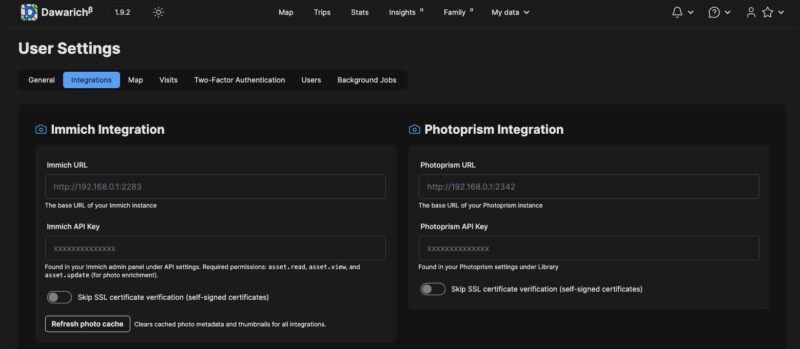
A real advantage: its own mobile apps. Where many alternatives rely on third-party apps, Dawarich provides its own iOS and Android apps to send your location data, while remaining compatible with Overland, OwnTracks, GPSLogger, PhoneTrack, or Home Assistant. On the data side, import supports multiple formats from Google Maps Timeline, OwnTracks, Strava, as well as GPX/GeoJSON files in general. Your photos’ EXIF metadata can also be used.
The self-hosted side, with no nasty surprises. Technically, Dawarich is built on Ruby (with the Rails framework), a PostgreSQL/PostGIS database, and background jobs handled by Sidekiq. Installation is done via Docker Compose, and the interface is then accessible on port 3000 (a reverse proxy is, of course, recommended if you want to expose it over HTTPS).
Open-source license. An important point for professional use: Dawarich is released under the AGPL-3.0 license, a free software license widely used by open-source solutions. There is also a managed offering, Dawarich Cloud, with paid tiers (Lite/Pro), but self-hosted instances are free: all features remain available there. The cloud funds development.
GeoPulse, the Lighter Alternative (But Watch the License)
Newer and lighter, GeoPulse targets the same goal with a minimalist approach. It focuses on a small footprint (less than 100 MB of claimed RAM usage), a Java/Quarkus stack, and a Vue interface. Features include automatic detection of stays and trips, Immich integration, and data import from Google Timeline, GPX, GeoJSON, or CSV. On GitHub, it is much more modest than Dawarich, with close to 900 stars and around 40 forks. It is also a newer project.
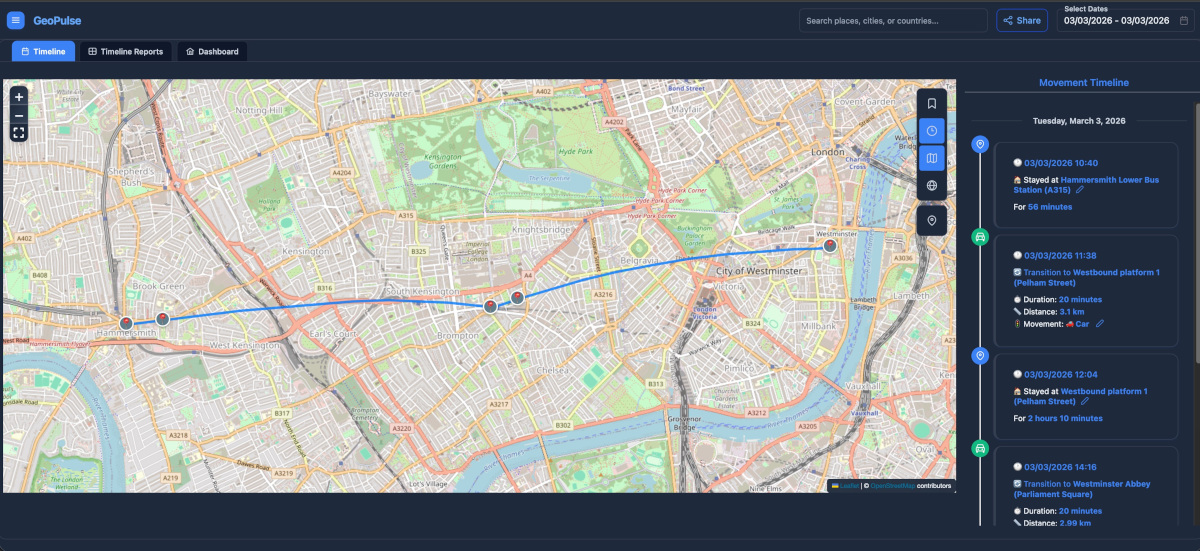
When it comes to licensing, there is a notable difference between Dawarich and GeoPulse. GeoPulse presents itself as an open-source alternative, but its code is distributed under the Business Source License 1.1 (BSL 1.1). Used by other solutions such as Dockhand, this license is not recognized as open source by the Open Source Initiative: it is a so-called source-available license, meaning the code is public but certain uses are restricted, including commercial production deployments. In plain English: free for personal and non-commercial use, but a paid license is required for commercial use.
This article is also an opportunity to compare Dawarich and GeoPulse.
| Criterion | Dawarich | GeoPulse |
|---|---|---|
| License | AGPL-3.0 (free, OSI-approved) | BSL 1.1 (source-available, not OSI-approved) |
| Commercial use | Allowed (copyleft) | Paid commercial license required |
| GitHub adoption | ~9,000 stars / ~300 forks | ~900 stars / ~40 forks |
| Age | In development since 2024, 1.0 in Jan. 2025 | First release: October 21, 2025 |
| Technology | Ruby (Rails), PostgreSQL/PostGIS, Sidekiq | Java (Quarkus), Vue, PostgreSQL/PostGIS |
| Mobile apps | Built-in iOS and Android apps | No built-in app (third-party apps) |
| Tracking sources | Built-in apps, Overland, OwnTracks, GPSLogger, PhoneTrack, Home Assistant | OwnTracks, Overland, GPSLogger, Home Assistant, Traccar, Colota |
| Geotagged photos | Immich and Photoprism | Immich |
| Import | Google Timeline, OwnTracks, Strava, Immich, GPX/GeoJSON, EXIF | Google Timeline, GPX, GeoJSON, CSV, OwnTracks |
| Strengths | Complete ecosystem, rich map (heatmap, Fog of War), stats/insights, family sharing | Lightweight (< 100 MB RAM), simple, OIDC/SSO, guest links |
| Deployment | Docker Compose, port 3000 | Docker Compose, port 5555 |
Why Use a Solution Like Dawarich?
As a private user, your travel timeline is useful in several scenarios:
- Relive your trips and memories. This is the most obvious use case: replay a road trip or vacation on a map, with the exact route trace and a heatmap of frequently visited places. If you connect Immich or Photoprism, your photos also appear exactly where they were taken.
- Map your sports activities. Dawarich can import your Strava activities and automatically detect walking or cycling trips: your running sessions, bike rides, or hikes enrich the map, with the exact route, distance, and duration of each one. You get a complete archive of your routes (and training sessions).
- Find a place you forgot. That small restaurant you spotted two years ago, the street of a great viewpoint, the hotel from a weekend away: the tool keeps everything and lets you go back to a specific date to recover the name and address.
- Count your days per country (useful for tax residency). The tool totals the time spent in each country. Handy if you travel often, work abroad, or need to justify the number of days you spent somewhere without handing these sensitive data to a third party.
- Get insights into your movements. Total distance traveled, number of countries and cities visited, time spent per place, and more. If you want to explore an entire region of the world or a whole country, it is also a good way to see how far you have progressed.
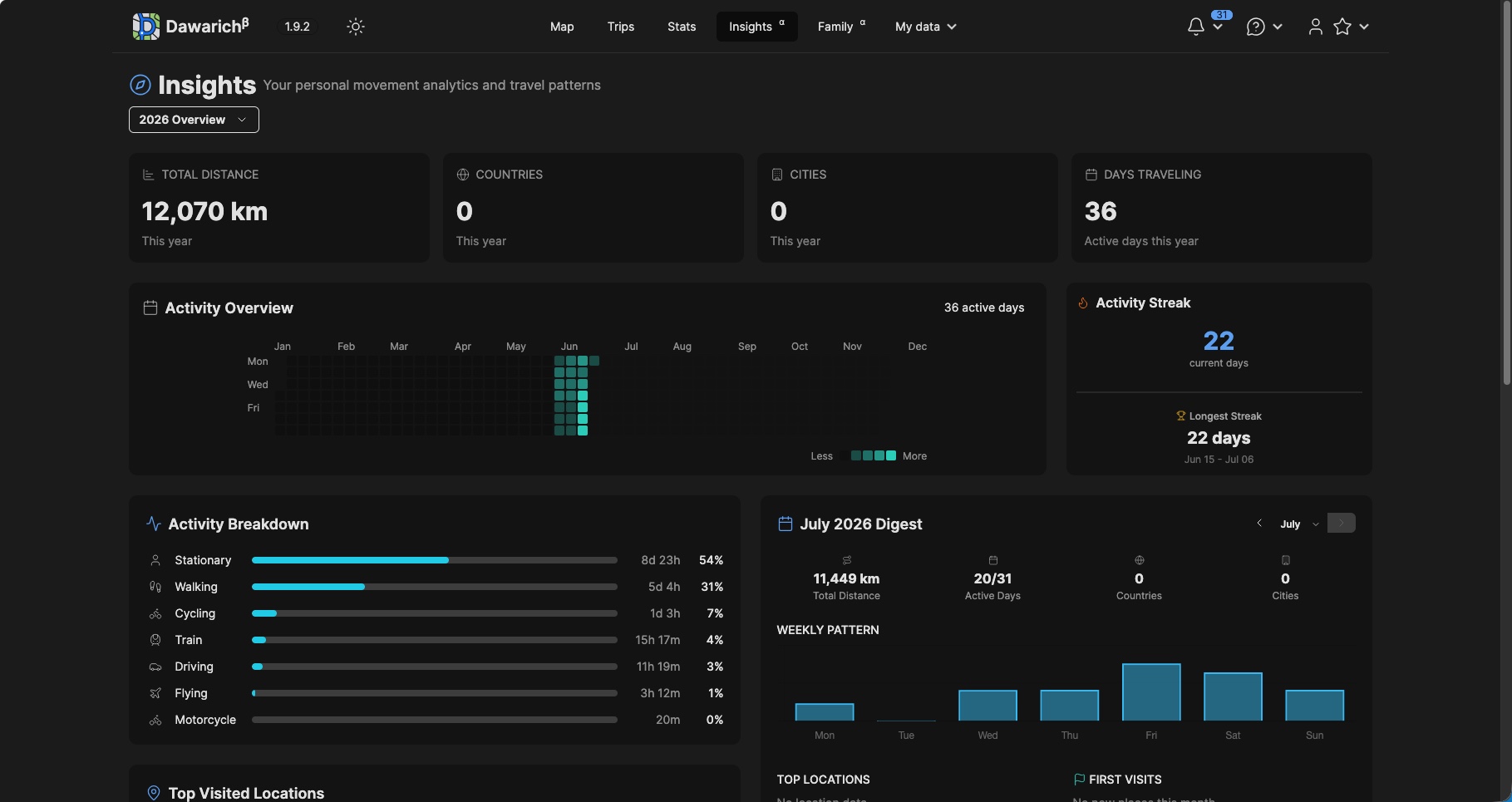
By taking back control of your travel history, Dawarich proves that you can regain the convenience of a tool like Google Timeline without accepting its trade-offs: here, it runs locally, on your own server.
Do you use this kind of solution? Feel free to share your thoughts in the comments.