www.it-connect.fr

How the iPhone 18 Pro Signs Photos at the Sensor to Prove They’re Real
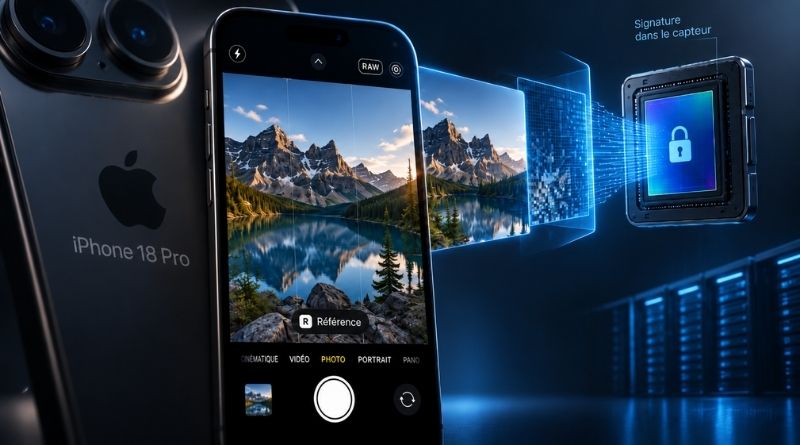
Can a photo still serve as evidence when anyone can generate a photorealistic image with AI in seconds? Apple’s answer has a name: Apple Reference Image, a photo mode reserved for the iPhone 18, where the sensor signs the pixels at capture time. Here’s what you need to know.
A new problem calls for a new solution. During the unveiling of the iPhone 18 Pro and iPhone 18 Pro Max on September 9, 2026, Apple mentioned a new feature: Apple Reference Image. An article published on the Apple Security Research blog a few days later explains how this interesting feature works.
"An image that only looks photorealistic is no longer enough to establish its truthfulness", Apple’s engineers wrote. And that is a reality, because as you know, the most advanced generative AI tools make synthetic images indistinguishable from real photos. That creates a real problem in some cases, to the point where you may wonder whether an event really happened.
Apple has therefore decided to respond, though it is not the only company doing so. Another answer has also been proposed: the C2PA standard, backed notably by Adobe and Microsoft. But Apple openly criticizes it. According to Apple, this standard attaches provenance metadata after capture, then certifies the editing history. Apple argues that the chain can be compromised at any step, without the person viewing the image being able to detect it.
A digital negative signed inside the sensor
Apple decided to build proof of a photo’s authenticity directly into the sensor itself, including the creation of a secure digital negative.
- A sensor that signs the photo: when the user switches to Reference mode, the sensor reboots into a special capture mode. It signs the pixels immediately after digitization, using an ECDSA P-256 key generated in the factory during the sensor’s first initialization. The private key never leaves the sensor; only the public key is recorded in the device’s hardware manifest manifest.
- Secure Enclave handles the rest: the few metadata elements coming from elsewhere (digital zoom, exposure, focal length) are signed by the Secure Enclave.
- Two timestamps: instead of using a time provided by iOS, Apple certifies the capture between two RFC 3161 tokens signed by its timestamping service. The first arrives regularly over the push notification channel, on average every 15 minutes, and serves as the lower bound. The second is requested immediately after the shot, as the upper bound.
Everything is stored on the device in DNG format, alongside the regular photo, and can be shared as is. What you need to understand is that this is an optional mode enabled through the Photos app settings. And above all, it is limited to two models: the iPhone 18 Pro and the iPhone 18 Pro Max.
Developed in Private Cloud Compute, signed post-quantum
Raw sensor data does not yet form a displayable image. Apple refuses to trust iOS with this processing, since it could be compromised, and instead runs it in Private Cloud Compute (PCC), the infrastructure already used by Apple Intelligence. The advantage is that the code being executed is verifiable: every PCC version is published in an immutable log, and the iPhone sends nothing to a server that does not prove it is running one of those versions. Apple says it never sees the processed pixels.
PCC verifies all signatures, develops the negative into JPEG, and assigns a confidence score to the image in the process. If a sensor accumulates scores that are too low, it is revoked and its photos are no longer signed. The final signature is applied by Apple, not by the photographer, for one purpose only: an image declared authentic in 2026 must remain verifiable decades later. That is why Apple uses a hybrid scheme combining RSA-3072, a classical algorithm, and ML-DSA-87, its post-quantum counterpart.
What this proves, and what it does not
A reference image guarantees one thing: these pixels came from an iPhone 18 Pro sensor, between two known moments, and have not been altered since. It says nothing about the scene photographed. Even if it is a step forward, a staged scene will still be considered an authentic capture in Apple’s sense: but at the same time, this feature is not designed to tell real from fake. Its main purpose is to certify that the image was not generated by AI.
In any case, Apple will not solve this problem alone. Here, the scope is fairly limited: two iPhone models, one sensor, and a development process that must go through Apple’s servers.
A real solution, or just a marketing move?