www.it-connect.fr

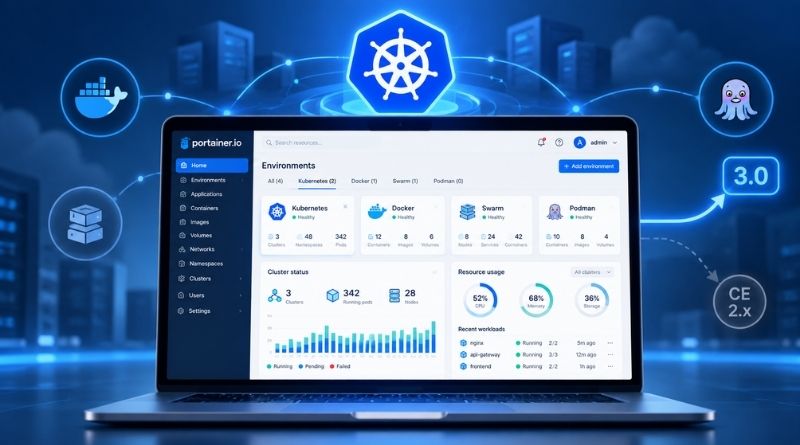
Portainer 3.0 Puts Kubernetes First as CE Stops at 2.x
Do you manage your Docker containers with Portainer? The next major release, Portainer 3.0, will put Kubernetes at the center of the product and push Docker, Swarm, and Podman into the background. Another major change: there will be no Portainer CE 3.x. Here’s what you need to know.
As a reminder, Portainer is a web-based container management interface that is widely used in enterprises and homelabs. It supports Docker, Docker Swarm, Podman, and Kubernetes, which is one of its strengths. If you are not familiar with the tool, you can read my tutorial on installing and using Portainer CE to manage Docker containers.
In recent days, Neil Cresswell, Portainer's CEO, announced the arrival of Portainer 3.0 through a blog post. And it is fair to say that it is packed with information. The first key piece of information is this: Portainer 2.45 LTS, available since the end of August, is the last release in the 2.x branch. No new features should be expected on this branch, but Portainer is committed to continuing to release security fixes, bug fixes, and selectively backporting certain features.
The next step will be a 3.0.0 release shipped as STS (short-term support), followed by a new LTS release. Why a new major version? Portainer explains that the gap between Docker and Kubernetes has widened over the past two years to the point where it is no longer viable to offer the same features across all supported solutions. In other words, there is Docker and Podman on one side, and Kubernetes on the other.
"Every new policy management feature, our operations API, and our internal authentication model had to be built three times, for three foundations, and two of them are no longer where the ecosystem is investing", Neil Cresswell argues.
Portainer 3.x will therefore be built on a code base designed first and foremost for Kubernetes.
Docker remains supported, but without the new features
If you use Portainer to manage Docker, what will change? Here is what the future looks like.
- On Portainer 2.x: nothing changes. This is what you know today, and it will continue in the same direction, with very limited development.
- On Portainer 3.x: native Docker, Swarm, and Podman environments will still be able to be added and managed from the interface, but they will be pushed into a secondary role. Most importantly, they will not receive future updates to the policy engine, GitOps engine, or observability layer.
Rather than a single interface that tries to do everything, Portainer also wants to move toward a set of specialized consoles. Each console will serve a specific use case and all will be dedicated to Kubernetes:
- Portainer-Run: already available, it lets non-technical users deploy, in a controlled self-service way, the applications they created with AI tools.
- Portainer-IDP: an internal portal for development teams that want a real platform, not just a deployment target.
- Portainer-Command: a MCP gateway that governs the actions of AI agents. They receive temporary read-only roles, and every change goes through GitOps and the existing validation chain.
- Portainer-Operations: a console dedicated to cluster management and day-2 operations, with GitOps enforced.
- Portainer-AiGrid: running AI workloads on Kubernetes.
With these decisions, Portainer aims to position itself more clearly as a Kubernetes platform for enterprises.
Portainer CE stops at the 2.x branch
Portainer CE, the community edition that has existed for ten years, will remain stuck on 2.x. And yes, there will be no Portainer CE 3.x. That means that to use Portainer 3.x for free, you will need to use Portainer's 3 Nodes Free program, which provides access to Portainer Business Edition on 3 nodes. In fact, Portainer is said to have issued more than 110,000 free licenses of this type.
However, it is not quite the same thing. Portainer CE is open source software distributed under the zlib license, whereas Portainer Business Edition is a proprietary product used with a license key issued by the vendor, including in its free version. That free version is also limited to one license per organization and the first three nodes.
For a homelab or a Docker server, there is no rush: Portainer 2.45 LTS continues to work and is still maintained. Even so, the direction is clear. If you are looking for an interface designed primarily for Docker, I presented Dockhand for managing Docker containers, as well as Arcane, a very complete open source solution for managing Docker containers.
What do you think?