www.it-connect.fr

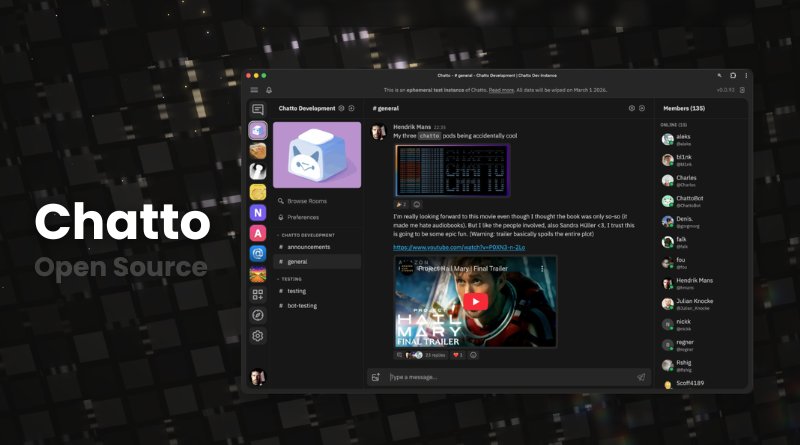
Chatto Goes Open Source: Can One Binary Replace Teams, Slack, and Discord?
One binary to launch, no database, no message broker, no cache to maintain. On July 8, 2026, German developer Hendrik Mans released the source code for Chatto, a team messaging app he presents as an alternative to Slack, Microsoft Teams, and Discord.
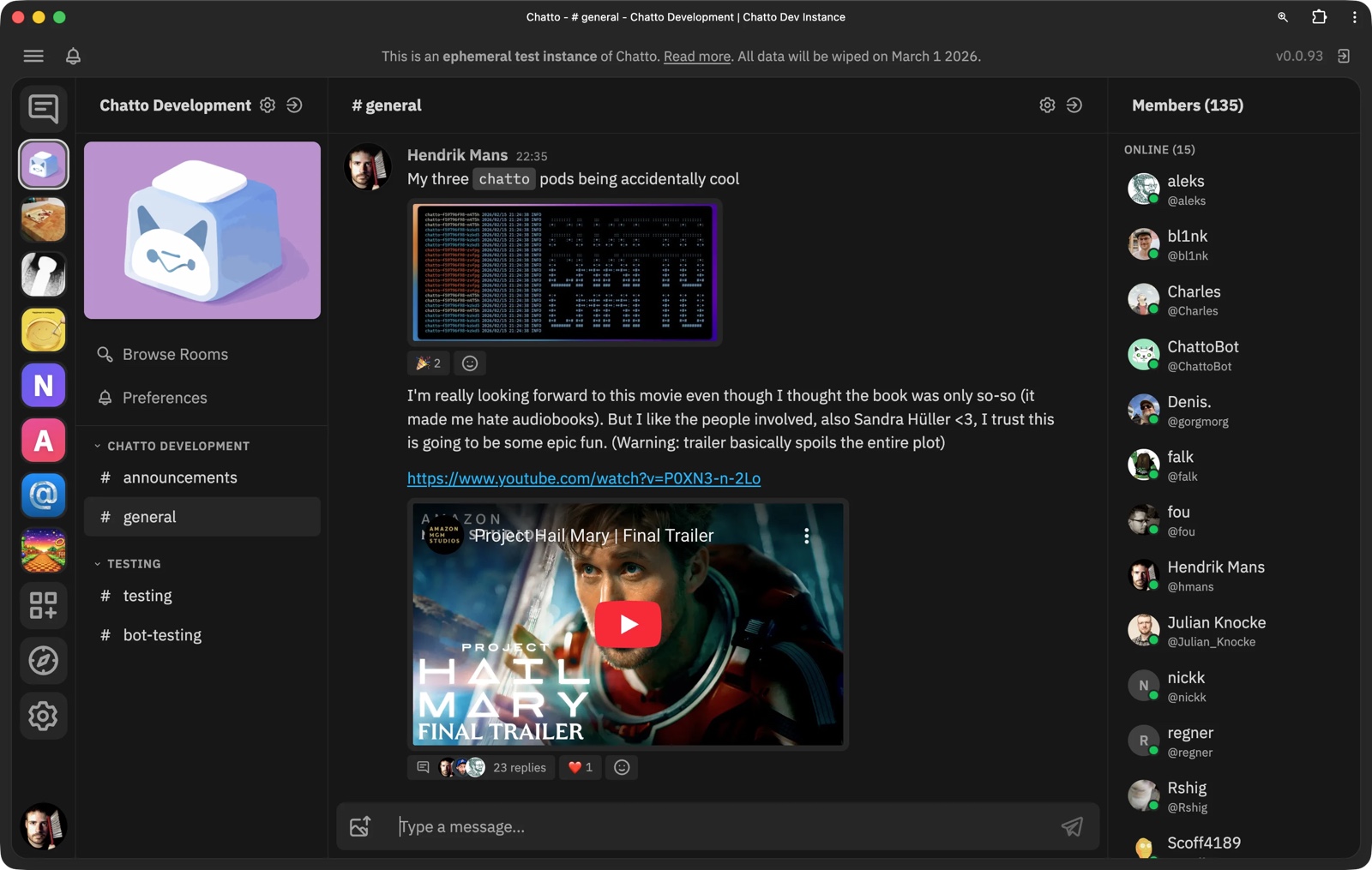
You might say Chatto is just another project in the long list of self-hosted alternatives to enterprise platforms like Microsoft Teams and Slack, or even Discord. But it has one notable feature: deployment simplicity. Where most comparable solutions require a database, a key/value store, and a broker for message handling, Chatto boils down to an executable that serves its own web frontend.
The project is available as binaries for Linux, macOS, and Windows. As with any respectable open source project, there are also Docker images, so you can choose your preferred deployment method.
One server, one community, zero federation
Chatto's architecture is based on the following model: one server hosts a single community or organization. There is no federation between instances, unlike Matrix. A user who participates in multiple communities must connect their client to multiple servers. An administrator who wants to host multiple communities must run multiple Chatto instances.
Beyond instant messaging, which is the core building block, version 0.4 adds some really cool features:
- Built-in audio and video calls, with screen sharing.
- End-to-end encryption for calls.
- Encryption at rest for personal data and conversations, with keys unique to each user and destroyed when the account is deleted.
- Two APIs (client-side and server-side) for building third-party clients, bots, or integrations.
- No third-party tracking or analytics, according to Hendrik Mans.
The latest version available at the time of writing is v0.4.3, released on July 9, 2026.
The License: Promised Apache 2.0, Delivered AGPL
In December 2025, when the project was first announced, Hendrik Mans wrote that the source code would become available "sometime in 2026 under the permissive Apache-2.0 license," adding that there would be no usage restrictions.
The reality is different. The chattocorp/chatto repository is published under AGPL-3.0-or-later by default, with limited Apache-2.0 exceptions for the standalone frontend, integration surfaces, documentation, and examples. The exact boundary is described in the LICENSING.md and REUSE.toml files in the repository.
OK, but what does that actually change? AGPL requires that modified source code be made available to users who access the service over the network, which Apache 2.0 does not require. So a company that modified the server source code and exposed it to third parties would end up with obligations it would not have had under Apache 2.0 (in other words: contributing back).
Another point to keep in mind: the project is not accepting outside contributions for now. The code is visible to everyone, but it is not collaborative at this stage: Hendrik Mans is the only developer. That is stated clearly in the README.md published on GitHub.
There is also a trademark clause, formalized in the NOTICE file: the licenses do not grant the right to reuse the Chatto name and logos as the official identity of a fork. You can fork Chatto, modify it, host it, and redistribute it. However, you cannot present your fork as "Chatto," nor reuse the logo as the official identity of your version.
At least the source code is open, so researchers can inspect it, assess the security aspects, and even identify potential flaws. That's a step in the right direction, even if it remains fairly closed for now: maybe it's a way to protect against AI-generated reports.
Finally, in the world of free alternatives, I had already written about Stoat, the open source alternative to Discord, and of course there is Matrix, which you probably know already (not the movie).
Sources: