www.it-connect.fr

Brave Says It Loads Pages 20% Faster Than Chrome, Edge, and Firefox
Brave appears to be significantly faster than its competitors, especially Chrome, Edge, and Firefox. That is at least what Brave’s new benchmark series suggests, but how much of it really holds up? Here’s what you need to know.
On September 2, 2026, Brave published the results of its new performance tests on desktop, after running the same exercise for Android in 2025. According to Brave, its browser is faster, more energy-efficient, and uses less CPU and memory, while also transferring less data than its three competitors.
Before getting into the numbers in more detail, I think it is important to remember that Brave, Chrome, and Edge all share the same engine: Chromium. Mozilla Firefox, on the other hand, relies on Gecko. The difference therefore does not come from the rendering engine itself, but from everything around it... According to Brave, the browser performs better mainly by blocking ads and trackers through mechanisms enabled by default. In a sense, that makes sense: fewer third-party requests, fewer scripts to parse, and less work for the CPU.
The numbers Brave puts forward
First of all, these tests were not performed on Windows or Linux, but on Mac. Brave chose to use a Mac mini equipped with an Apple M2 chip and 8 GB of unified memory, running macOS 26.5.1, with a dedicated 50 Mbps connection in London. The versions compared in this benchmark were the following:
- Brave 1.92.139 (Chromium 150),
- Chrome 150,
- Edge 150,
- Firefox 146.0.1.
This automated benchmark was run using the Playwright framework, and the tool used is published on GitHub. The procedure: load the home page of the 50 most popular sites according to Brave Search, ten times each, with a fresh profile on every run.
Here are the averages recorded across all browsers:
- CPU. Brave shows average usage of 33%, compared with 47% for Chrome, 53% for Edge, and 78% for Firefox. Firefox even approaches 100% on some pages.
- Memory. About 1,200 MB for Brave (combined RSS of all processes), versus 1,750 MB for Chrome, 1,620 MB for Edge, and 1,650 MB for Firefox.
- Energy. 31.1 mWh per page load for Brave, which is 4% less than Chrome, 12% less than Edge, and 14% less than Firefox.
- Full load time. 4.4 seconds for Brave, 5.1 seconds for Chrome, 5.3 seconds for Firefox, and 6 seconds for Edge.
- Network data. 4.4 MB received per page for Brave, compared with 4.8 MB for Chrome, 6.3 MB for Firefox, and 6.8 MB for Edge. Outbound, Brave sends 0.18 MB, while Chrome sends 0.34 MB, almost twice as much.
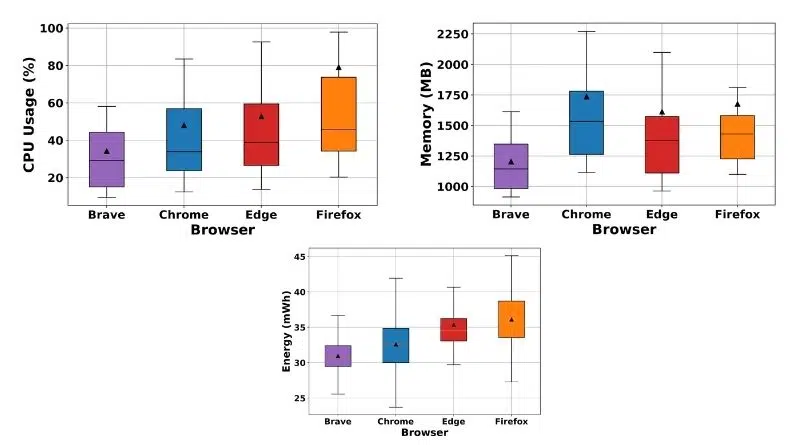
What we need to understand is that performance and privacy go hand in hand: outbound data largely corresponds to tracking code and telemetry, which is what Brave blocks by default. On paper, when you look at CPU and RAM performance, there is no contest. But it is also interesting to look at LCP.
The detail that changes the picture: LCP
The loading time measured in the tests mentioned above corresponds to the loadEventEnd event, meaning the moment the page has finished loading everything, including background scripts. But if you look at another key metric called LCP (Largest Contentful Paint), the results are less clear-cut. This indicator is well known and serves as a reference when optimizing website performance (Google even uses it as a Core Web Vitals criterion). It measures when the main content appears on screen. And here, all four browsers are almost tied: about 2.4 seconds for Brave and Chrome, 2.5 seconds for Edge and Firefox.
In other words, the page appears ready at the same time for the user. But for your machine, there is still an advantage: lower resource usage, which can also improve battery life, even if it does not change how fast the page feels on screen.
Finally, it is worth noting that the competing browsers were tested with their default settings, meaning without an ad blocker. It would be interesting to compare Brave with Firefox or Chrome equipped with uBlock, and that would probably produce a very different outcome. It is also worth pointing out that Safari was left out, which is surprising since the test was run on Mac. Brave explains this omission by saying that Playwright does not fully support Apple’s browser.
What do you think?