www.it-connect.fr

Agent Standup Turns Claude Code and Codex Agents Into a Video Call Dashboard
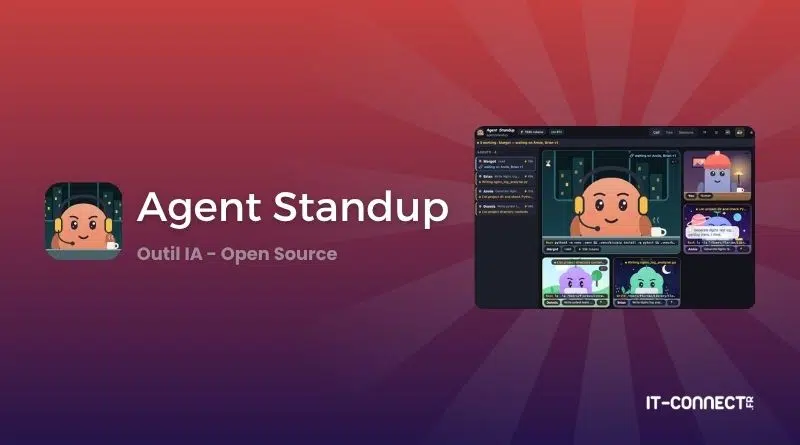
What if your coding agents met on a video call to show you what they’re doing? That’s the idea behind Agent Standup, an open source tool that turns your Claude Code, Codex, and Mistral Vibe sessions into an animated team meeting. A creative concept.
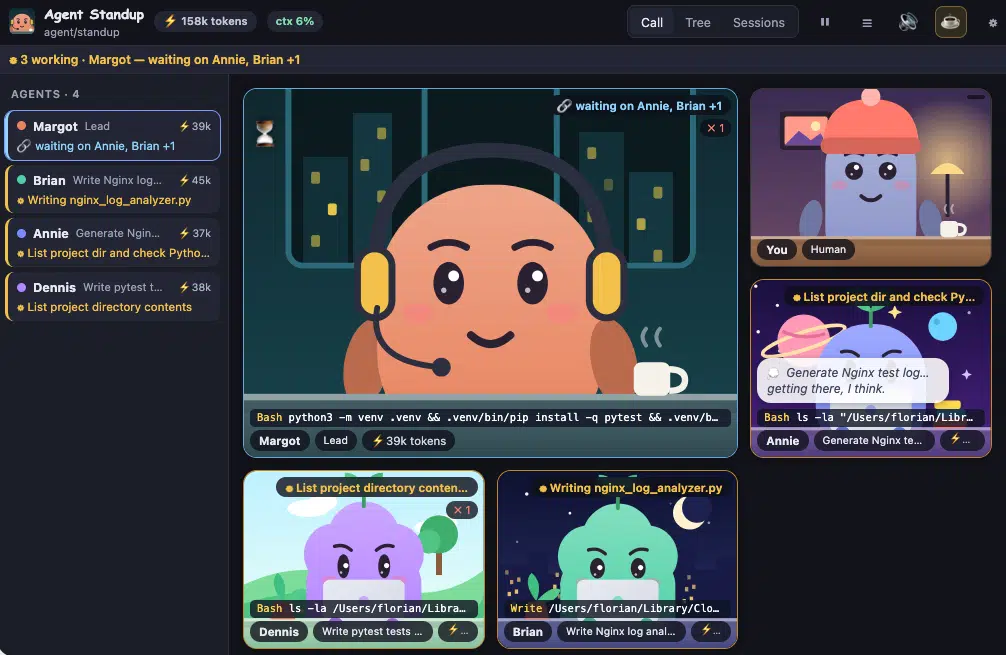
When an AI agent launches several sub-agents in parallel, keeping track of who is doing what in the terminal quickly becomes tedious. More importantly, it is not very convenient and far from visual. Agent Standup tackles the problem with an original and bold answer: each agent becomes a character sitting at its desk, inside an interface that looks like a Teams or Meet call.
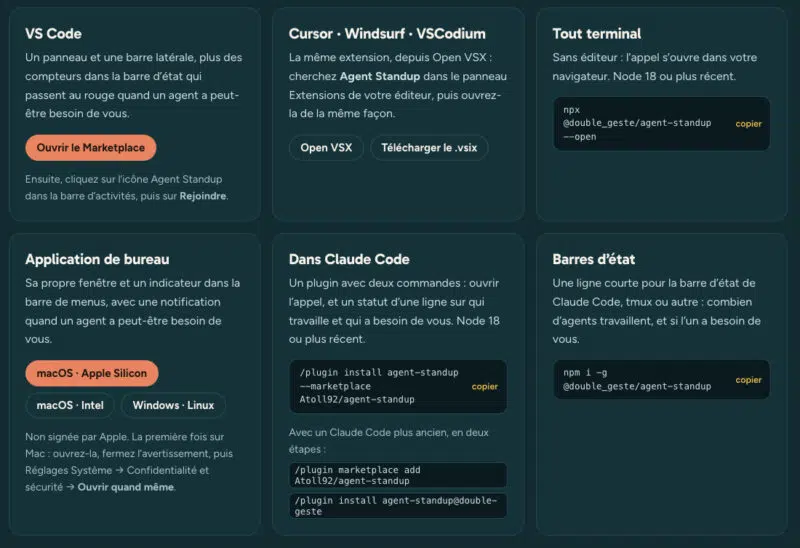
This tool, launched by a French developer based in Marseille (according to the GitHub profile), seems to be well received: in three days, it has more than 150 stars on GitHub and already six contributors! It is open source, available on GitHub, and can be installed in several ways: Linux, Mac, Windows, and as an extension for Visual Studio Code (or Cursor and Windsurf via Open VSX). It can also be installed with the npx @double_geste/agent-standup --open command (Node.js 18 minimum) or via a Claude Code plugin.
So how does it work? The application reads the session files that agents already write on your machine (for example ~/.claude/projects for Claude Code) and replays them as a meeting, live or later on. If you are just getting started with Anthropic’s tool, I’ll point you to our tutorial to install and get started with Claude Code on Windows or Linux.
A video call where each agent shares its screen
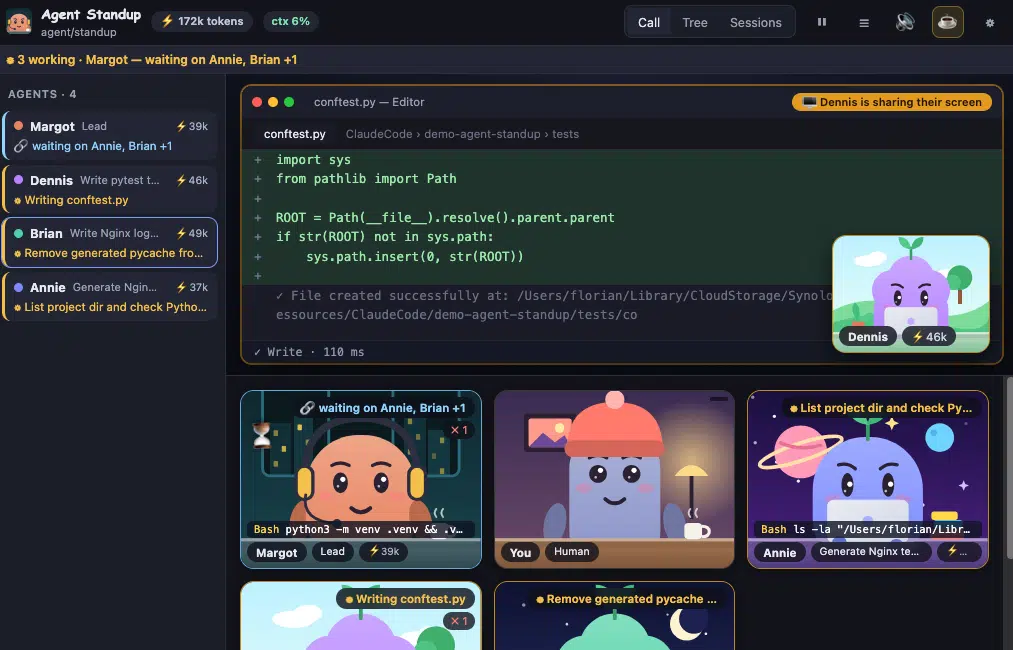
The team lead assigns tasks: the sub-agents then join the call when they receive a mission and leave it once their report is delivered. The one who is speaking comes to the foreground, with a synthetic voice.
- A status for each agent: working, waiting for another agent, needs you, or done. The number of tokens consumed per agent and a context gauge before compaction are also displayed. Useful information!
- Screen sharing: when an agent runs a command, you see the command and its actual output. When it edits a file, you see the diff. Failed commands are also flagged.
- Replay: a past session can be scrubbed with a cursor, jumping directly to the first error or a loop. A summary then lists the commands, errors, tokens, and modified files.
- Characters: you can use your own images, and a pack of eleven cats provided by a contributor is included (of course...). The interface is available in ten languages, including Korean, which was also recently added by a contributor.
"A little stupid. Surprisingly useful.", says the official website. And the point holds up: with eight sub-agents active at the same time, this view is more readable than a scrolling log. I tested it, and indeed, I agree with the official summary. The audio part is interesting because it lets you stay informed in real time about what is happening, without keeping an eye on the Claude Code session (or another one). The replay function (with an export feature) is also useful for going back to a specific point.
Nothing leaves your machine... by default
On the Agent Standup website, it is explained that the tool runs locally and consumes no tokens. Indeed, the local server listens only on 127.0.0.1 and rejects requests that do not come from your machine, which is preferable. The session files themselves are read, never modified.
But be careful with the options you choose. If you choose French, or if you enable the agents’ “jokes,” short excerpts from the session are sent to Anthropic via your own Claude Code connection (or your API key). Since translation relies on the Haiku model, these options do consume tokens: a reminder that Haiku is a fast, efficient, and low-cost model.
From now on, Agent Standup joins a fast-growing ecosystem of open source tools around AI-assisted coding, like Graft, the tool that maps your code for AI agents.
What do you think?