www.it-connect.fr


CyberXero Used 51 Claude Code Agents to Attack WordPress and Ukraine
4,708 targets scanned, 429 WordPress sites compromised, and 32 web shells deployed in 61 seconds. Fast, right? Behind those numbers stands just one hacker: CyberXero. His secret? Aiding himself with an army of 51 Claude Code agents. Here is what we know about this cyberattack.
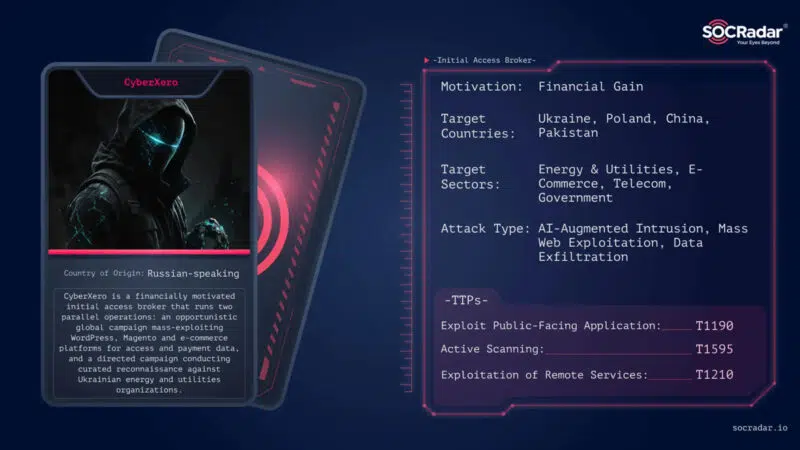
Researchers at SOCRadar have published a report about CyberXero, a Russian-speaking initial access broker. As a reminder, this type of actor (IAB, for Initial Access Broker) specializes in compromising organizations in order to resell the obtained access to other cybercriminals.
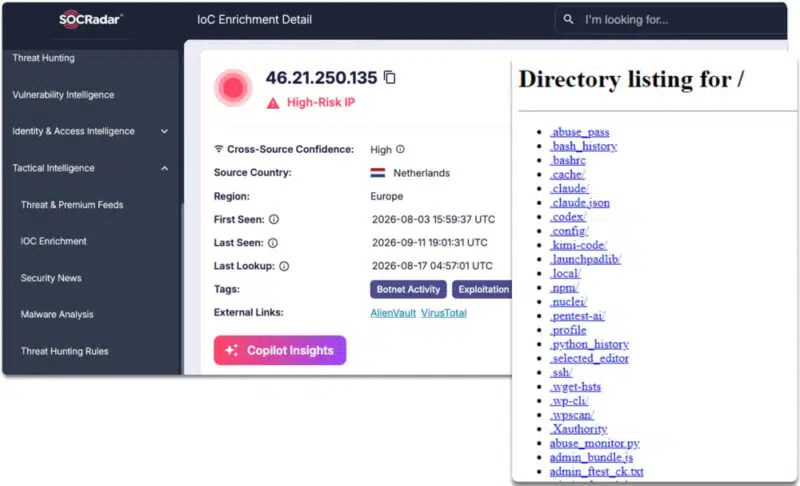
According to SOCRadar, CyberXero's infrastructure was first observed in July 2026, and it was still active at the time the report was published. It was discovered because of a misconfiguration that exposed public access to a working directory used by the attacker on a server hosted by Zomro in the Netherlands. This access made it possible to reach more than 90,000 files, including AI session logs, scripts containing plaintext tokens, and data stolen from victims.
Enough to better understand how this campaign works.
Two campaigns, one operator
From the same machine, CyberXero ran two operations in parallel:
- The opportunistic campaign targets WordPress and the e-commerce sector worldwide
It relies on wp2shell (CVE-2026-63030 and CVE-2026-60137). Last July, I published an article about wp2shell, this critical flaw that allows remote code execution on WordPress without authentication. The attacker developed his own version as a Python tool, which creates a bogus administrator account and installs a web shell disguised as a plugin.
Added to that are the SQL injection CVE-2026-4815 in the Support Board plugin, exploited less than 30 days after disclosure, and attacks against Magento. The target list exceeds 56,000 URLs, and each compromise is reported in real time via a Telegram bot.
- The targeted campaign is of a very different nature: it targets Ukraine
The attacker targeted seven Ukrainian organizations in the energy and utilities sectors, including the national transmission system operator and the country's largest private energy group.
Four Ukrainian organizations suffered confirmed exfiltration, for a total of more than 628,000 records of personal data. There was also an impact on a district heating provider in Kharkiv: 564,073 subscriber records exfiltrated, including home addresses and account numbers. Remember that this city is located on the front line...
In total, more than 40 organizations are believed to be affected worldwide. Beyond those Ukrainian organizations, there are also victims in the Netherlands, Poland, and China.
Claude Code to speed up attacks
To orchestrate these attacks, CyberXero relied on Claude Code and up to 51 specialized agents: reconnaissance, exploit chaining, lateral movement, exfiltration... There is also a link with PentAGI, an open source AI-driven penetration testing framework.
Aren't there supposed to be safeguards with frontier LLMs? Yes, indeed. But the attacker managed to bypass them by presenting himself as the author of an authorized penetration test on his own infrastructure. And according to the researchers, when refused, he simply opened a new session with that preloaded context. "A model's security controls operate on the context of a session, not on the model weights," SOCRadar explains.
However, the hacker probably had to work hard to get around the restrictions. According to the recovered logs, the AI repeatedly refused to install a backdoor, disable a firewall, move laterally, or deploy a web shell.
What is also striking here is the execution speed made possible by AI: "What stands out here is the scale of the operation: the total number of identified targets exceeds 56,000 URLs, and a single automated run made it possible to analyze 4,708 targets, confirm the presence of 429 accessible admin panels, and deploy 32 shells, all within 61 seconds," the report says, which you can find on this page.