www.it-connect.fr

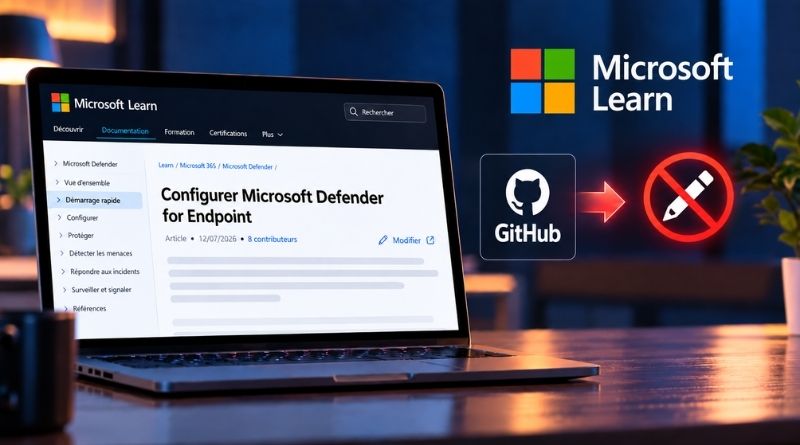
Microsoft Learn: Most GitHub Documentation Repositories Will Close by the End of 2026
Microsoft’s official documentation, aka Microsoft Learn, is collaborative: you can fix an error in the documentation through GitHub. However, Microsoft has made an important decision: it will shut down the majority of the public repositories associated with its product documentation by the end of 2026.
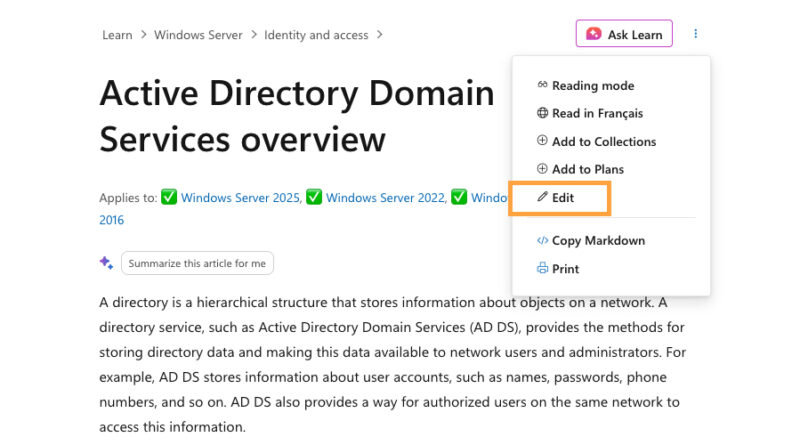
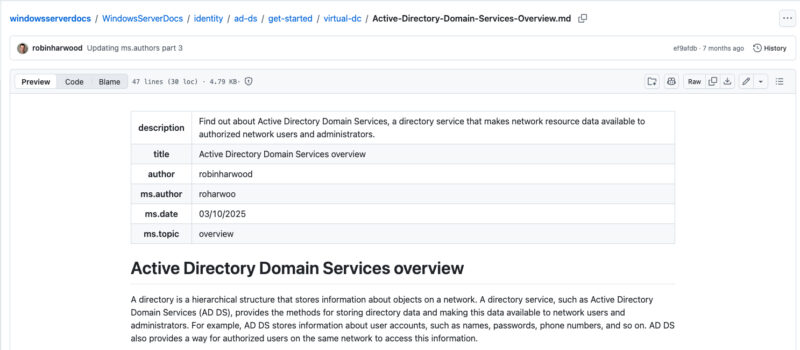
For years, Microsoft Learn pages have displayed a small link that lets you suggest an edit on a page (see above). Clicking this button takes you to the source Markdown file, hosted in a GitHub repository under the MicrosoftDocs organization. Anyone with a GitHub account can then propose a correction via a pull request or report an issue through an issue. The editor responsible for the page reviews it, approves it, and the documentation is updated.
The Redmond-based company has decided to end this collaborative model for most products. A few days ago, Microsoft published a post explaining that most public repositories linked to its product documentation would be taken down.
There are exceptions. Documentation repositories associated with open source products, projects, or communities should remain open to contributions. Product source code repositories and code sample repositories are not affected. Microsoft justifies this decision by saying it wants to "maintain reliable, high-quality technical content for customers", while establishing clearer criteria for deciding which repositories remain public. However, the publisher does not explain how a private repository would better serve that goal...
My main feeling is that AI will end up doing this work for us... If that is indeed the case, I’m not convinced that is reassuring. Microsoft does not mention AI at all in its announcement, but it is hard not to think about it.
What Will Change for Us as Contributors
Microsoft’s project will unfold as follows:
- Case-by-case review: each repository will be evaluated based on contribution activity, community engagement, business needs, and operational dependencies.
- Invisible repositories: once removed, a repository will no longer be publicly accessible or visible. Its history, pull requests, and issues will no longer be visible either. Only forks will remain accessible (this may be the time to fork, by the way).
- Ongoing contributions: before a repository is removed, open pull requests and issues will be reviewed. Their authors will be notified with a comment on GitHub.
- Timeline: Microsoft has started with the smallest repositories and expects to complete the process by the end of December 2026.
The move is already underway. On September 30, 2026, the MicrosoftDocs/defender-docs repository, which serves as the source for Microsoft Defender for Endpoint, Defender for Office 365, and Microsoft Sentinel documentation, returns a 404 error when you try to view it without being authenticated.
To report an error in the documentation, Microsoft now points you to three channels: Microsoft Q&A, the feedback options available on Microsoft Learn pages, and Microsoft community forums. A year ago, I published an article about the shutdown of the Microsoft Answers forum in favor of Microsoft Learn Q&A. This support platform is therefore taking on an additional role, but I do not really understand Microsoft’s decision. It feels like going against the grain.
A Poor Choice for Tracking and Transparency
Public repositories also made it possible to track documentation changes commit by commit. A warning added quietly, a limit lowered, a feature marked as deprecated: everything was traceable. And documentation is sometimes the first place where these changes appear. That was the case with the removal of the memberOf operator from Entra ID dynamic groups, which I wrote about in August: in addition to the message published in the message center, a warning had been added in Microsoft Learn.
Above all, this documentation could be updated based on real-world feedback, in a collaborative and efficient GitHub-based approach. That will no longer be the case. Too bad.