www.it-connect.fr

Maia 300: Microsoft Turns Its In-House Chips Into the Engine Behind Copilot Inference
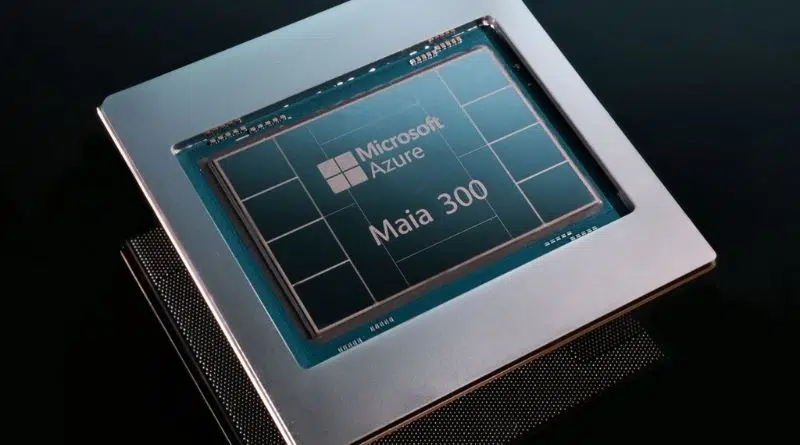
40% more tokens per megawatt consumed: that is the promise of Maia 300, the third generation of AI accelerators designed by Microsoft. More importantly, the hyperscaler says that starting in 2027, its Maia chips will become the primary inference system for its own products and services, with major deployments measured in gigawatts. Here’s what you need to know.
On October 12, 2026, Scott Guthrie, Executive Vice President of the Cloud + AI division, unveiled Maia 300, Microsoft’s new in-house chip. The announcement was also shared on LinkedIn by Satya Nadella, Microsoft’s CEO: "Today, we are announcing our biggest bet yet on our own silicon," he said.
That said, Maia is not new. Microsoft introduced its first in-house chips, Azure Maia and Azure Cobalt, at Ignite 2023. The second generation, Maia 200, followed on January 26, 2026: a 3 nm accelerator manufactured by TSMC and dedicated to inference, meaning the execution of already trained models. Now, the third generation, aka Maia 300, is ready.
Maia 200 Is Already Running in Production
Maia 200 now powers Microsoft Copilot and the MAI team, which develops the vendor’s in-house models (such as MAI-Thinking-1, Microsoft’s first reasoning model unveiled at Build 2026). GitHub Copilot and Microsoft Foundry are expected to follow before the end of the year.
These chips run OpenAI models, MAI models, and several open-source model families. Maia 200 is being deployed in the United States, Europe, and Australia. According to Microsoft, it delivers up to 1.7 times more tokens per watt for AI features built into Teams, Copilot, and Cowork, one of the components of the new Copilot organized around Home, Code, and Autopilot.
These figures should be compared with what reference GPU-based infrastructures can deliver. But Microsoft does not say what it used as the benchmark.
Maia 300: What Microsoft Is Announcing
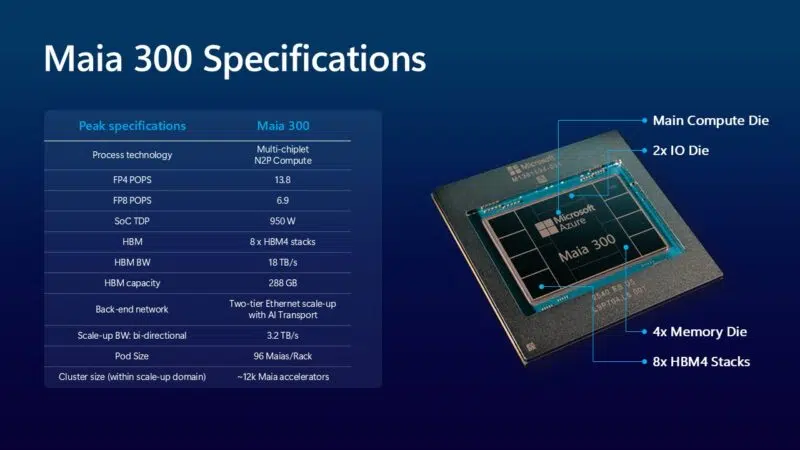
Maia 300 adopts an architecture designed first and foremost for inference, with a focus on long contexts, latency-sensitive conversations, and multi-step agentic tasks. Production deployments will begin in 2027. The deep dive published on the Azure blog also provides some interesting details about this large-scale Maia 300 deployment:
- Multi-chiplet architecture: compute units are manufactured using TSMC’s N2P process, while the memory controller and I/O are split across separate chips. The key takeaway: Microsoft says compute power is up 36%.
- Memory: eight HBM4 stacks provide 288 GB and 18 TB/s of bandwidth per accelerator, with a 950-watt TDP. Compared with Maia 200, that is 2.5 times more bandwidth and 33% more capacity.
- Low-precision formats: enhanced MXFP4 and storage formats below 3 bits reduce the memory footprint, including KV cache, for larger context windows.
- 96-accelerator rack: each rack consumes 167 kW and totals 27.6 TB of HBM memory for 1.7 PB/s of aggregate bandwidth. Liquid cooling removes more than 80% of the thermal load.
- Network: an in-house AI transport layer based on Ethernet makes it possible to build a "superpod" of 12,288 accelerators spread across 128 racks.
The result: up to 7 times more token throughput at full-rack scale compared with Maia 200, and more than 2.5 times better performance per watt consumed.
The Redmond-based company wants to make its AI infrastructure more efficient in order to maximize "useful tokens per watt and useful tokens per dollar". In other words, it wants to lower the cost of each Copilot request without abandoning GPUs. Satya Nadella also said he wants to keep integrating "the latest innovations from the entire ecosystem" into the fleet. NVIDIA and AMD accelerators will therefore remain in Azure datacenters as well.