www.it-connect.fr

Open Printer: A Repairable, DRM-Free Open Source Printer Is Taking Shape
An printer you can take apart, understand, repair, and refill without a manufacturer putting obstacles in your way—does that sound appealing? That is exactly the goal of the Open Printer project. Driven by the Paris-based startup Open Tools, the project has just crossed an important milestone: a prototype that actually prints. Here is what we know about this printer that embraces refillable, DRM-free cartridges.
Zero DRM, refillable HP cartridges, and the choice between roll or sheet paper
The pitch is simple: take back control of a device that the industry has carefully locked down. Open Printer ships with no proprietary driver and, above all, no DRM chip designed to reject third-party cartridges. This printer gives you a degree of freedom, and we like that. It reuses cartridge modules from HP that are easy to find on store shelves, HP 302 in Europe and HP 63 in the United States, which you can refill yourself whenever you want.
No more razor-and-blade model, where the printer costs next to nothing and ink cartridges cost an arm and a leg.
On the ink side, the operation remains open. According to Open Tools, you can install one cartridge only (black or color) or both, and printing continues even when one of the two tanks is empty. No hostage situation just because a hint of magenta is missing. On the performance side, the company mentions 600 dpi in black and white and 1200 dpi in color.
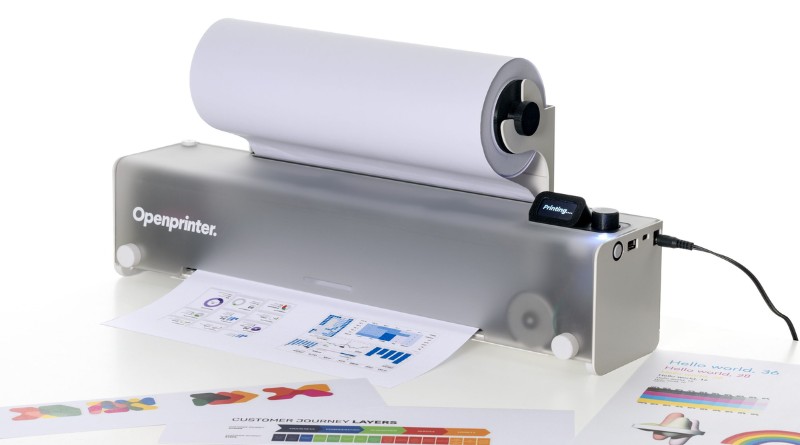
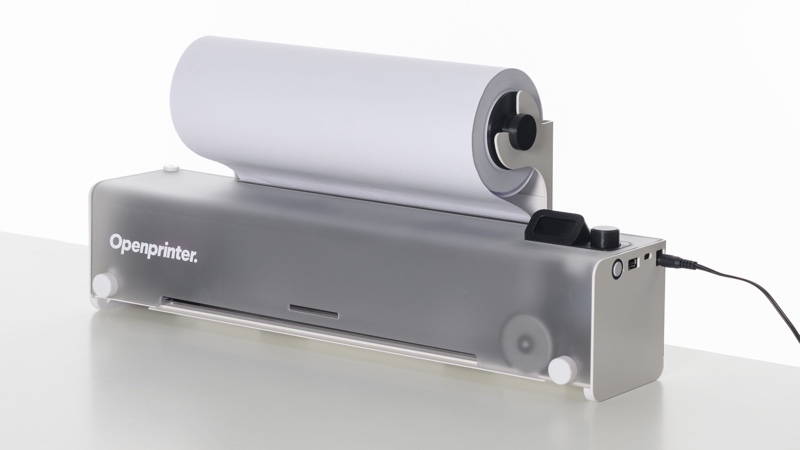
Open Printer also stands out for its media handling: the printer takes standard sheets as well as paper rolls, with an integrated cutter that trims them to the exact desired length. That opens the door to far more than simple A4 documents, thanks to support for A4, A3, and 297 mm-wide rolls for the European market.
To communicate with your machines, everything runs through CUPS, the open source print server inherited from the Unix world. As a result, the printer is said to be compatible with Windows, macOS, Linux, Android, and iOS, with no vendor-specific driver to install. That is a long way from the usual headaches of proprietary ecosystems.
Raspberry Pi Zero W, open files, and a license you need to read closely
The main board will also be familiar: it is a Raspberry Pi Zero W. A STM32 microcontroller handles the dedicated cartridge board. The rest follows the same logic of standard components: a small 1.47-inch TFT LCD screen, a navigation wheel, USB-C and USB-A ports, Wi-Fi, and Bluetooth, all housed in a case measuring roughly 50 x 10 x 11 cm and powered by 24 V. Nothing exotic, which is also an important point when it comes to extending the machine's lifespan through part replacement.
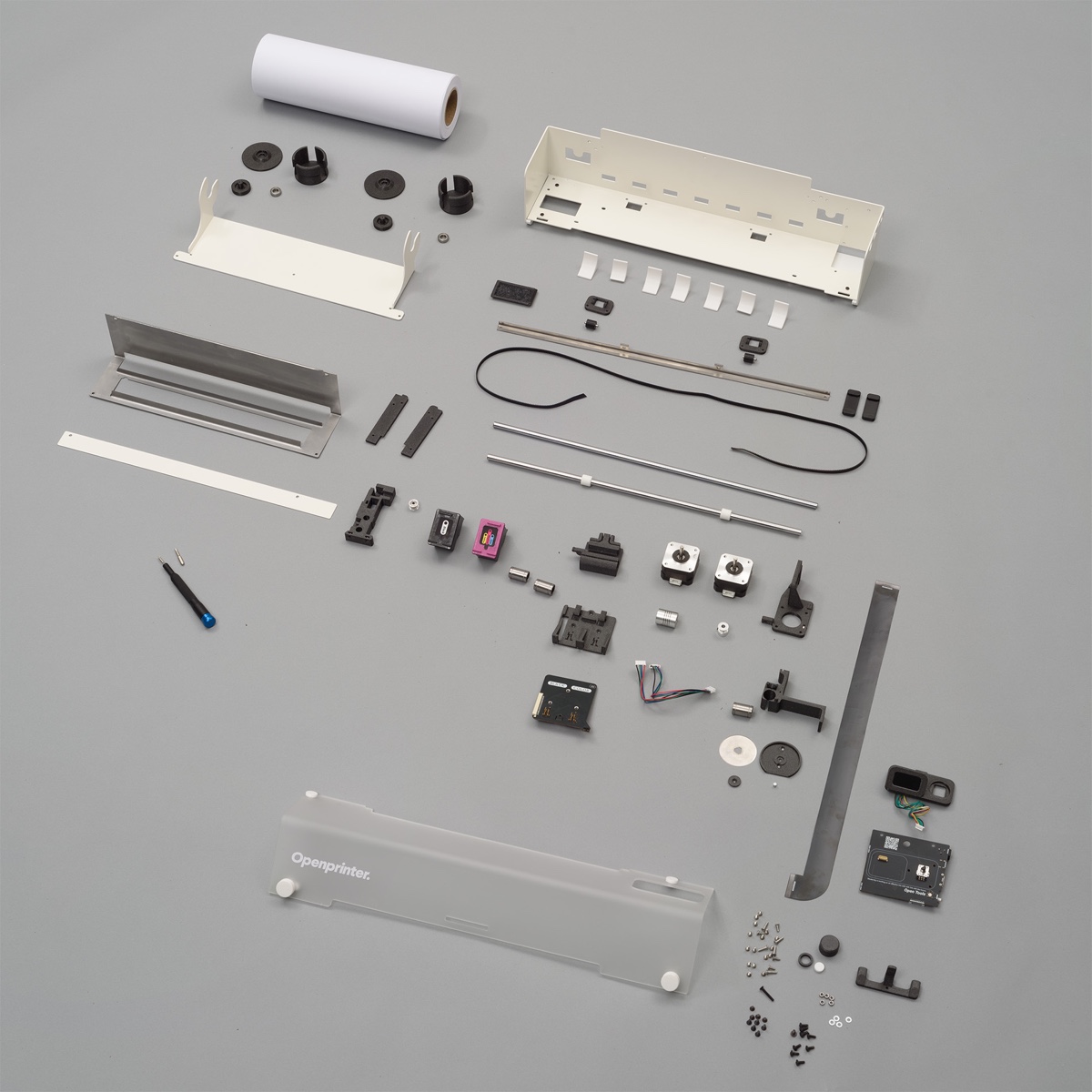
This clearly fits Open Tools' philosophy, since the company even wants to publish all of its files—electronics, mechanical plans, firmware code, and bill of materials—under the Creative Commons BY-NC-SA 4.0 license. The goal is for anyone to be able to repair, modify, and share the machine so it never ends up in the scrap heap for lack of support.
One important clarification is needed, because the devil is in the details. The NC (non-commercial) clause in the license allows repair, modification, and sharing, but it prevents a third party from manufacturing and reselling the printer for profit. The project is therefore "open" in terms of documentation and right to repair, without being a software open source license approved by the OSI (although the intent is there). It is a coherent choice, since a company is behind the project.
On June 29, 2026, the Open Tools team announced a solid prototype capable of printing in both black and color, switching between sheets and rolls, and cutting paper on demand with its built-in cutter.
That said, there is still work to do, including upcoming efforts to optimize ink drying, tune nozzle cleaning cycles, and further improve print speeds. Beyond that, the whole industrialization process remains: adapting the design for manufacturing, driving down bill-of-materials costs, and lining up production partners.
One question remains unanswered: the price. Open Tools says the final amount still depends on too many variables (volumes, costs, and more...). It will only be revealed when the Crowd Supply campaign launches, which is expected in the coming months. It also remains to be seen whether users will be able to assemble the printer themselves and whether it will ship as a kit.
What do you think?