www.it-connect.fr


Microsoft 365 Outage Hits Outlook, Teams and Copilot for 11+ Hours
More than 11 hours after the incident began, Microsoft still has not fully resolved this outage, especially for everything related to Exchange Online. Since Thursday evening, a global outage has been disrupting Outlook, Teams, Copilot and much of the Microsoft 365 ecosystem, including security tools. Here is where things stand on Friday morning.
It all started on Thursday, November 12, 2026, late in the afternoon. At 6:54 p.m. (French time), the Microsoft 365 Status account reported on X access issues with Exchange Online mailboxes, initially in the Americas (reference EX1550543). A few messages later, Microsoft broadened the scope: the issue could affect users in any region. A second incident (MO1550821) was opened around 7:30 p.m. to group all impacted services together. The situation worsened over several hours.
Earlier in the afternoon, Microsoft Teams had already experienced disruptions between 3:45 p.m. and 4:53 p.m., resulting in message sending failures in North and South America. Microsoft then pointed to resource saturation.
According to Downdetector, reports were registered in 74 countries and territories, with nearly 130,000 reports for Outlook shortly after 7:00 p.m. (French time). As of Friday morning, the situation is still difficult, whether for Outlook, Teams or Microsoft 365, according to reports in France.
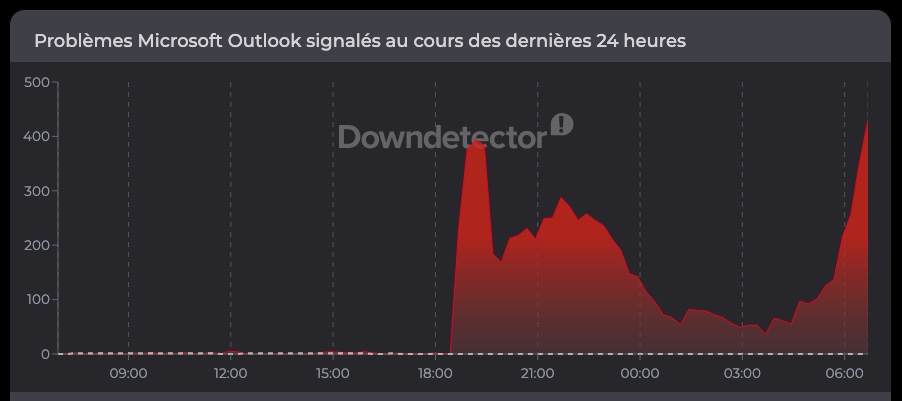
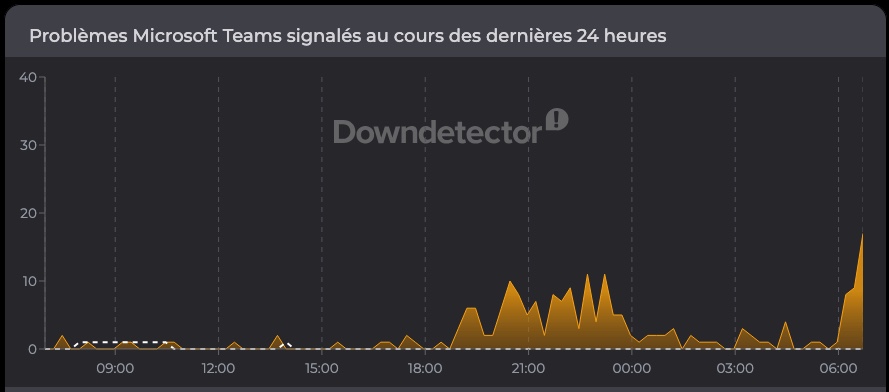
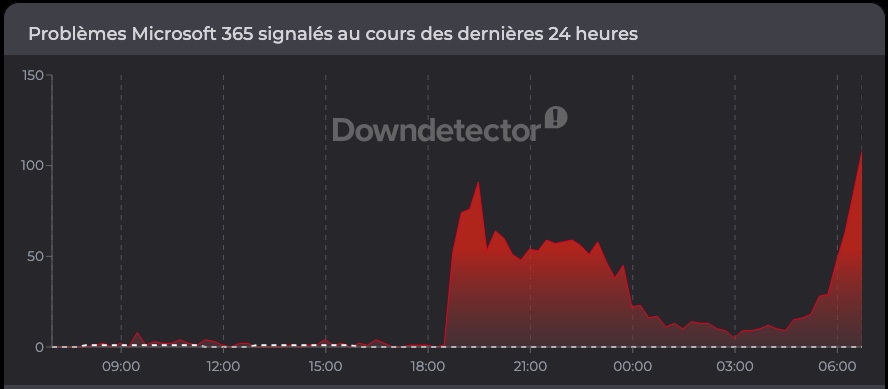
Servers going down, then going down again
So how can this outage be explained? Microsoft initially cited high load on part of its infrastructure across multiple regions. The diagnosis later evolved. "We determined that the elevated load is not related to a spike in traffic, but rather to a number of servers unexpectedly becoming unavailable, which is putting significant strain on the rest of the infrastructure." the company explained on X. In other words, servers are failing one after another.
In the evening and throughout the night, Microsoft provided more details about the observed behavior. The affected servers are failing their automated health checks, causing them to be removed from the active server pool. According to Microsoft’s technical teams, a process responsible for establishing secure connections is becoming overwhelmed to the point that the server stops processing requests. Worse, servers brought back into service can become unavailable again as soon as they start receiving traffic once more.
To regain control of the situation, Microsoft blocked all deployments, redistributed traffic globally, restarted servers, and even went as far as restoring an older configuration on some servers. Could a configuration error be behind this chaos? At 8:43 p.m., Microsoft mentioned a possible link to a recent change in a component, before stating at 8:58 p.m. that it had found no recent change coinciding with the start of the incident. Yet at 10:31 p.m., the Redmond company was considering rolling back a few recent configuration updates. That trend was confirmed at 2:12 a.m., when Microsoft said it had begun rolling back "a recent network configuration change" that does coincide with the start of the impact.
Where things stand on Friday morning
In its latest update on incident MO1550821, published at 6:43 a.m., Microsoft says it is pursuing several leads to identify the origin of a traffic surge and restore the affected servers. A little earlier, the U.S. company reported partial recovery in some regions. Microsoft is also trying to add capacity, including virtual machines, to relieve its infrastructure, but some machines remain stuck in a degraded state.
No restoration timeline has been announced, but Microsoft promises a report detailing the root cause once the incident is under control. Regarding the possibility of a cyberattack, "at this time, we are not aware of any malicious activity causing this incident.", Microsoft says.
According to Microsoft’s continuously updated list, here are the main current impacts:
- Exchange Online: access to mailboxes may fail from Outlook on the web, the Outlook desktop app (MAPI), mobile apps (ActiveSync) or applications using the REST API, and email delivery may be delayed.
- Microsoft Teams: joining a call or meeting, group chats and channel messages work, but Exchange-related features fail (scheduling and editing meetings, invitations, creating live events).
- Defender for Office 365: links rewritten by Safe Links (the feature that checks every link at click time) may no longer open, quarantine release may fail, and message trace data may be delayed.
- Purview and Intune: data loss prevention (DLP), sensitivity labeling and eDiscovery searches are disrupted, while device enrollment and compliance may have been intermittently affected.
- Copilot: the chat may fail to load or may no longer access emails, calendars and files.
On its status.cloud.microsoft page, Microsoft also reports disruptions to its consumer services, including Outlook.com, OneDrive, OneNote, To Do, Teams and Microsoft 365 for the web.
It’s shaping up to be a difficult day for Microsoft tool users... Friday the 13th effect?