www.it-connect.fr


I Failed the CCNA Three Times in an Intensive Training Program: Damien Soulages, the Founder of Formip, Tells His Story
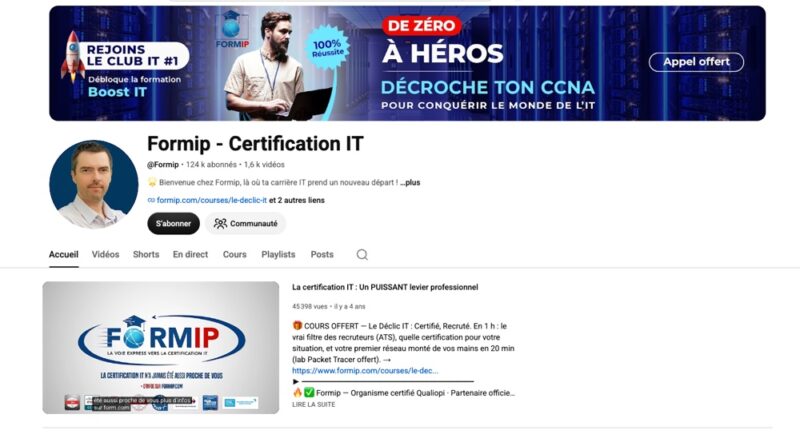
Three CCNA failures, five years of attempts, and more than 20,000 euros spent on in-person training. That’s where Damien Soulages, founder of Formip, started. Today, his YouTube channel has more than 100,000 subscribers, and his guided learning paths boast a first-attempt CCNA pass rate of over 90%. More importantly, his story led him to a conclusion that will resonate with anyone feeling stuck in their job or preparing for a certification: the problem was not his ability, but the method.
I spoke with Damien and asked him a set of questions about his story, what pushed him to create Formip, and why his approach is different. Here’s what came out of that conversation, and why his method may be of interest to you.
Five Years, Three Courses, Zero Certifications
Damien was a telecom technician when VoIP made ten years of skills obsolete. "Networks literally ate telecom. I had to relearn a profession from scratch: computer networking.", he explains.
To get there, he asked for a training course at every annual review. The same course each time, and it was always the same format. "Two weeks of intensive in-person training, billed at 8,000 euros, CCNA voucher included. And I was working a lot outside of work to get it. But nothing."
A program that would normally represent more than 300 hours of training, compressed into ten days. And a mechanism Damien describes as perverse: "You’re handed a 400-euro exam voucher, valid for 3 months. So in order not to throw that virtual money in the trash, you take the exam even when you know very well you’re not ready. You head straight for failure, fully aware of it." - Across every session he attended, not a single participant passed the exam.
His third attempt, called a "CCNA FAST" and priced at a handsome 5,000 euros. The same program, this time in one week, which dropped him straight into the second week of the training he had already taken twice. "I was sickened. And exhausted."
Beyond the repeated disappointments, the problem seemed deeper. Several anecdotes he shared with me clearly show that something was off: one trainer falling asleep during a Packet Tracer lab, another announcing from the very first minute that everything he was about to teach was obsolete, because the commercial side didn’t have an up-to-date catalog.

The Wake-Up Call: What If the Problem Wasn’t Me?
After those failures, Damien began to doubt himself. « I honestly thought I had a problem. That my brain was running slow. » Then came the question that changed everything: what if the problem was the method?
Over those five years, he didn’t stop at classroom training: forums, American online courses, official Cisco books (« those huge textbooks written in tiny print, to be read with a box of ibuprofen next to you »). When he finally passed the CCNA, just barely, the conclusion was clear: « It was clearly not the two weeks of in-person training repeated three times that made the difference. It was the regular work, spread out, at my own pace. »
He also sees intensive training as intellectual force-feeding, with a pace designed only for the trainer. Yet it should be the other way around, shouldn’t it?
He points out a paradox that I find very accurate. Training programs that prepare students for a state diploma last 9 to 15 months, follow curricula updated about every five years, and have high pass rates (91.6% for the 2025 baccalauréat according to DEPP). CCNA prep, which is more demanding and updated much more frequently by Cisco, lasts two weeks. Go figure.
What Learning Science Says
What I appreciate in Damien’s approach is that it’s not based on a hunch. He researched how memory works and applied that knowledge to the CCNA. That helped him understand three things:
- Retention: the brain forgets very quickly what it doesn’t reactivate; that’s the forgetting curve described by Ebbinghaus as early as 1885 and reproduced ever since. « Cramming subnetting for 8 hours on a Saturday is the best way to have forgotten everything by the following Wednesday. »
- Spacing: revisiting a concept at regular intervals anchors the information far better than a single massive session (Cepeda et al., 2006). That’s what explains the Formip video format: 5 to 12 minutes max. « Not one-hour videos where you have to sit through the full 60 minutes again just to find one gem. »
- Active practice: self-testing helps you retain information better than rereading (testing effect, Roediger and Karpicke, 2006), and active learning outperforms lecture-based instruction (Freeman et al., PNAS, 2014). By contrast, rereading and highlighting are among the least effective documented techniques (Dunlosky et al., 2013). Hence the alternation of short videos, illustrated lessons, quizzes, and hands-on labs. « You learn by doing, not by watching. Otherwise, that’s called Netflix. », he says.

How That Shows Up in Formip Learning Paths
The central pillar of the Formip learning paths is hands-on work validated by a trainer. « Simply having to show your work to someone massively increases the likelihood that you’ll take action. »
Each chapter opens with guided practice, step by step, to remove the fear of the tool before everything is even fully understood. The full lesson is then delivered, followed by an unguided lab: « That’s when you have to make your brain work, make mistakes, start over, dig around. That’s how it sticks. Not by having everything handed to you on a silver platter. », Damien says.
The second challenge is reducing drop-off, which he describes as the number one plague in IT training. For several years now, Damien has offered what he calls discovery calls. He has done hundreds of them with people interested in computer networking and CCNA success. According to him, three causes show up every time:
- Lack of empathy from trainers: all Formip trainers are made aware of this, and their written responses go through AI-assisted proofreading.
- Getting stuck on labs: where many providers require students to succeed without help, Formip gives the solution, explains it, and simply asks the learner to do the exercise again. In other words, persistence is the key.
- Isolation online: a dedicated WhatsApp channel, weekly check-ins, and a community of learners and trainers.
The Numbers, Without Polishing Them
The numbers highlighted by training providers always deserve to be unpacked. So I asked him what the reality was at Formip.
The 25,000 people trained? « Those are the people who took my video courses on Udemy, content that I now offer for free on YouTube. So no, they’re not all certified, and many dropped off along the way. »
The guided learning paths, with validated labs and human follow-up, are a different scale altogether: around 500 people trained and about fifty CCNAs earned. A ratio that can be explained by the absence of a deadline. « If the person is ready in 2 months, great. If they need several years, that’s okay. » - Formip’s record is one and a half months, and three months for someone in the middle of a career change. Compared with five years for Damien, let’s remember that.
The 90% first-attempt pass rate is explained by a deliberately selective filter: nobody is registered for the exam without having validated all their labs and passed every practice assessment. « So yes, we don’t take unnecessary risks. But there is no way we’re going to send a learner into the meat grinder so they can get hit with a failure and lose their motivation. It’s exactly the opposite of the system I went through. » - In order for exam fees to be covered (the famous CCNA voucher), the student must also meet all of those conditions.
To put those figures in perspective, major open online course platforms show about 3% completion across more than 12 million enrollments analyzed by MIT and Harvard (Reich and Ruipérez-Valiente, Science, 2019).
Three Tips If You’re Preparing for a Certification This Month
I asked him for three things to change starting tomorrow in his revision method. His answer boils down to one word repeated three times: practice. « In real estate, it’s location, location, location. In IT, it’s practice, practice, practice. »
To build on that:
- Get help from an AI: by nature, it’s patient, and it can rephrase as many times as needed without ever judging you.
- Stop memorizing everything by heart: it’s completely useless, except for making you doubt yourself and lose motivation.
- Stop sitting through 8 straight hours: if your brain checks out after 2 hours, the next 6 go straight into the brain trash can.
On lab work versus pure theory, there’s no possible debate: « Would you let yourself be operated on by a surgeon who has only read books and never practiced? The brain is wired for practice. » - Fair point, and besides, practice is what we enjoy, isn’t it?
Who Is Formip Not For?
A deliberately uncomfortable question, answered directly: « For those who think all it takes is signing up to earn a globally recognized certification. » Damien is looking for people with a defined goal, discipline, and the ability to be coached and challenged. « You don’t come to Formip just to get trained. You come to be transformed. »
As for AI, his position is clear: it helps enormously those who have adopted it, and gives a false sense of mastery to those who use it to cheat themselves. « An AI won’t nudge you back on a Sunday night when you’re discouraged. An AI won’t validate your practical work. At Formip, the rule is simple: AI to understand, humans to validate and to keep you from giving up. »
He illustrates the impact on the job market by talking about one of his students: a stuck support technician, uninteresting tasks, no prospects for advancement. He followed the Network Administrator path just as his daughter had been born and while holding down another job. In 2 months, he passed the CCNA on the first try. Three weeks later, he had three job offers, including one near home with a much better salary. And today? He’s the one guiding people during our discovery calls. He lived through that transformation, so he’s in a much better position than anyone else to advise those who want the same thing. Makes sense.
Interested in Training?
If Formip’s approach interests you, note that two career paths are offered:
- IT Support Technician (CompTIA A+)
- Network Administrator (Cisco CCNA)
In all cases, the entry point is a free discovery call with someone who works in IT every day, not a salesperson. Several financing options are available, and they are discussed during that call.
In addition, Formip runs a real community, with weekly webinars (useful for asking questions live) and free content available on the YouTube channel and the formip.com blog. Damien has also published two professional books covering the full CCNA and A+ curriculum on Amazon:
- Network Administrator: You’ll Love This Career Full of Opportunities
- IT Support Technician: You’ll Love This Promising Career
If you failed a certification thinking the problem was you, Damien’s story may be the reason you ask the question differently.