www.it-connect.fr


U.S. Data Center Capacity Dwarfs 14 Countries Combined
102.6 GW. That is the data center capacity the United States would reach if all ongoing projects come to fruition, more than fourteen other nations combined. A chart is circulating widely right now to illustrate this staggering gap.
The chart below is based on figures from real estate firm Cushman & Wakefield, analyzed by Antony Adshead of Computer Weekly in a feature published on April 15, 2026. If it is resurfacing today, it is because it was reused on September 18, 2026 in a report from the Centre for British Progress think tank focused on the United Kingdom's AI strategy. One look is enough to see it: U.S. data center capacity is phenomenal, especially when projected growth is taken into account.
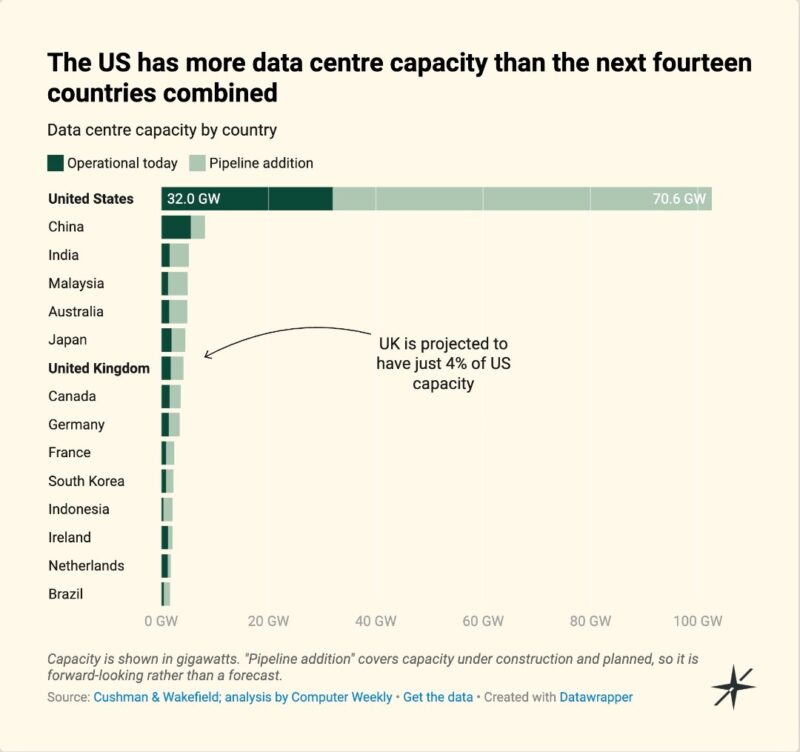
In practical terms, the United States currently has around 32 GW of operational capacity, plus another 70.6 GW tied to construction or ongoing projects (although, notably, some have not yet received all required permits). Far behind, really far behind, come China, India, Malaysia, Australia, Japan, the United Kingdom, and then a series of countries including Germany and France. Even when added together, they still do not surpass the United States.
To put the scale into perspective, Cushman & Wakefield estimated that all of EMEA had 11.4 GW of operational capacity at the end of 2025. Europe, the Middle East and Africa combined therefore account for barely more than one-third of the existing U.S. capacity.
A gap that is likely to widen further
U.S. capacity would triple if the entire pipeline materializes (+221%). The United Kingdom, meanwhile, would grow from about 1.7 GW to nearly 4 GW and drop from 4th to 7th place globally, overtaken by India, Malaysia and Australia. "If Britain does not build compute capacity, someone else will," the report's authors argue.
Even though the United States is impressive on paper, it is not the fastest-growing market when looking at raw growth:
- Indonesia: +451%, reaching 2.1 GW.
- Malaysia: +279%, up to 4.87 GW.
- Australia: +224%, reaching 4.8 GW.
- India: +222%, for a total of 5.1 GW.
How can this rush to build data centers be explained? AI, yes. But not only that. While AI is probably the main driver behind the surge, there is another explanation: sovereignty. More and more countries want to keep their data on home soil, which forces them either to build locally or to ask hyperscalers to do it. Data sovereignty is also measured in megawatts.
What about France?
In the chart, France sits in the lower half of the ranking. Computer Weekly also cites France, the United Kingdom and Germany among the European markets running into electricity supply constraints, with grid connection delays measured in years.
Yet, according to figures published by RTE: "In May 2026, RTE had reserved nearly 18 GW of capacity for around 80 projects. At the end of 2024, there were around forty projects totaling about 5 GW," the report says. There is clearly real momentum.
However, reservation should not be confused with consumption. RTE specifies that data centers connected over the past two to three years are only using, on average, 20% of the power they requested, and that operators are aiming for 10 to 15 years to reach around 80%. Today, France's roughly 300 data centers consume about 10 TWh per year, or nearly 2% of the country's total electricity consumption.