www.it-connect.fr

Discord Rolls Out Age Verification Without ID or Selfie
More than 90% of Discord users should never have to prove their age. That is the promise of the new verification system the platform is rolling out worldwide this week, using methods that require neither an ID card nor a selfie. So how does it work?
As a reminder, Discord had already announced global age verification earlier in 2026. As with every announcement involving age proofing, the news was met with a frosty reception. Some users even wanted to leave Discord altogether: I had also published an article on Stoat, the open-source alternative to Discord that rode the backlash over identity checks. On February 24, 2026, Stanislav Vishnevskiy, Discord co-founder and CTO, backtracked by pushing the worldwide rollout to the second half of the year.
Here we are.
On September 22, 2026, Discord introduced the new version of this controversial system. To justify it, Discord points to the growing number of age-verification laws, which have already forced it to deploy checks in Brazil and Texas.
How does Discord estimate your age range?
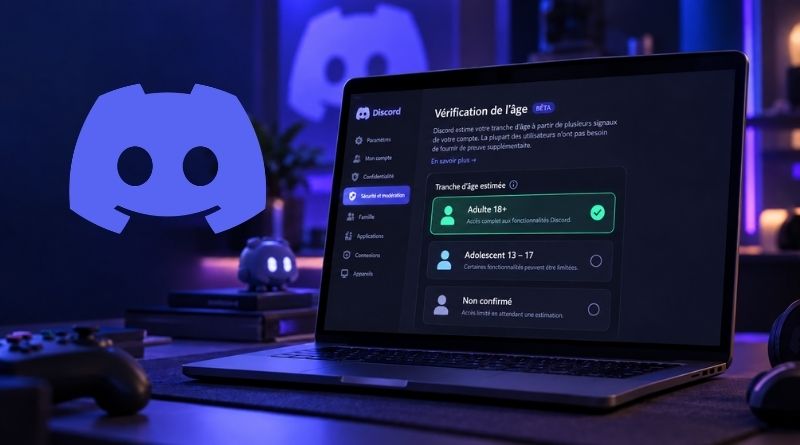
Every account is now automatically placed into one of three categories: adult (18 and over), teen (13 to 17), or unconfirmed when the signals are insufficient. This is especially common with new accounts.
The estimation model relies on account-related signals: the servers, communities, and games associated with the account, overall activity level, and account age. "We do not look at your messages, calls, or any other content to decide your age range," Stanislav Vishnevskiy says. Discord claims it achieves accuracy comparable to biometrics and has published a technical article explaining how the model works.
"Because the model is based primarily on social graph structure rather than individual attributes, it is highly resistant to manipulation. Changing a account's position in a social graph requires sustained, organic interactions that are difficult to create from scratch or reverse engineer.", warns Discord.
If you are classified as an adult, nothing changes. The process is transparent for you. For teen accounts, however, three sets of protections and restrictions apply:
- Contacts: messages from people who are not your friends go into message requests, and a warning appears before accepting a stranger's friend request.
- Content: sensitive images are blurred or blocked, and age-restricted servers, channels, and bot commands become inaccessible.
- Visibility: the full profile and activity status (for example, the game you are currently playing) are visible only to friends and members of small servers.
Unconfirmed accounts receive the same restrictions, except for profile visibility. What you need to understand is that private messages, voice calls, and unrestricted servers remain accessible to everyone. Your age range will be visible in user settings (the rollout is underway).
New ways to prove you are an adult
What if you are an adult but the system places you in the unconfirmed state? That is where you can manually confirm your age. This is also where video selfies and ID scans will be offered. However, Discord has planned several alternatives:
- Bank card: k-ID sends the information to Stripe, which verifies that the card belongs to an adult. Neither k-ID nor Discord can see the banking details, but Stripe keeps the last four digits because of its payment processor obligations. A small temporary charge may be made and then refunded within 14 business days.
- App Store and Google Play: Apple or Google share only the age range, not the date of birth.
- Google Wallet: verification relies on a passport already stored in the wallet. Only passports from Brazil, Singapore, Taiwan, the United Kingdom, and the United States are supported: no French passport, then.
- AgeKey: a reusable age credential across multiple services.
The options available vary depending on region and device. In all cases, Discord says it receives only the age range. Still, some methods may not please users: the good news is that the user gets to choose.
Discord has therefore chosen to rely on an age range rather than an identity. That is better. It is also the approach Microsoft has chosen with the age APIs that will let Windows 11 tell apps whether you are a child, teen, or adult.
It remains to be seen in practice how accurate Discord's new model really is.