www.it-connect.fr

Claude Fable 5 Returns Worldwide as Anthropic Launches Sonnet 5
Suspended barely three days after launch, Claude Fable 5 is about to resurface! On Wednesday, July 1, 2026, Anthropic will restore access to its most powerful public-facing AI model, after the U.S. government lifted the export controls it had imposed. At the same time, the AI giant unveiled Claude Sonnet 5, billed as nearly as capable as Opus 4.8, but far less expensive. Here’s what we know.
Table of Contents
Fable 5 returns worldwide on July 1, 2026
On June 30, Anthropic announced on X, before elaborating in a blog post, that the U.S. Department of Commerce had lifted the export controls affecting its two most advanced models, Fable 5 and Mythos 5. "We have been informed that the Department of Commerce has lifted the export controls on Claude Fable 5 and Mythos 5. We will begin restoring access tomorrow and will publish an update shortly," Anthropic said.
The Fable 5 AI model will be available again from July 1, worldwide, on Claude, Claude.ai, Claude Code and Claude Cowork. Anthropic clarifies the rollout terms, which remain unchanged (except that the "trial" phase has been extended):
- For Pro, Max, Team and some Enterprise plans, Fable 5 is included at 50% of weekly usage limits until July 7,
- After that date, access will switch to a usage credits system (usage credits);
- Access via AWS, Google Cloud and Microsoft Foundry will be restored "as quickly as possible".
If you check right now, you won’t see Fable 5 yet: because of the time difference, it should arrive later in the day if you are in France. Mythos 5, on the other hand, remains limited to a closed circle. Anthropic has restored access for a set of U.S. organizations, after receiving the green light from the government on June 26, and continues discussions to expand the list of Project Glasswing partners. This model, more powerful and equipped with lighter safeguards that make it possible to identify security flaws, is not intended for the general public.
As a reminder, the two models were launched on June 9, 2026, before Anthropic was forced to cut off access to Fable 5 and Mythos 5 on the orders of the U.S. government three days later. The directive required access to be restricted to foreign nationals. Since it could not verify users’ nationality in real time, Anthropic was forced to suspend access for everyone. An episode that echoes the questions raised when Anthropic mentioned age and identity verification for its users starting July 8.
A jailbreak workaround triggered the block
What happened to justify such a decision? According to Anthropic’s post, the decision to block access to Fable 5 came after an Amazon researchers’ report uncovered a method for bypassing Fable 5’s safeguards: by prompting it to identify software vulnerabilities and, in one case, to generate code demonstrating the exploitation of one of them.
However, as Anthropic had previously suggested, Fable 5 was not needed to identify the vulnerabilities in question. With less advanced models such as Opus 4.8, GPT-5.5 or Kimi K2.7, it was possible to spot the same vulnerabilities. In other words, this did not expose any offensive capability unique to Mythos.
Nevertheless, Anthropic was forced to add extra safeguards to reassure the U.S. government. Without them, Fable 5 would remain locked in a box. From now on, the AI can block the technique described by Amazon in more than 99% of cases. The trade-off: a more sensitive AI, and therefore more false positives on legitimate development or debugging tasks.
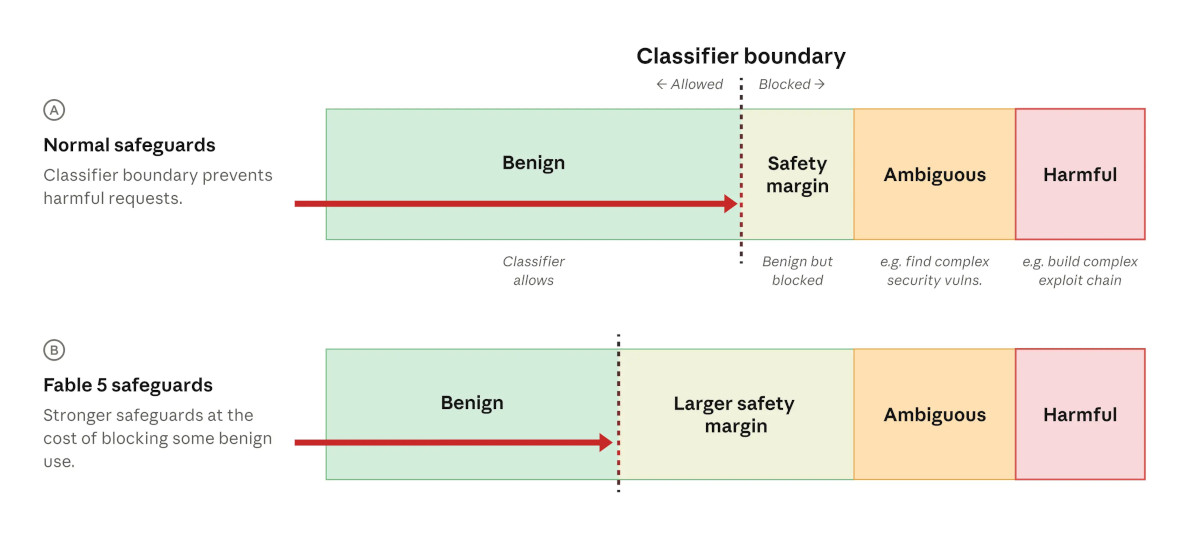
Anthropic is using this opportunity, together with Amazon, Microsoft, Google and other Glasswing program partners, to propose a common framework for assessing the severity of jailbreaks (techniques that bypass a model’s protections). This framework would be based on four criteria:
- The capability gain provided to the attacker compared with existing tools,
- The scope of that gain, meaning the number of distinct offensive tasks affected,
- The ease of weaponization, meaning the amount of human effort required to turn the jailbreak into an attack,
- The discoverability, or how easy the technique is to obtain.
At the same time, Anthropic is committing to deepen its collaboration with the U.S. government: "We will share the new safeguards we put in place in response to these threats so they can undergo independent testing. We will also provide our threat intelligence reports to our government partners before publication and participate in the interagency vulnerability information-sharing center established under Section 2(d) of the Executive Order of June 2."
Claude Sonnet 5 arrives alongside it
In addition to announcing the return of Fable 5, Anthropic launched another model: Claude Sonnet 5, described as "the most agentic Sonnet model yet". This version focuses on autonomy: the ability to build plans, operate tools such as browsers or terminals, and carry out multi-step tasks without supervision. In this respect, Sonnet 5 moves closer to Opus-class models.
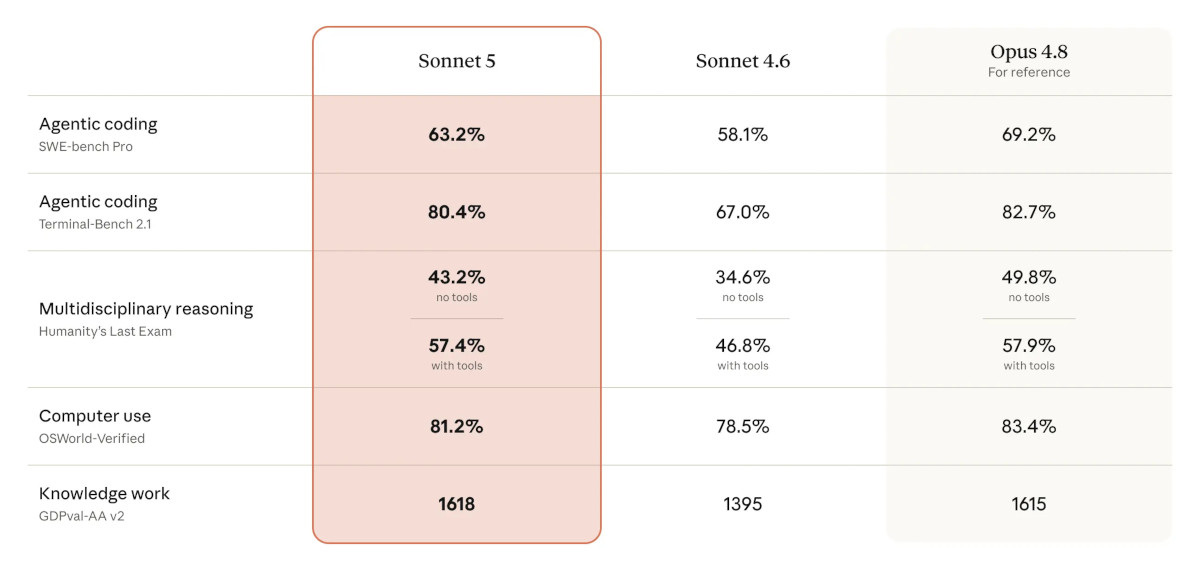
But there is one notable difference that has a direct impact on your wallet: the main selling point is the performance-to-price ratio. Anthropic says Sonnet 5 is close to Opus 4.8, at a significantly lower cost.
On the API side, Sonnet 5 (claude-sonnet-5) is being launched with a favorable introductory price, valid until August 31, 2026, before moving to its standard price. The positioning becomes clearer when compared with Opus 4.8:
| Model | Input (per M tokens) | Output (per M tokens) |
|---|---|---|
| Sonnet 5 - introductory pricing (until August 31, 2026) | $2 | $10 |
| Sonnet 5 - standard pricing (from September 1, 2026) | $3 | $15 |
| Opus 4.8 | $5 | $25 |
You can use Sonnet 5 right now, since it is available through Free and Pro plans, as well as for Max subscribers.