www.it-connect.fr


Ubuntu Kernel Updates Are Speeding Up: Canonical Moves to Weekly Releases
Linux kernel 7.2 fixes more than 1,500 vulnerabilities, which is huge. Even more striking, there were around 500 per release up to Linux 6.19. Faced with this wave fueled by AI, Canonical has decided to change its plans: Ubuntu's kernel release cadence is evolving, and above all, it is accelerating. Here is what is changing.
As a reminder, since August 2023, the Ubuntu kernel team has been operating on a 4/2 cycle. This means that a stable update (Stable Release Update) is released every four weeks, with an intermediate release after two weeks reserved for urgent security patches and fixes. It is clear that this model is reaching the end of its life and is no longer aligned with current needs and trends.
In a new article, Canonical announces a move to a unified cycle with a release every two weeks. The vendor explains that LLMs and specialized AI agents have turned bug hunting into a largely automated process. Another factor is that Linux kernel developers assign CVE identifiers themselves, and they have assigned them to thousands of bugs, considering that almost every bug identified in the Linux kernel can have a security impact.
Just look at the graph below to understand how the number of CVEs patched in the Linux kernel has exploded, especially with the 7.X branch. You can see that around 500 CVEs were fixed per release between Linux 6.9 and 6.19, more than 1,000 since Linux 7.0, and more than 1,500 for Linux 7.2. The 2,000 mark is not far off... Even if many flaws are not truly dangerous, the amount of work to process is very real.

A Two-Week Cycle, But a New Kernel Every Week
With the new cycle, each kernel takes two weeks to move from preparation to release. But Canonical does not wait for one kernel to be released before starting the next one: while one kernel is in the testing phase, the next one is already being prepared. The result is that a new kernel will be released every week.
- Continuous integration : fixes are integrated as they come in, then the source tree is frozen at a cutoff date before the first automated checks.
- Week 1, preparation : package builds and basic tests are run to verify that the kernel boots and works without any critical issue. At the end of this stage, builds are published in the
-proposedrepository. - Week 2, certification : in-depth testing, including hardware certification (Ubuntu Certified program), distribution integration, and regression testing.
- Release : the kernel is published as an update.
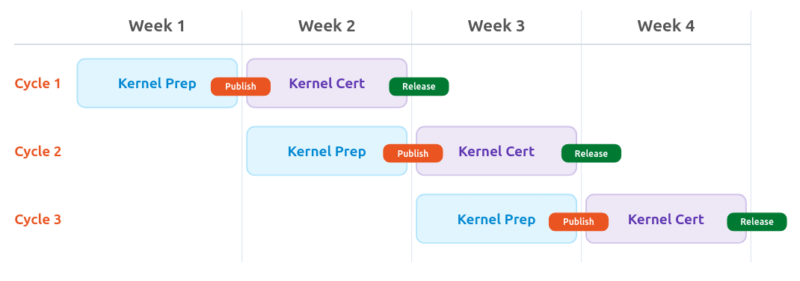
The transition will happen in two stages, as Canonical explains on the Ubuntu Discourse forum. Two two-week cycles will follow one another starting on September 28 (so this is already underway) and October 12, 2026, and then the new pace based on the cycles mentioned above will begin on October 26, 2026.
Should We Be Concerned?
Should we expect a drop in release quality as the pace increases? It is reasonable to ask that question. Canonical, for its part, says it is not sacrificing the testing phase. "It is not possible to speed up releases while thoroughly testing each release candidate.", the vendor admits. For environments that cannot wait, the -proposed repository, updated every week, makes it possible to retrieve candidate kernels and run their own validation tests. However, these kernels have only passed compilation and basic tests. They are therefore intended only for teams capable of validating them themselves.
Canonical is making these changes to allow admins to benefit from security patches as quickly as possible. We have seen in recent months that this can matter, especially when several critical vulnerabilities are disclosed in a short time.
From an operations standpoint, this change also affects maintenance, because one kernel per week can potentially mean one reboot per week... Even though Ubuntu has Livepatch, it is reserved for Ubuntu Pro. This version is paid for professionals and free for up to 5 machines for individual users.