www.it-connect.fr


Proton Apologizes and Says Its Internal AI Tools Will Soon Be Open Source
After the 404 Media investigation, Proton breaks its silence: denials, apologies, and a promise to open up the curtains on how it uses AI. Here’s what you need to know.
Last Friday, I published an article about 404 Media’s investigation into the pressure Andy Yen allegedly put on Proton to push AI. On the menu: a CEO who reportedly called a request for a penetration test “loser mentality,” a CTO who said 90% of the code was written by AI in October, and interviews scheduled from November 4 to 11 that could affect employees’ job security. Proton’s reputation took a hit after those revelations.
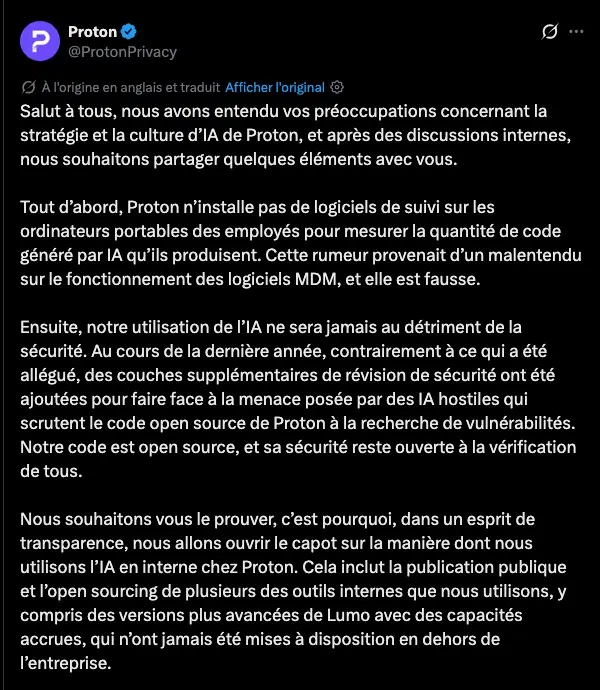
On Friday, October 30, late in the day, Proton finally reacted publicly, with a long message posted on its official X account. "We have heard your concerns about Proton’s AI strategy and culture." the Swiss vendor wrote in the opening lines. Denials, commitments, and then apologies: it covered all the bases.
Proton promises to show how it uses AI
Proton says it wants to "lift the hood" on its internal use of AI, with concrete actions planned:
- Open-source internal tools: several internal tools will be released as open source, including more advanced versions of Lumo, Proton’s AI assistant.
- Code review processes: Proton will publish how code reviews and security testing are carried out (but isn’t that for losers? The statement does not revisit that point).
- The AI policy: Proton will explain where AI is allowed, where it is not, and why.
"Instead of only being able to review the final open source code we produce to verify its security, you will also be able to assess how that code was created." Proton promises. The Swiss company also says its use of AI will "never come at the expense of security", and claims it added extra layers of security review over the past year.
The message posted on X ends with an apology: "We know we have not lived up to the high standards you have every right to expect from us, and for that, we can only apologize. We are sorry." Proton concludes. However, no timeline was provided, and nothing was said about the license for the future tools. More importantly, I wonder whether Proton would have shown this kind of transparency overnight without 404 Media’s revelations.
Denials that deserve to be put into context
Proton writes that it will not re-interview its staff about their use of AI. That is true... since Friday. The internal email from October 26 had indeed announced them, and according to 404 Media, it was Andy Yen himself who canceled them on October 30 during an approximately two-hour all-hands meeting. "I want to personally acknowledge that there was a communication failure on my part", he reportedly said, before warning: "Going forward, I’m going to keep pushing." CTO Bart Butler was more blunt: "We screwed up, and we know it.", he reportedly said.
The same nuance applies to jobs: Proton says no positions were cut because of those interviews. It is hard to claim otherwise, since they never took place. According to 404 Media, however, Andy Yen announced a reorganization next month, with a "redistribution of talent," but without any job losses related to AI.
As for the software that would measure how much code is generated by AI, Proton denies installing it on employees’ laptops and points to a misunderstanding about how an MDM tool works. But the denial concerns the tool installed on endpoints, not the measurement itself. GitHub Copilot’s admin console, for example, provides this kind of statistics without any local agent. In itself, if the CTO is able to cite the 90% figure regarding the share of code written with AI, then there must be some measurement somewhere.
What do you think?