www.it-connect.fr

Microsoft Unveils Intelligent Terminal, a New AI-Powered Console
At Build 2026, Microsoft unveiled Intelligent Terminal version 0.1, an experimental open-source fork of Windows Terminal. What’s the point of this extra terminal? Here are some initial answers.
Table of Contents
A Terminal with Access to AI Agents
Windows Terminal works well and has established itself as the go-to terminal on Windows. It is built into Windows, customizable, and pleasant to use every day. Still, Microsoft has decided to create a fork: Intelligent Terminal. Since this is a fork, the new project inherits the interface and features of its predecessor.
If Windows was replaced by Intelligent in the name, it is because this project is about artificial intelligence, and more specifically AI agents. At the heart of Intelligent Terminal is the agent pane. This is a panel anchored at the bottom of the window (which you can move), contextual, and fully configurable.
When you are working in your Terminal, it makes interactions with AI easier. For example, instead of copying an error, opening a browser, and browsing forums to find a fix, you can directly ask an AI agent. You can ask it to explain an error or help you resolve it. What is handy is that if an error is detected (and it will be automatically), all you have to do is click a button or use the Ctrl + Alt + . shortcut to summon the AI.
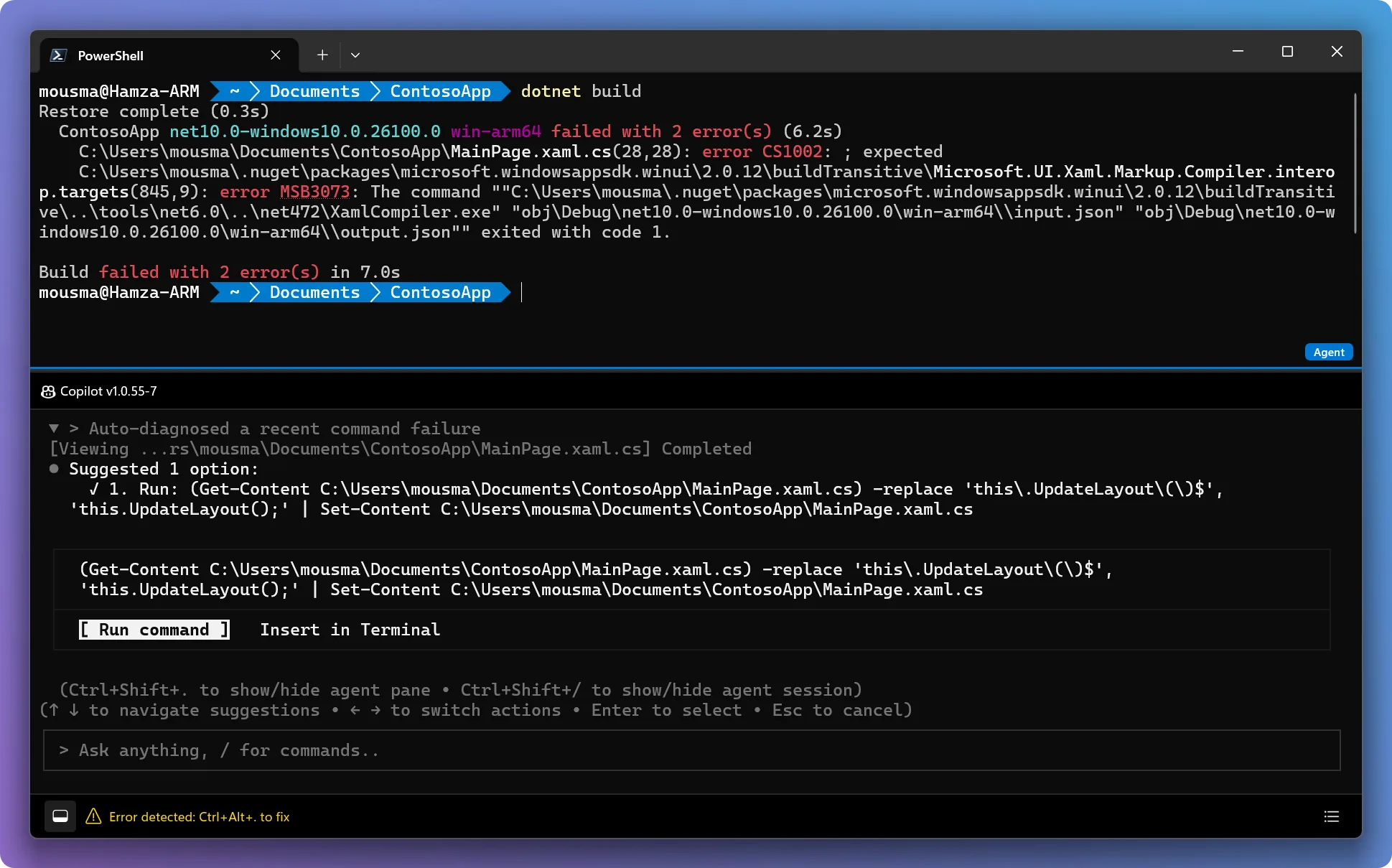
The value of Intelligent Terminal is that it continuously retains ready-to-use context about your console output. This allows it to immediately understand what you need help with. By default, the AI agent that is invoked is GitHub Copilot CLI, but the terminal is compatible with any agent that follows the ACP (Agent Client Protocol) protocol. This makes for a flexible approach, including compatibility with AI tools running locally, while still working out of the box thanks to GitHub Copilot CLI.
"If the agent needs to perform multiple tasks or complex tasks, it will launch background tasks in new tabs so that your active terminal window remains in the foreground.", Microsoft explains.
Managing AI Agents with Intelligent Terminal
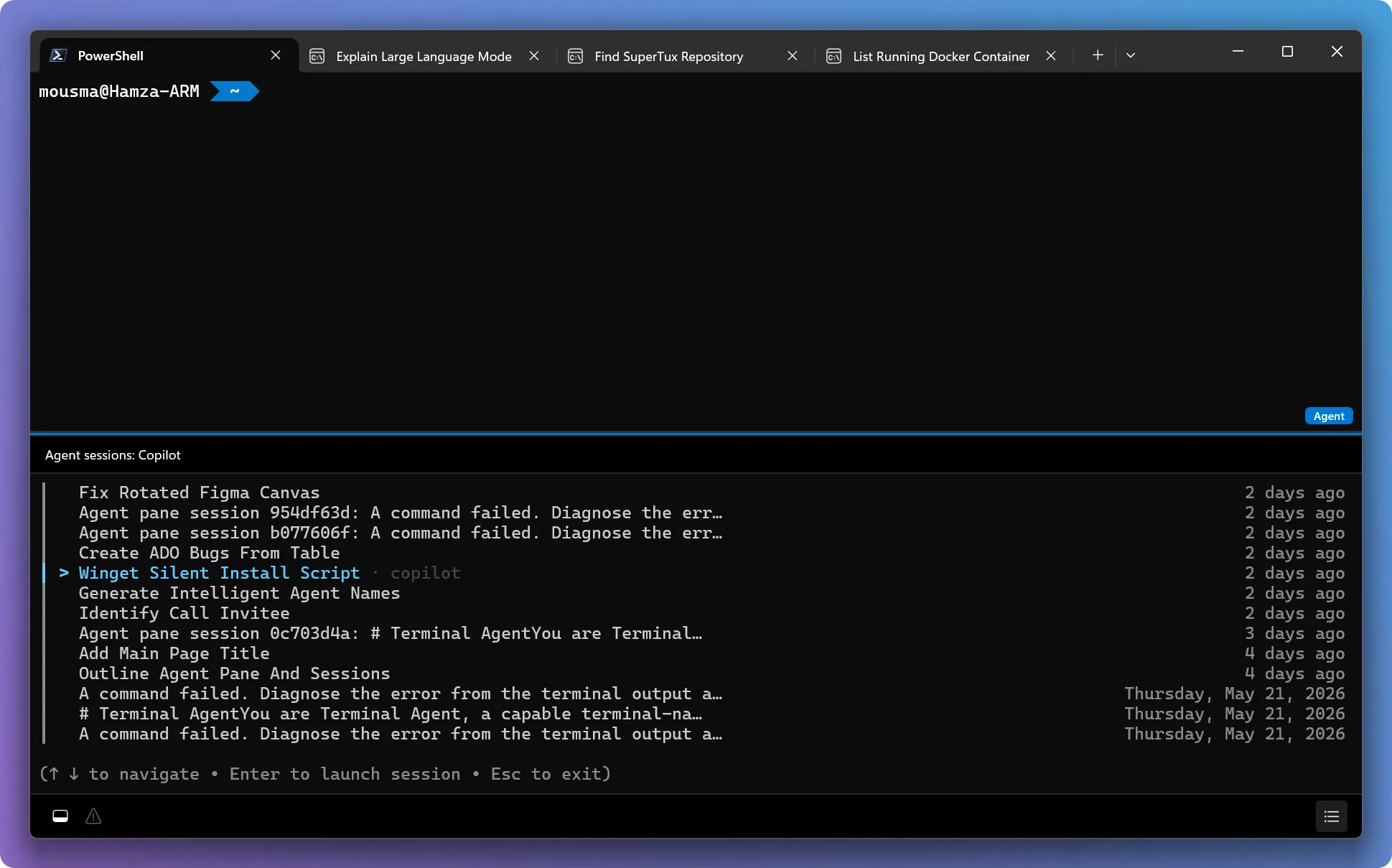
Intelligent Terminal inherits the tab system from Windows Terminal. This means you can have multiple tabs open, each with access to an AI agent. As a result, managing the AI agents associated with your consoles can quickly become complicated. To address this need, Intelligent Terminal includes an agent management panel.
It centralizes the status of all active agents and lists past sessions in the form of a history. This makes it possible to monitor the activity of a long-running task executing in the background and even resume a previous task.
Microsoft also came up with the idea of creating a link between Intelligent Terminal and the Command Palette available through PowerToys. Indeed, it also serves as an entry point for invoking AI by using the ? character followed by your query.
The idea is simple: you are in your Intelligent Terminal tab, you open the Command Palette, and you enter your query. In doing so, the terminal automatically injects the context of the active pane and starts the agent in a background tab without blocking your current session. This lets you launch a task without disrupting your console.
How Do You Install Intelligent Terminal?
Intelligent Terminal is distributed as a separate application from Windows Terminal, and it installs alongside your regular Windows Terminal. It is available via GitHub, the Microsoft Store, and WinGet.
To install it, open WinGet on Windows and run this command:
winget install Microsoft.IntelligentTerminalFinally, note that Intelligent Terminal also marks the end of the Terminal Chat feature previously present in the Canary versions of Windows Terminal. It remains to be seen what the future holds for Intelligent Terminal.
What do you think?
- Discover Coreutils for Windows - Build 2026 news