www.it-connect.fr

Microsoft Teams Opens the Door to Deepfake Detection: What Changes in November
Seeing and hearing someone on a video call is no longer enough to prove their identity. AI generation tools can now produce convincing voices and faces, including in real time. To address this, Microsoft plans to integrate third-party deepfake detection solutions into Teams.
Announced on October 2, 2026 in the Microsoft 365 Roadmap under ID 573451, this feature is currently marked as "In development" and general availability is scheduled for November 2026. This article is a chance to review the announcement, its limitations, and the IT-side preparations.
AI generation is moving faster than our instincts
Audio and video generation tools are evolving at a rapid pace. Cloning a voice from a short sample or replacing a face live has become accessible and fast, especially with artificial intelligence. The malicious uses are varied:
- CEO fraud and urgent transfer requests;
- Fake candidates in remote interviews;
- Fake technical support to gain remote access;
- Impersonating a customer or supplier during an external meeting.
Microsoft Teams is a direct target. According to Microsoft's second-quarter 2026 email threat report (source), weekly malicious voice call attempts on Teams reached nearly ten times the mid-2025 level by the end of June. Voice phishing attempts rose by around 80% since January 2026. The more models improve, the less enough the ear and eye become. Human checks lose effectiveness. Automated, stronger detection is therefore becoming relevant to counter these threats.
What Microsoft is announcing
The principle behind this change is simple: certified third-party vendors analyze the audio and video of a meeting. They then send detection signals to Teams. Teams displays them and provides in-meeting experiences and controls to organizers and participants.
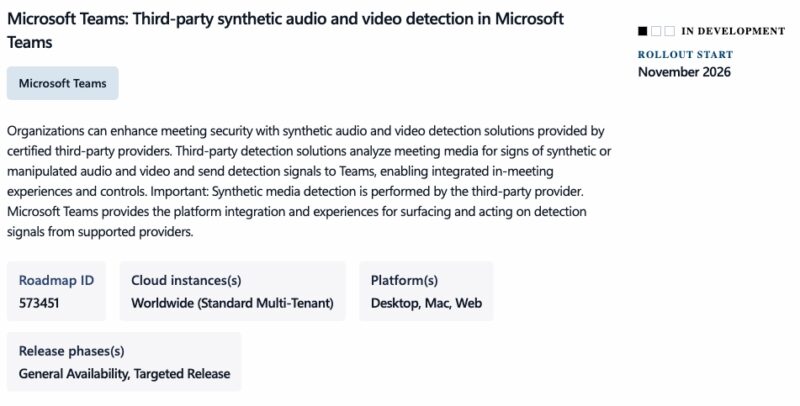
The announcement specifies that this integration will be available across all tenants and applies to all Teams versions and platforms (Windows, Apple, Android, Web).
Several points are still unknown at this stage:
- The list of certified vendors
- The required licenses
- The administration controls
- The exact in-meeting user experience.
And a date in a roadmap is still a schedule that can change at any time.
An architectural choice: Microsoft is not doing the analysis itself
As Microsoft states in its Roadmap: detection is performed by the third-party vendor. Teams provides the third-party service integration and the display of signals. This choice has advantages:
- Free choice of solution depending on the security and regulatory environment
- Rapid innovation, driven by a specialized market
- No dependency on a single detection engine
It also has trade-offs:
- Detection quality varies depending on the vendor
- Selection criteria to define: audio and video coverage, real time, reports, false positive rate
- Meeting streams handed over to a subcontractor
Solutions already exist on the Microsoft marketplace:
- Resemble AI offers real-time audio and video detection, with an integrated Teams app and an optional visible bot.
- Uncovai is currently limited to audio and joins the meeting as a participant.
Nothing confirms at this stage that these solutions will be among Microsoft's certified vendors.
A complement to Impersonation Protection
Microsoft published a second entry the same day, Impersonation Protection (ID 573157). It focuses on identity rather than media. When Teams detects an impersonation attempt, it displays warnings and risk indicators. The goal is to help identify a suspicious organizer or participant.
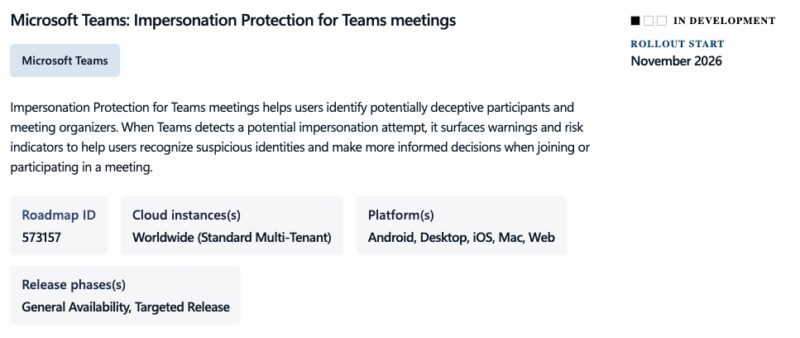
The two features complement each other: deepfake detection flags synthetic or manipulated audio or video, while Impersonation Protection flags a suspicious identity. For now, the roadmap does not say how Teams identifies an impersonation attempt.
Finally, a meeting protection policy has already been rolling out since August. It allows administrators to automatically block identified external bots. If the selected detection solution works with a bot, it will need to be checked to ensure it is not blocked.
Limits and points to watch
In any case, these new features also come with a few limitations:
Probabilistic detection : a detection tool can be wrong in both directions (false alarm or missed threat). Generation and detection are in a constant race. The absence of an alert is not proof of authenticity.
Impact on users : without communication and training, an alert on a legitimate participant can disrupt the meeting. Teams need to know what an alert means and what to do.
Privacy: analyzing voice and image by a third party raises questions about data processing, participant information, legal basis, and retention of results. This must be validated with the DPO. The topic also ties into the AI Act transparency obligations for synthetic content.
The process before the tool: even with active detection, unusual requests must still be verified. This applies to payments, credentials, confidential files, and software installations. A callback on a known channel and dual approval remain the basic reflexes.
Conclusion
Deepfake detection is becoming a security building block in Teams, alongside existing protections. Microsoft is choosing to open its platform to specialists rather than building the detection engine itself.
The announcement comes at the right time. AI generation is moving faster than human instincts. But the tool adds a signal; it does not replace verification or user vigilance. To watch in November: the list of certified vendors, the licenses, and the administration controls.