www.it-connect.fr

Jev: The Textless AI Challenging LLMs with Structured Answers
Launched by startup TypeSafe AI, the Jev model is generating a lot of buzz even though it cannot write a sentence. This model does not generate text, yet its approach is relevant: it chooses from answers you have predefined and assigns a probability to each one. Fast and inexpensive, it could be a game changer when it comes to integrating into software, whether for moderation or classification.
Behind Jev is TypeSafe AI, a San Francisco-based company founded in 2024 by Diogo Almeida, Erik Gafni, and Sasha Sheng. Diogo Almeida is no stranger: at OpenAI, he worked on the methods that made language models capable of following instructions, work that helped pave the way for ChatGPT, as he explains in the official announcement.
A few days ago, TypeSafe introduced Jev (named after economist William Stanley Jevons) as the first representative of a new model category called System One Models. The name was chosen in reference to System 1 described by Daniel Kahneman: fast, intuitive thinking, as opposed to slow, deliberate reasoning (which represents System 2).
Jev Never Responds in Free Text
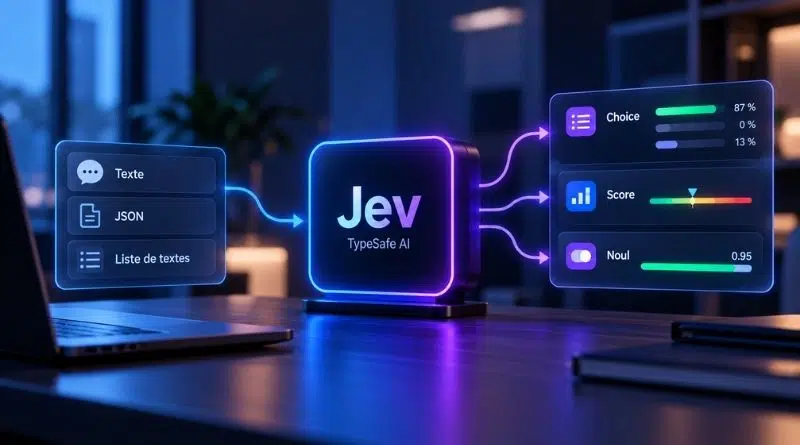
Jev works differently from an LLM like those offered by OpenAI or Anthropic. You send it a state (the state field), which can be a string, a JSON object, or an array of texts, along with one or more typed questions. The model evaluates all questions in parallel, in a single pass (saving time), and returns structured values with probabilities. There is no word-by-word generation, which is an important difference.
Three types of questions, which TypeSafe calls “primitives,” are available:
- Choice : choose one option from a defined list, with a probability per option and a confidence score.
- Score : rate the state on a scale of ordered, described levels, again with probabilities and a confidence score.
- Noul : assess a yes/no statement, with a probability between 0 and 1.
For a support ticket, the response looks like this (example taken from Cloudflare documentation, which offers Jev in its Workers AI catalog):
{
  "model": "jev-1.13.0",
  "answers": {
    "is_urgent": { "type": "noul", "noul": 0.95 },
    "department": {
      "type": "choice",
      "choice": "billing",
      "confidence": 0.8,
      "probabilities": { "billing": 0.87, "sales": 0, "technical": 0.13 }
    },
    "frustration": {
      "type": "score",
      "score": 1.04,
      "confidence": 0.94,
      "legend": { "0": "Calm", "1": "Frustrated", "2": "Very angry" },
      "probabilities": { "0": 0, "1": 0.96, "2": 0.04 }
    }
  }
}
Your code then only has to rely on these values: route the ticket to billing, escalate it if is_urgent exceeds a threshold, or hand it back to a human if confidence is too low. TypeSafe also recommends breaking down a complex decision into several simple questions, then combining the results in code rather than in a prompt.
Beyond how it works, Jev offers two advantages in terms of cost and performance:
- Pricing: Jev is billed at $0.042 per million input tokens, or $42 per billion, and output tokens are not billed. By comparison, TypeSafe places current LLMs between $0.20 and $10 per million input tokens. That is a huge difference.
- Latency : TypeSafe reports end-to-end response times ranging from 70 to 500 milliseconds.
However, the current model, jev-1.13.0, accepts 64,000 tokens per request, including 32,000 for the state and the longest question. It handles text only: no images, audio, or video. A Choice question can include up to 255 options. On paper, this feels like the limits of early LLMs, but since Jev takes a different approach, it is probably less restrictive. At least for now.
“Jev reaches an intelligence level similar to existing LLMs on System One tasks, while being two orders of magnitude faster and more efficient,” says Diogo Almeida in the official announcement. TypeSafe’s homepage goes further, with a blunt slogan: “193.6x faster, 444.6x cheaper”, calculated from workflows where Jev is compared with several market LLMs.
Zero Hallucinations
Reminder: an AI hallucination happens when a generative model confidently produces false or made-up information (a fact, number, source, or command) that seems plausible. This happens because an LLM predicts the most likely text instead of verifying the truth of what it states.
For its part, Jev has a major advantage: it does not hallucinate. Technically, Jev cannot return a value that is not part of the schema, since the possible answers are fixed in advance. Zero hallucination is not a measurement, but a consequence of this technical constraint. On the other hand, nothing prevents Jev from making a mistake and choosing the wrong answer among the allowed ones. But it will not invent a value, so it will not hallucinate.

Another point directly concerns French-speaking teams: English is Jev’s primary training language, and the one where its accuracy is best. Other languages are supported, but “not as well.”
Note : TypeSafe commits not to train its models on customer requests, and Jev is not personalized with your data. The absence of data retention, however, is reserved for enterprise customers.
A Safety Layer in Front of Your LLM, Not a Silver Bullet
Among the use cases highlighted, one will be of interest to security teams: using Jev as a filter before and after an LLM. The idea is to ask each message a series of Noul questions (jailbreak attempt, request for help committing a crime, dosage request, etc.) and a Score question about severity, then decide in your code whether to let it through, send it for human review, or block it. For a chatbot exposed on the Internet, this amounts to adding a fast and inexpensive control against prompt injection techniques, without paying for a second LLM call on every exchange. TypeSafe explains that the final decision is up to you, and everything depends on the thresholds you set.
In the end, Jev does not replace an LLM, and TypeSafe does not claim that it does. Its value lies elsewhere: handling, for a fraction of the price, the small repetitive decisions currently delegated to a general-purpose model (sorting, routing, filtering), and sending to the LLM only what truly requires writing or reasoning.
What do you think?
Here are a few links to learn more about Jev:
- TypeSafe AI - Introducing System One Models & Jev
- TypeSafe AI - Documentation, introduction
- TypeSafe AI - Documentation, models and limits
- TypeSafe AI - Jev 1.13 jaggedness
- TypeSafe AI - Guardrails for LLMs
- Cloudflare - Jev (typesafe), Workers AI (to test it)