www.it-connect.fr


Internet Traffic: Bots Have Officially Overtaken Humans, Says Cloudflare
For the first time in Internet history, traffic generated by bots has officially surpassed traffic generated by humans. That is the assessment shared by Matthew Prince, CEO and cofounder of Cloudflare, who points to the surge in agentic traffic.
The Rise of "Agentic Traffic" Is Outpacing Predictions
Everyone suspected that traffic generated by bots, and therefore indirectly by AI, would eventually overtake traffic generated by humans. Even if this crossover was expected, was it expected this quickly? Not really.
"Well, it happened faster than I predicted. I thought it would be by the end of 2027, then early 2027, but agentic traffic is growing so fast that bots have now overtaken human traffic online for the first time in Internet history.", Matthew Prince, Cloudflare's CEO, says in a X post.
Although this observation is based solely on Cloudflare's data (which sees a large share of Internet traffic), it gives a clear picture of the current trend.
According to the latest Cloudflare data, the balance now tilts in favor of automated requests, even if only by a narrow margin. The overall volume of HTTP requests is split as follows:
- 51% for bots;
- 49% for humans.
These are the most up-to-date figures at the time of writing. Over the past few days, the gap was wider, with bots accounting for as much as 58% of traffic. You can check the latest data on the Cloudflare website.
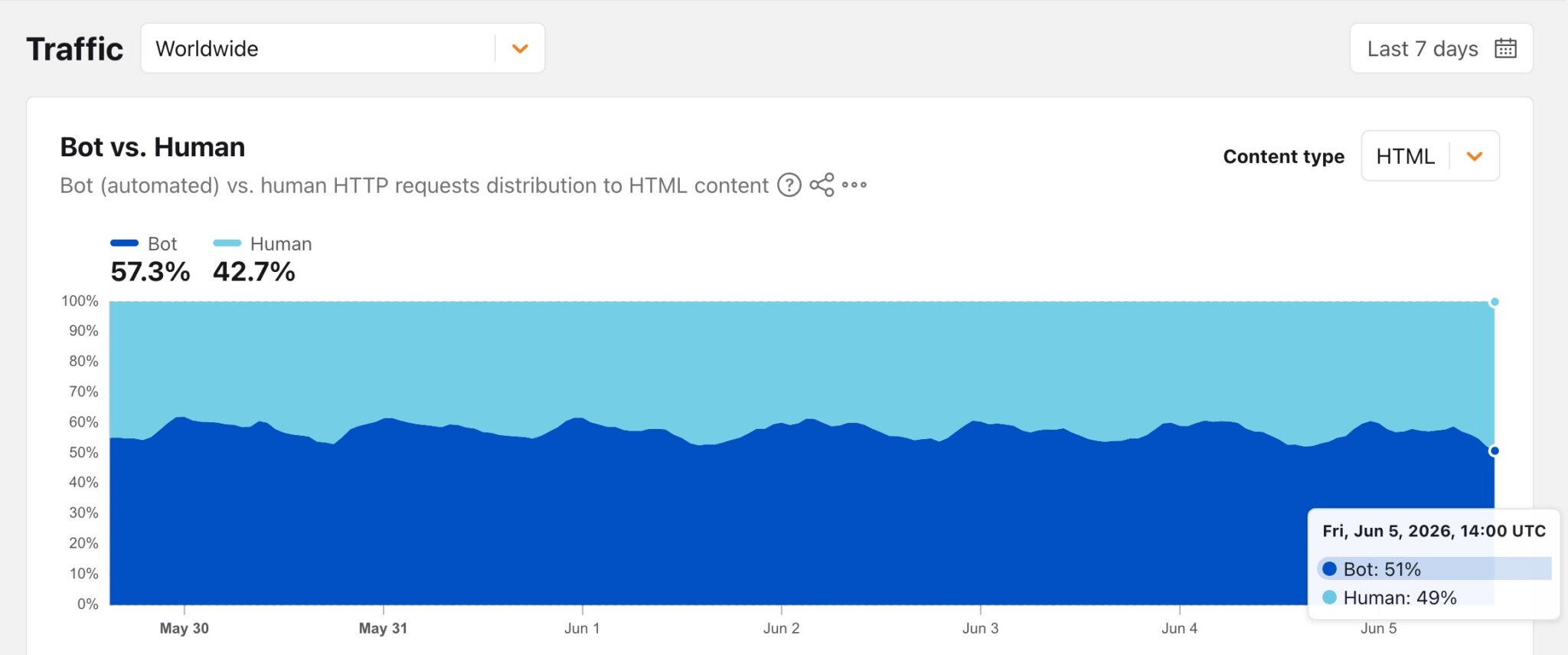
If we filter for France, the share of traffic in favor of bots is even more pronounced. Over the last 7 days, 63.4% of Internet traffic was generated by bots.
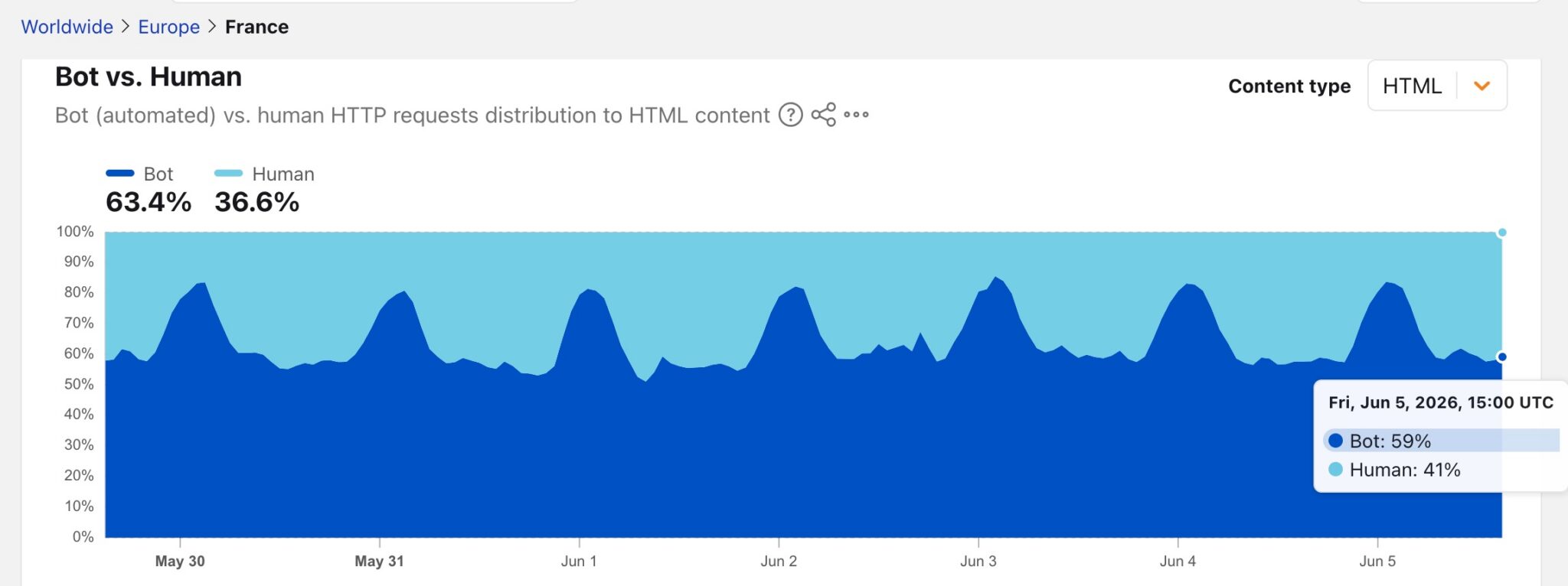
There are probably even larger gaps for some countries or regions around the world. The location of SaaS scraping tools can also significantly affect this analysis for certain countries, depending on where the servers are hosted.
Different Behavior Between Bots and Humans
A few years ago, bot-related traffic referred to search engine crawlers, malicious bots, or web crawlers. But the source of this surge lies elsewhere: artificial intelligence, and more specifically AI agents.
At present, these AI agents perform a wide range of tasks on behalf of users:
- Checking product pages and verifying prices,
- Running full browsing sessions (for example, to compare flights),
- Collecting and indexing web content to train AI models,
- Acting as personal assistants to answer various queries.
- Acting as personal assistants to order food, shop, or handle customer service interactions.
Cloudflare's indicators are based on the number of HTTP requests made, not on engagement time. In other words, a session carried out by a human will usually last longer than one carried out by a bot. The latter may consult several sources at the same time, without lingering, which generates a large volume of requests and some repetition.
What do you think?