www.it-connect.fr

Flipper One: Full Specs and the Surprising Changes in the Flipper Zero Successor
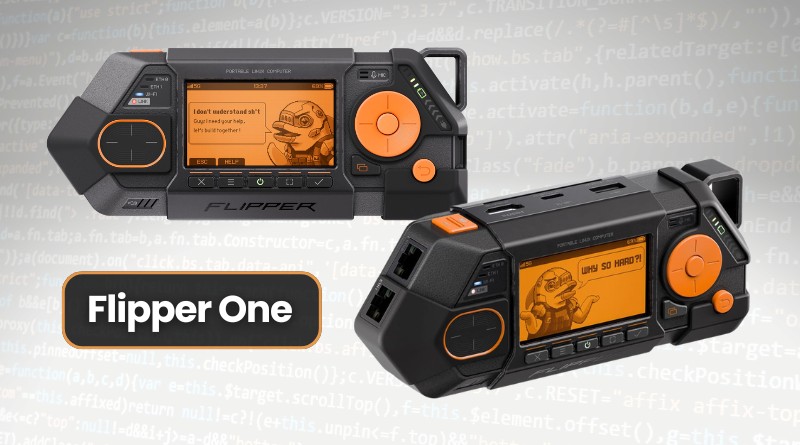
The famous Flipper Zero, widely adopted by the Cyber community and hacking enthusiasts, has a successor: the Flipper One. More powerful, it is also bulkier, and some of its design choices will not please everyone.
A true hybrid PC running Linux
The Flipper One has just been unveiled, and one thing is certain: it is noticeably less compact (and less cute, some would say) than the Flipper Zero. Its dimensions? Here they are: 15 cm long, 6.7 cm high, and 4 cm thick, which is almost the size of some smartphones. For the record, here are the Flipper Zero dimensions: 10 cm long, 4 cm high, and 2.5 cm thick. Quite a difference.
The gadget vibe has been set aside, as the Flipper One now feels more like a miniature workstation.
Here is what its technical sheet on Flipper's official website reveals:
- Display: a 2.4-inch color screen (256 x 144 pixels), replacing the old 1.4-inch monochrome display.
- Performance: an 8-core Rockchip RK3576 processor, backed by 8 GB of RAM and 64 GB of storage.
- Battery life: for now, the battery capacity is listed at 7,000 mAh, but this could change (according to the documentation).
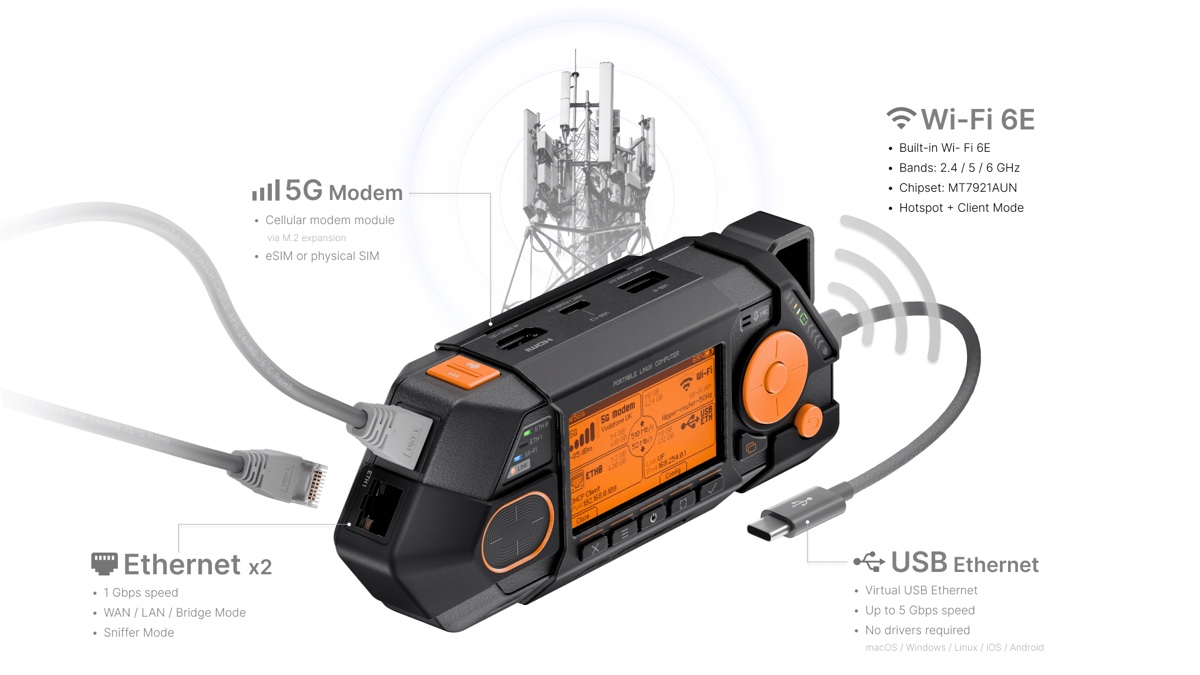
- Connectivity: two Ethernet ports (1 GbE), an HDMI 2.1 port, and a USB-C port that lets you connect it directly to an external display.
- Wireless networking: Wi-Fi 6 with a MediaTek MT7921AUN chip and Bluetooth 5.2.
- Hardware expandability: the famous GPIO pins are still included, now joined by an M.2 slot. As for the latter, it will not be the M.2 2280 format (the drive would be too long), but other formats instead (2242, 3042, 3052).
There are many differences between the Flipper One and the Flipper Zero at this level. Indeed, the Flipper Zero had no Ethernet ports, nor even an HDMI port. There was also no expandability via an M.2 slot, nor Bluetooth or Wi-Fi.
Artificial intelligence is also part of the plan, locally and offline. "Thanks to a built-in AI accelerator, Flipper One can run local language models (LLMs) without an Internet connection, allowing users to operate the device, generate configurations, and get useful advice.", we can read in the official announcement.
All of these adjustments make the Flipper One a compact computer (a Raspberry Pi on steroids?) rather than a true continuation of the Flipper Zero.
Flipper's goal is to build the ARM computer capable of running natively with any recent Linux mainline kernel, without relying on closed drivers, proprietary firmware, or a chip vendor-locked Board Support Package (BSP).
A deliberate pivot and reduced connectivity
From what I have just told you, you are probably thinking that the Flipper One is better in every respect. In the end, the manufacturer has decided to remove by default certain hacking and tinkering features that made the previous model such a success. The goal: to avoid attracting the wrath of law enforcement and certain governments. It bears repeating: the Flipper Zero is a hacking device.
The Flipper One therefore skips several modules:
- Sub-GHz frequencies
- NFC
- RFID
- Infrared
If you want to use them (for example, to clone NFC badges), you will need to use an external module: it is your responsibility to do so, since it is no longer integrated by the manufacturer.
On the other hand, new opportunities are offered with the new ports added to the Flipper One. For example, the presence of two independent Ethernet ports (usable as WAN or LAN) makes it possible to imagine some interesting scenarios: a transparent bridge, traffic interception (the Flipper One acting as a MitM), and more. I could mention other examples related to the built-in Wi-Fi and Bluetooth.
Flipper OS and FlipCTL: rethinking the mobile Linux experience
The Flipper One ships with a preinstalled Linux distribution: Flipper OS. Based on Debian, this system introduces a profile system that makes it possible to create full OS snapshots.
It will be accompanied by a FlipCTL framework. It solves a common cyberdeck problem: the lack of graphical interfaces suited to small screens. Rather than forcing heavy environments like KDE or GNOME onto a tiny display, FlipCTL offers a menu-driven interface designed for a directional pad and a few buttons.
The idea is to make common Linux command-line utilities (such as ping, nmap, or traceroute) accessible through an interface adapted to this screen. This will not prevent connecting the device to an external display.
In the long term, Flipper wants to go even further! Indeed, the development team would like a simple apt install flipctl to be enough to add a user interface to any embedded Linux device (routers, NAS, etc.). A standalone hardware board called the "FlipCTL Control Board", including the Flipper One's screen and buttons, is also planned for this purpose.
Want to get your hands on the Flipper One? You will have to wait a little longer, and above all, start saving now. This new device will not be released before summer 2026, at the earliest. As for the estimated price: between $300 and $500, while the Flipper Zero currently sells for 229 euros.