www.it-connect.fr

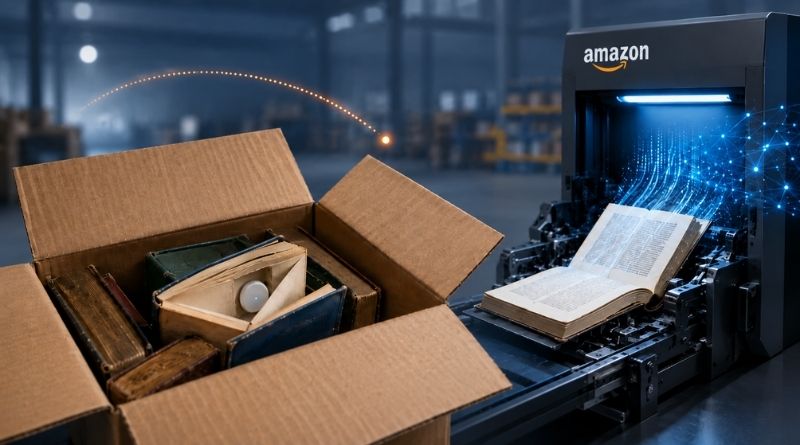
Amazon Is Cutting Up Rare Books to Train AI, and an AirTag Tracked the Shipment to Las Vegas
This story is insane. A $29 Apple AirTag was hidden inside a second-hand book in the middle of an order for 1,000 volumes. The shipment crossed four U.S. states before reaching its final destination: an Amazon warehouse in Las Vegas, where a team slices off the bindings and scans the pages. The goal: feed AI.
For months, many booksellers have been asking questions. And for good reason: some orders are surprising. Bulk orders for hundreds of titles with no thematic connection are regularly placed. All of this happens without price negotiations, and marketplaces do not disclose the buyers' identities. The question remained: who was behind these orders? 404 Media had a good idea: track a shipment.
A $29 tracker and a warehouse called LAS8
In July, a bookseller (whom 404 Media granted anonymity) receives an order for about 1,000 books via Biblio, a marketplace specializing in rare and used books. He agrees to hide an AirTag provided by the publication inside the shipment. The parcel leaves California, passes through Milwaukee, sits in Wisconsin for two weeks, then heads west again by truck to the northeast of Las Vegas, in Nevada, to the Amazon site identified as LAS8.
On paper, LAS8 is a print-on-demand facility. Probably the kind of printing site Amazon uses to print books published through the Amazon KDP program. But the signal was pointing to the northern end of the building, which would house another operation identified by the code VGT3 and a logo displayed at the entrance: a tyrannosaurus holding an open book.
"I work at VGT3 here in Vegas, and all we do is scan books," one employee working in the VGT3 space wrote in an excerpt quoted by 404 Media. Other messages describe how tasks are split up: some workers cut the books apart, while others receive the pallets and scan the barcodes. The bindings are removed to speed up the passage of pages through industrial scanners, and the paper copy does not survive the process.
When asked, Amazon replied: "Amazon buys books through commercial channels to help develop and improve the products and services used by our customers." - which does not explain why Amazon goes to the trouble of scanning these books page by page. In its statement, Amazon notably does not mention artificial intelligence. But then what happens to the books after digitization?
Why it's legal, and why pre-2022 paper is worth gold
Amazon is not the first to adopt this kind of practice. Remember that in January 2026, the Washington Post revealed the existence of Project Panama, an internal Anthropic program whose goal was to destructively scan all the books in the world. There is little doubt that Amazon is doing this to train its AI models.
In the United States, the practice remains legal:
- In June 2025, federal judge William Alsup ruled that digitizing a legally acquired book to train a model qualified as fair use, a first-instance decision that has not yet been settled on appeal.
- The first-sale doctrine allows the owner of a physical copy to destroy it without having to reveal their identity or their intentions.
What earned Anthropic a sanction was rather a mistake, or rather crossing a red line by downloading more than seven million pirated books. The destructive digitization of legally purchased copies, by contrast, was not penalized.
One question remains: why buy paper when the Web is free and already digital? Because the Web has become... suspicious. We are now in a situation where models are trained on text generated by other models. As a result, models can lose accuracy and diversity. This phenomenon even has a name: model collapse.
In practice, a book printed before 2022 offers the opposite guarantee: it was written naturally before the arrival of large language models. It was written at a time when ChatGPT and its peers were not yet in use. Based on that principle, it cannot contain synthetic text or information poisoning.
We do not know the volume of books processed by VGT3 on Amazon's side, nor the models specifically fed by these data. But one thing is certain: the AI giants have no limits. After pillaging the Web, they are now targeting physical archives, even if that means destroying rare books.