www.it-connect.fr

SynthID Detector Goes Public: Google’s Tool to Spot AI-Generated Content
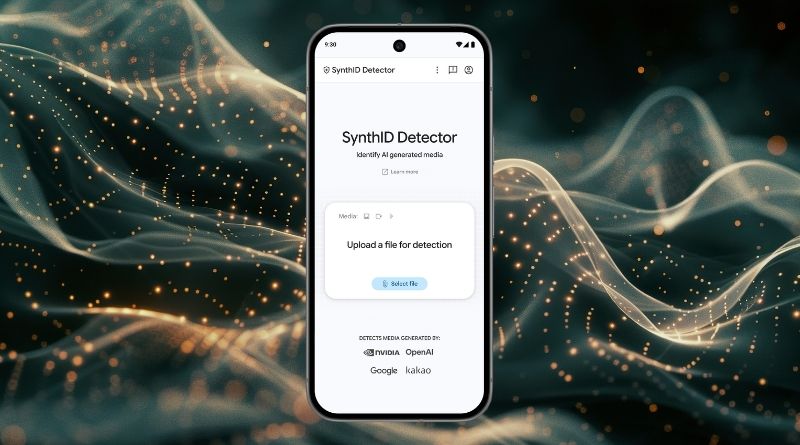
A viral photo, a suspicious video, or an audio clip that sounds a little too perfect: how can you tell whether it was generated by AI? Google is opening SynthID Detector to the public, its tool capable of spotting the invisible watermark applied by its models and by those of several partners, including OpenAI. Here’s what you need to know.
On October 7, 2026, Google announced the public rollout of SynthID Detector, worldwide, but only in English for now. The tool is available on synthid.com, and you need to sign in to use it. You can choose a Google, Apple, or OpenAI account to log in.
But what exactly is SynthID? It is Google’s digital watermarking technology launched in 2023. It is used to insert an imperceptible mark into AI-generated content, detectable by Google’s tools. In May 2025, Google had introduced an early version of the detector, intended for selected media outlets. This time, everyone can use it.
There is a huge amount of AI-generated content out there. More than 180 billion images and videos have been watermarked by SynthID since 2023, along with the equivalent of 240,000 years of audio content. In May 2025, Google mentioned just over 10 billion watermarked pieces of content, text included. A literal explosion.
How does SynthID Detector work?
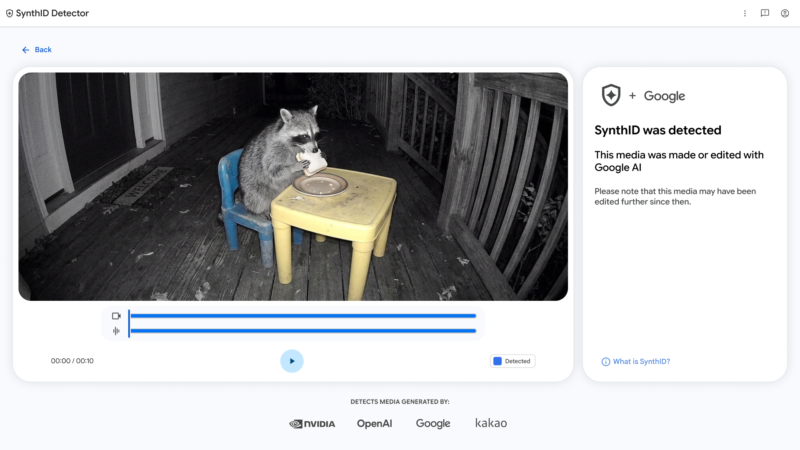
The tool works in a very straightforward way: you upload a file, and it checks for the presence of a SynthID watermark. If one is found, it indicates that the media was created or modified with AI, while also warning that it may have been edited since. For a video, the analysis is shown on a timeline, with the video track and audio track displayed separately.
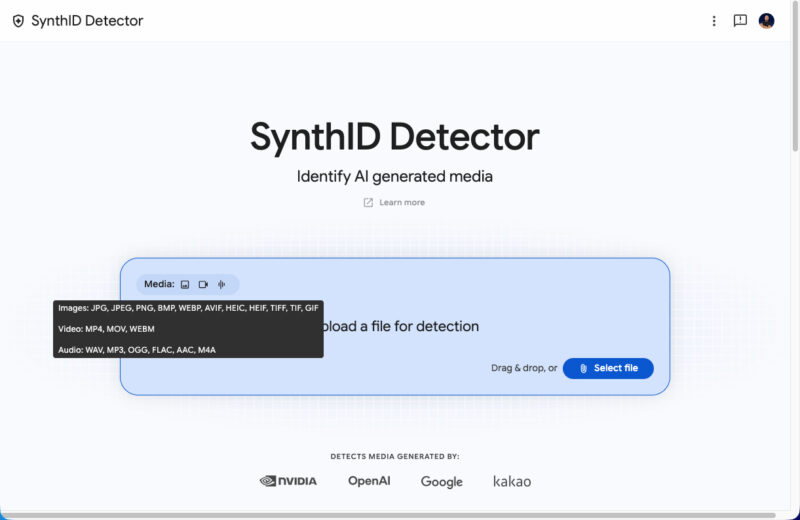
The current version of the tool supports images, videos, and audio files. However, text files are not included in the list of formats offered by this public release. It seems to me that the version presented in 2025 did support them, so it would not be surprising if this is added later.
Google describes the watermark as resistant to common transformations, but recommends uploading the highest-quality file possible to improve detection reliability. Detection is also limited to media generated by AI from certain providers: Google, OpenAI, NVIDIA, and Kakao. Apple is expected to be added soon.
The example below is provided by Google. On my side, I ran a few tests with images generated with ChatGPT and images I created myself, and it correctly told them apart without making a mistake.
A detector that does not identify all AI content
Google makes a point of stating this on the tool’s page: "This is not a general-purpose AI detector", it says. SynthID Detector only recognizes media produced by companies that have adopted its technology. In other words, if you generate an image with Claude, this tool will not be able to detect it. The same applies to media created from an open-source model running locally. In other words, the absence of a watermark does not prove that content is authentic.
This article is an opportunity to remind readers that in the European Union, Article 50 of the AI Act requires AI-generated content to be labeled in a machine-readable format. Everyone is getting on board, but Google now has a public-facing tool. That is not the case with Anthropic and OpenAI (although Google’s tool does cover OpenAI media).
What do you think?