www.it-connect.fr

Windows 10: Microsoft Quietly Extends ESU Support Through October 2027
No press release: it was through a simple note posted on its blog that Microsoft announced, probably reluctantly, that it is extending its Extended Security Updates (ESU) program for Windows 10 by one year. Enrolled PCs will therefore continue receiving security fixes until October 12, 2027, one year longer than expected. Here’s what we know.
An extension slipped in quietly
The change was not the subject of any official announcement, although at the same time Microsoft may see it as a defeat. In any case, the extension of the ESU program beyond October 2026 is official, since Microsoft confirmed it through several notes here and there.
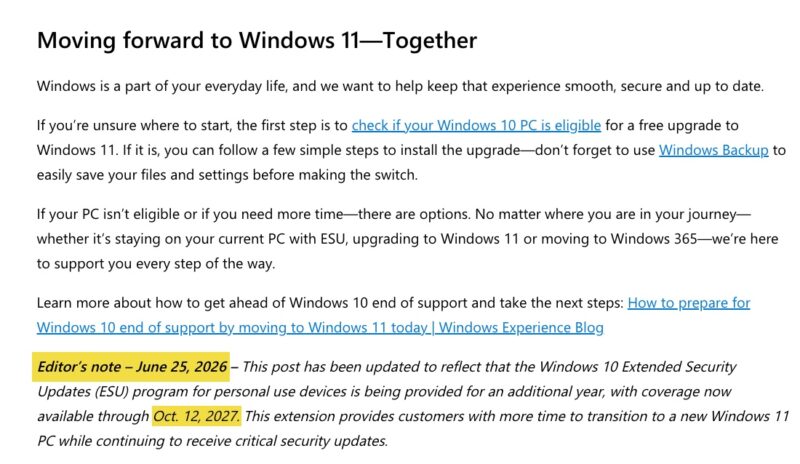
A first note dated June 25, 2026, states that the security update program for personal devices is now available for an additional year, with coverage guaranteed through October 12, 2027. Microsoft explains that this extension gives Windows users more time to move to a new PC running Windows 11 while continuing to receive security patches.
This is also stated on the dedicated ESU program page:
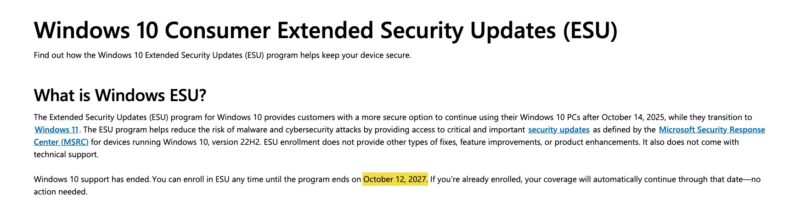
As a reminder, Windows 10 reached the end of standard support on October 14, 2025. As we explained at the time in our article on the end of standard support for Windows 10 and its consequences, Microsoft has since then stopped providing technical support, functional updates, and security updates for the operating system. There is one exception, however: LTSC editions.
The consumer ESU program was originally due to end in October 2026, so this is an extra year. For anyone using a Windows 10 PC, it is an opportunity to keep it for one more year!
How to keep receiving updates for free
Private users have several options to enroll in the ESU program and continue receiving patches at no cost. In practice, the methods remain the same, namely:
- Pay a one-time fee of 30 euros.
- Back up your Windows settings to your Microsoft account.
- Redeem 1,000 Microsoft Rewards points.
- For users in France (and the European Economic Area in general), you can get ESU for free by signing in to Windows 10 with a Microsoft account.
If you have not taken the plunge yet, our detailed tutorial explains how to enroll a Windows 10 PC in the ESU program, including when the activation option does not appear automatically in Windows Update (although by now, it probably should).
One thing to keep in mind about how it works: an ESU license can be used on up to 10 devices associated with the same Microsoft account, and users already enrolled will automatically be covered until the new October 2027 deadline, with no additional action required.
A reprieve for individuals, not for businesses
In terms of eligibility, the consumer program is intended only for personal devices. It is not available for machines joined to an Active Directory domain, Microsoft Entra, or managed through an MDM solution.
In other words, for businesses, the ESU program remains paid and can be subscribed to for up to three years (through October 2028). But the cost is a deterrent: the total can reach $427 per PC over the full period. It is indeed discouraging.
| Year | Dollar price | € excl. tax |
|---|---|---|
| Year 1 (2025-2026) | 61 $ | ~56 € |
| Year 2 (2026-2027) | 122 $ | ~112 € |
| Year 3 (2027-2028) | 244 $ | ~225 € |
| 3-year total | 427 $ | ~393 € |
That leaves one question: why this move, and why now? Microsoft has not given any official reason. One can imagine that pressure from certain organizations may have finally paid off.
An issue that goes beyond the technical question
The end of Windows 10 support reignited the debate over software obsolescence and its environmental impact. According to Halte à l'Obsolescence Programmée (HOP), nearly 400 million computers worldwide could not migrate to Windows 11 because their hardware was not compatible, representing around 22% of the installed base in France.
The association also estimated that replacing them would generate 800,000 tons of electronic waste and 70 million tons of CO2. In response, several groups mobilized: a coalition of 23 organizations (including UFC-Que Choisir, France Nature Environnement, Zero Waste France, and Les Amis de la Terre) launched the petition "Non à la taxe Windows".
Back then, it was also under pressure from the Euroconsumers coalition, invoking the Digital Markets Act (DMA), that Microsoft eventually agreed to offer ESU free of charge to private users in the European Economic Area (via a Microsoft account).
In any case, Windows 10 remains an end-of-life operating system, and ESU is only a temporary patch, with no technical support. The monthly updates prove it: see for example our overview of the June 2026 KB5094127 ESU update.